For decades, the single most dangerous phrase in a Rawalpindi property deal was “zubani baat pakki hai” — the oral agreement is final. It is exactly what let fraudsters double-sell the same plot, forge mutations, and vanish before the paperwork caught up. From 1 January 2026, the Punjab Land Records Authority (PLRA) and the Board of Revenue have closed that door. The reforms replace trust and handshakes with an identity-linked, biometric, fully digital record. Handled correctly, they hand ordinary buyers a fraud-proofing toolkit the land mafia has never faced before.
What Actually Changed in 2026
Three linked rules form the backbone of the new regime, and every Rawalpindi plot buyer should understand each one before signing anything.
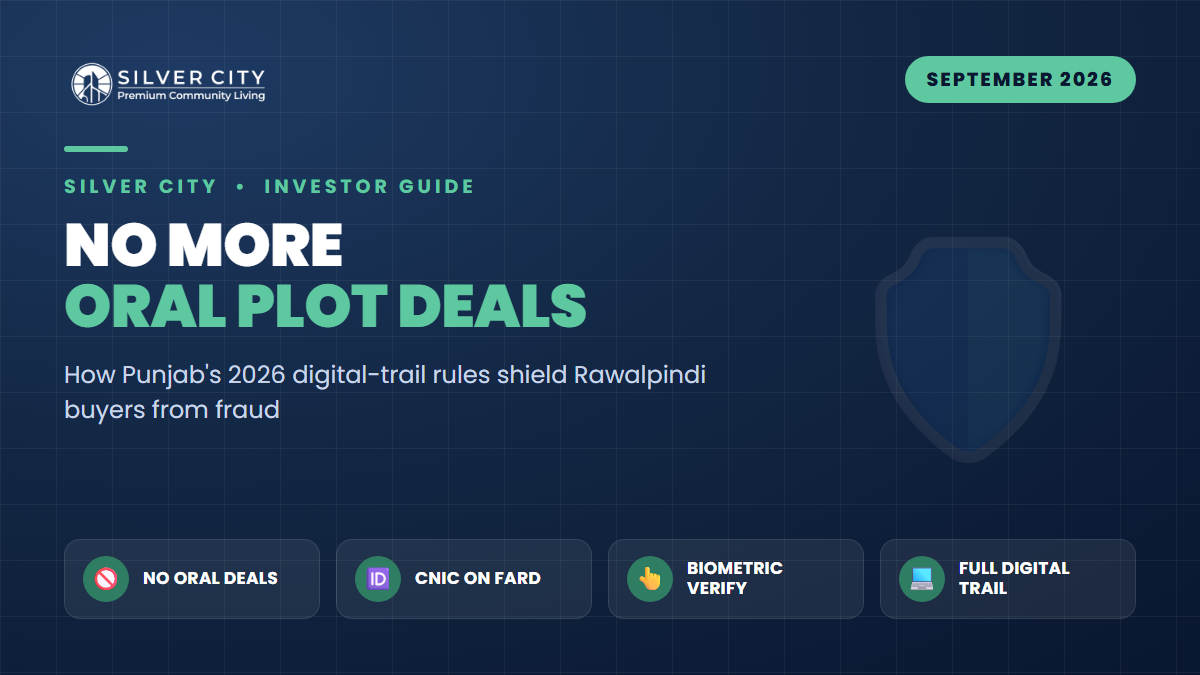
- No oral transactions. No mutation (intiqal) for sale, mortgage, exchange or gift can be entered or sanctioned on the basis of an oral statement or claim. The only carve-out is inheritance. Handwritten notes and plain stamp papers no longer transfer ownership on their own.
- Buyer CNIC and name on the Fard Baraye Bay. The Fard Baraye Bay — the record extract that confirms the seller’s ownership for a sale — must now clearly state the buyer’s full name and CNIC number from the outset. This ties the transaction to a verified identity before money changes hands, cutting off duplication and forgery at the source.
- Biometrics and a full digital trail. Both buyer and seller must appear before the Sub-Registrar with two witnesses and complete fingerprint biometric verification. Once the registry is done, the data flows automatically into the PLRA system. Critically, patwaris have been stripped of their role in sale and transfer documentation, removing a long-standing pressure point for corruption.
Alongside these, Punjab’s integrated PLRA–FBR “one-counter” system (live since 21 August 2026) auto-generates a single combined PSID challan covering stamp duty, CVT and withholding tax — Rawalpindi included. That means one traceable payment record instead of several loose receipts.
The Rawalpindi Backdrop: Why This Matters Now
The rules land in a market where fraud is still rampant. RDA has declared roughly 294 housing societies and farm schemes illegal within its jurisdiction, against only about 82 approved private societies — illegal schemes outnumber legal ones more than three to one. RDA’s Housing Societies Management System (HSMS), operationalised on 2 September 2026, now lets the public track a scheme’s approval and NOC status digitally. The 2026 PLRA rules protect the transaction; HSMS protects the project. You need both.
The Step-by-Step Verification Checklist
- Verify the scheme, not just the plot. Confirm the society and your exact phase/block on the RDA HSMS portal. Check for a genuine NOC (permission to sell and register) — not merely an “approved layout plan,” which the mafia routinely misrepresents. Scan the QR code on the plot file and confirm it resolves to a live RDA record, not a static PDF.
- Pull the Fard and confirm the seller. Obtain the Fard Baraye Bay from the Arazi Record Centre / e-Facility Centre and cross-check the seller’s name and CNIC against the record. Verify ownership independently through the PLRA Record of Deeds (ROD) portal by CNIC or registry number.
- Insist your CNIC and name go on the Fard. This is now the law, not a favour. If a seller or “file dealer” resists putting your identity on the document, treat it as a red flag and walk away.
- Reject every oral assurance. Any promise about location, dues clearance, or “guaranteed transfer later” must be in writing on the registered instrument. Post-2026, an oral claim has no legal standing.
- Demand a society dues/NOC letter. For a housing-society plot, get written transfer confirmation and an up-to-date dues clearance for your specific block.
- Register in person with biometrics and two witnesses. Both parties appear before the Sub-Registrar. Place your own fingerprint on the official machine and collect the challan yourself — never delegate this to an agent.
- Pay only through banking channels. Use pay orders, cheques or bank transfers tied to the combined PSID challan. Avoid large cash payments; a digital money trail is decisive evidence if a dispute ever arises.
- Confirm the data hit PLRA. After registry, verify online that ownership has updated in the PLRA/ROD system before considering the deal closed.
Old Way vs. New Way
| Step | Pre-2026 (fraud-prone) | 2026 PLRA regime |
|---|---|---|
| Agreement | Oral / handwritten “pakka” deal | Written, registered instrument only |
| Buyer identity | Often omitted until late | Name + CNIC mandatory on Fard Baraye Bay |
| Attendance | Agent could act loosely on your behalf | Buyer, seller + 2 witnesses, biometric |
| Patwari role | Central, discretionary | Removed from sale/transfer documentation |
| Payments | Scattered cash / receipts | Single PLRA–FBR combined PSID challan |
| Record | Manual, forgeable | Auto-synced digital PLRA trail |
Indicative Rawalpindi Transaction Costs (2026)
Costs are calculated on the FBR/DC value or the consideration, whichever is higher. Always confirm live figures with the PLRA–FBR challan calculator before you pay.
| Charge | Typical 2026 rate | Note |
|---|---|---|
| Stamp duty (urban) | ~5% | Rural cut to 1% in April 2026 |
| Capital Value Tax (CVT) | ~2% of value | Provincial |
| Registration fee | ~1% (capped in some cases) | Verify current cap |
| Withholding tax (u/s 236) | Filer vs. non-filer differ | Filer pays materially less |
| Female-buyer relief | Concession available | Registering in wife/mother/daughter name |
Frequently Asked Questions
Is my old oral or stamp-paper agreement still valid in 2026?
For a sale, no. A mutation cannot be sanctioned on an oral transaction from 1 January 2026. You need a properly registered instrument. Inheritance is the only recognised exception. If you hold an informal agreement, formalise it through registry as soon as possible.
What if the seller refuses to put my CNIC on the Fard Baraye Bay?
Treat it as a serious warning sign. Including the buyer’s name and CNIC is now mandatory and is precisely the feature that prevents double-selling and forgery. A seller who avoids it may be hiding an ownership defect or planning to resell the same plot.
Do the PLRA rules mean my society plot is automatically safe?
No. PLRA secures the transaction; it does not vet the housing scheme. You must separately confirm the society and your exact phase carry a valid RDA NOC via the HSMS portal — remember that illegal schemes still outnumber approved ones in Rawalpindi.
Can I send an agent to do the biometric verification for me?
No. Both buyer and seller must appear personally before the Sub-Registrar with two witnesses and give their own fingerprints. Personally collecting your challan and receipt is part of what protects you.
The Bottom Line
The 2026 PLRA reforms turn identity, biometrics and a digital trail into a shield the land mafia cannot easily bypass — but only if you use every step. Pair transaction-level verification with project-level checks on the RDA HSMS portal. If you want a starting point on the safe side of that ledger, Silver City on Girja Road — an RDA-approved society near the Thalian Interchange, minutes from Islamabad International Airport — is one option worth considering as you apply this checklist. Verify everything, sign nothing on trust, and let the paper trail do the protecting.