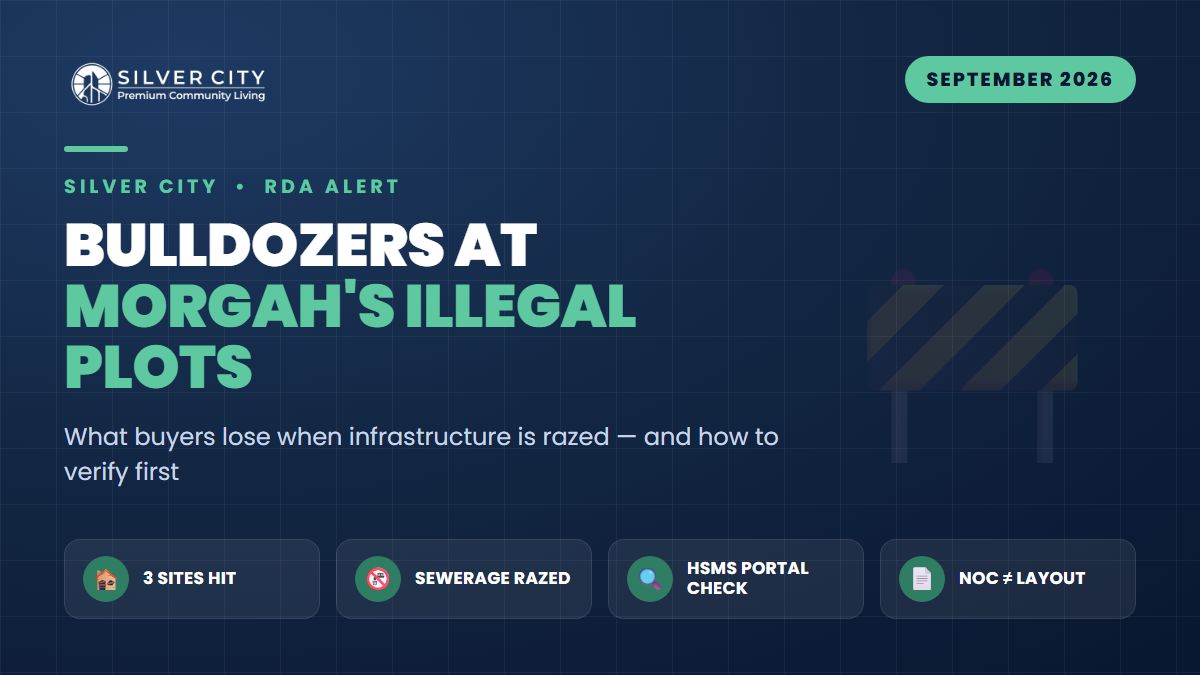
On 19 September 2026, the Rawalpindi Development Authority (RDA) Enforcement Squad rolled into Morgah and did something that should make every plot buyer in the Rawalpindi–Islamabad region pause: it demolished the roads, manholes, sewerage pipelines and boundary barriers of illegal housing activity. This was not a notice pinned to a wall. It was heavy machinery tearing up the very infrastructure that dealers had used as proof the project was “developing.”
If your money was sitting in a plot at one of those sites that morning, this article is the case study you needed before you paid. Let’s break down exactly what happened, quantify what a buyer loses when infrastructure is razed, and walk through the free RDA HSMS approval check that would have flagged the risk in minutes.
What Actually Happened in Morgah on 19 September
Acting on the directions of the Commissioner Rawalpindi Division and RDA Director General Salman Ghani, the enforcement team hit three locations in a single operation:
- Downtown Morgah — on Defence Road, opposite Askari-14
- An illegal land subdivision near Dhok Nawaz Graveyard
- An illegal housing scheme at Riaz Chowk, Morgah
At these sites, the squad removed illegally constructed roads, on-ground infrastructure, manholes, sewerage lines and barriers. The action was carried out under the Punjab Development of Cities Act, 1976 and the RDA Building and Zoning Regulations. An RDA spokesperson confirmed the authority will continue acting against unauthorised development and unlawful commercial activity across its controlled areas.
The lesson is blunt: visible development on the ground is not proof of legality. Illegal schemes build roads and lay pipes precisely to look legitimate to walk-in buyers — and RDA is now demolishing exactly that.
What a Buyer Actually Loses When Infrastructure Is Razed
People assume the worst case is “the value drops.” The reality is layered, and most of it is not recoverable. Here is what the loss looks like in practice for a typical 5-marla or 10-marla holding in an unapproved Morgah-type scheme.
| What you lose | Why it happens | Recoverable? |
|---|---|---|
| The development premium you paid | You paid a “developed plot” price for roads/sewerage that no longer legally exist | No — sunk cost |
| Resale market | No buyer will touch a plot in a demolished, RDA-flagged scheme | No — market disappears |
| Mortgage / bank financing | Banks lend only against approved, NOC-cleared societies | No |
| Legal transfer & registry | Sub-registrar cannot register plots in an unapproved scheme | No — title never perfects |
| Your booking/token capital | Developer often vanishes or cannot refund after enforcement | Rarely, via long litigation |
| Years of time | Possession, construction and any “profit exit” are frozen indefinitely | No |
Notice the pattern: nearly every column reads “No.” Unlike a stock that dips and recovers, an unapproved plot after demolition has no functioning market, no financing, no clean title and no timeline. Your capital is not falling — it is stranded.
The Tool That Would Have Caught This: RDA’s HSMS
On 2 September 2026 — just weeks before the Morgah operation — RDA operationalised its Housing Societies Management System (HSMS), a centralised digital portal that moves the entire lifecycle of a private housing scheme (fresh applications, revisions, layout approvals and related matters) from paper files onto a transparent online workflow.
The context makes it urgent: as of mid-2026, RDA had approved roughly 82 private housing societies in Rawalpindi district while declaring around 294 societies and farm schemes illegal. That means the illegal count is more than three times the approved count. The odds are genuinely stacked against a buyer who does not verify.
The critical distinction most buyers miss: Layout approval ≠ NOC
Many defaulters marketed aggressively on the strength of an approved layout plan (the map) while never securing the NOC (the permission to sell and register). RDA deliberately separates these two. A “layout approved” claim does not mean the scheme can legally sell you a plot. Always confirm the NOC status, not just the layout.
The 6-Step HSMS Approval Check to Run Before You Pay
- Use only the official domain. Open rda.gop.pk and find the Private Housing Schemes / HSMS section. Ignore look-alike sites and PDFs the dealer emails you.
- Search the exact scheme name. Match spelling precisely — illegal schemes often mimic the names of approved ones.
- Confirm the exact phase or block. Approval is phase-specific. “Phase 1 approved” does not make Phase 3 legal. Verify the phase your plot is in.
- Check NOC status, not just layout. Look for a valid NOC reference and “approved” status wording for that phase — the permission to sell.
- Scan the QR code printed on the plot file or layout and confirm it resolves to a live RDA/HSMS record — not a static image or emailed PDF.
- Cross-check the illegal list. Confirm the scheme is not on RDA’s list of declared-illegal societies before paying any token, booking, transfer or resale advance.
A legitimate society welcomes this. A live portal status, a valid QR code and a matching NOC reference cost an approved developer nothing to show. Hesitation or excuses at this step are the reddest flag in Pakistani real estate.
| Timeline | Event |
|---|---|
| 2 Sept 2026 | RDA operationalises HSMS digital portal |
| Mid-2026 | ~82 schemes approved; ~294 declared illegal |
| 19 Sept 2026 | Enforcement squad razes roads & sewerage at 3 Morgah sites |
| Ongoing | RDA vows continued action across controlled areas |
Frequently Asked Questions
Can I get my money back if my plot was in a demolished Morgah scheme?
Recovery is difficult and rarely full. RDA demolishes illegal infrastructure but does not refund buyers — that liability rests with the developer, who often becomes unreachable or insolvent after enforcement. Your route is civil litigation or an FIR against the developer, which is slow and uncertain. This is exactly why verification before payment matters far more than remedies afterward.
The scheme showed me an “approved layout plan.” Isn’t that enough?
No. A layout approval is only the map; it does not authorise the scheme to sell or transfer plots. That requires a valid NOC. Several defaulters marketed hard on layout approval alone while never obtaining the NOC. Always confirm NOC status for your specific phase on the HSMS portal.
How do I check a scheme is approved for the exact plot I want?
Go to rda.gop.pk, open the Private Housing Schemes / HSMS section, and search the exact scheme name and the specific phase or block. Approval is granted phase by phase, so confirm the status wording and NOC reference for your phase — not the society in general — then scan the QR code to check it resolves to a live RDA record.
Does existing roads and sewerage on-site mean a scheme is legal?
No. The Morgah operation proves the opposite: illegal schemes build roads, manholes and sewerage precisely to appear legitimate. RDA demolished exactly this kind of infrastructure. On-ground development is a marketing tactic, not legal proof. Only a live HSMS/NOC status confirms legality.
The Takeaway
The Morgah demolitions are a warning written in rubble: infrastructure you can see and touch offers zero protection if the scheme is illegal. The only durable protection is verified approval — a live HSMS status, a valid NOC for your exact phase, and a QR code that resolves to RDA’s own records. Run that check before every token, booking or transfer, and you sidestep the single most expensive mistake in Rawalpindi property.
If you would rather invest where that box is already ticked, an RDA-approved option like Silver City is worth considering — because the safest plot is the one whose approval you can confirm on RDA’s own portal, long before the bulldozers ever choose their next street.