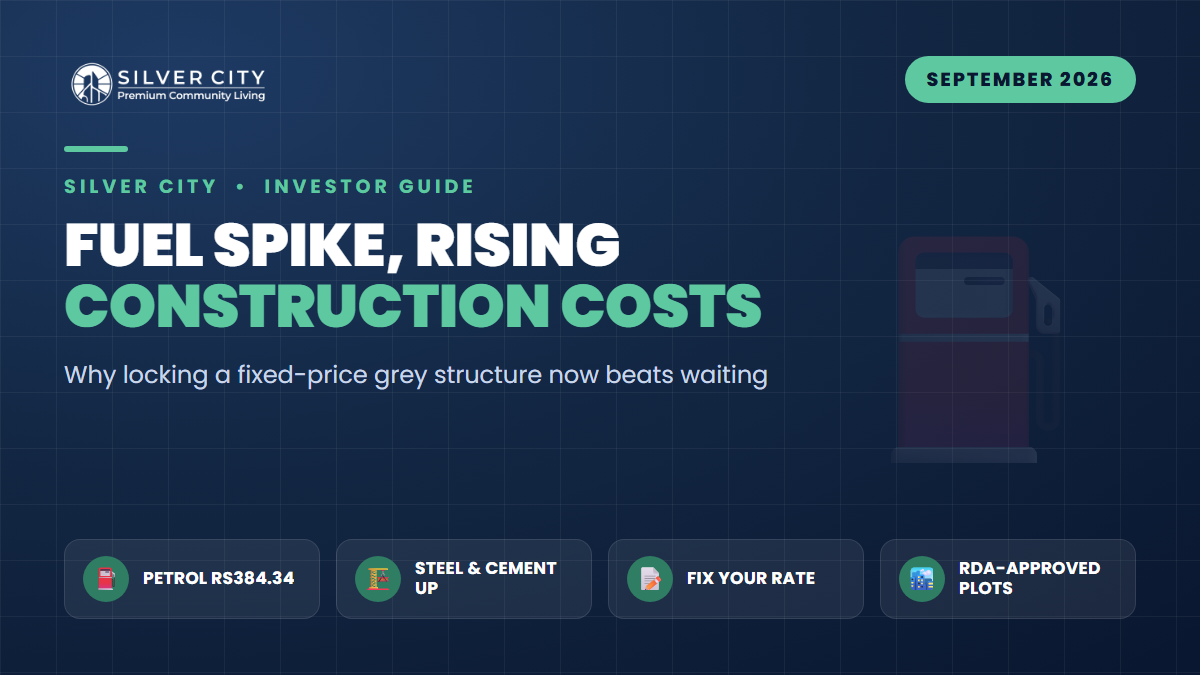
On 16 September 2026, the government raised petrol by Rs4.10 to Rs384.34 per litre and high-speed diesel by Rs6.41 to Rs415.83 per litre — the latest in a back-to-back run of increases under OGRA’s new daily pricing mechanism. Petrol has climbed from Rs342.79 on 1 September to Rs384.34, a jump of roughly Rs41.55 (about 12%) in just over two weeks. Diesel rose even faster, from Rs370.41 to Rs415.83.
Two forces are driving it: renewed tension in the Middle East keeping global crude jittery, and a rupee that stays under pressure. For property investors, the headline isn’t really about your car’s tank — it’s about what diesel does to the cost of building. Diesel is the bloodstream of Pakistani construction. When it spikes, steel, cement, sand, bricks and every truckload moving them get more expensive. This is exactly the moment to understand why a fixed-price grey structure contract can protect your budget.
How a Fuel Spike Travels Into Your Construction Budget
A grey structure — the bare bones of a house: foundation, columns, beams, roof slabs, brickwork and plaster — is dominated by materials that are all diesel-sensitive. Here’s the transmission chain:
- Steel: Re-rolling mills and induction furnaces run on power tied to fuel; scrap and billet arrive by diesel truck. Bar (sarya) currently trades around Rs238–265 per kg, with branded Grade-60 (Amreli, Mughal, Agha) at the higher end near Rs251–254.
- Cement: Coal, gypsum and packing move by road; distribution is pure diesel. A 50kg bag sits at roughly Rs1,335–1,450, and rupee weakness on imported inputs keeps the floor rising.
- Transport & aggregates: Sand, crush, bricks and block delivery are billed largely on diesel. A Rs6.41 diesel jump quietly reprices every dumper load reaching your plot.
- Labour mobility: Crews commute and machinery (mixers, vibrators, dewatering pumps) burns fuel — small line items that add up over months.
Put together, these push the grey structure rate to roughly Rs3,000–3,800 per square foot in the twin cities in 2026, depending on specification and location. On a modest 5 Marla home of ~2,200 covered sq ft, even a 6–8% materials creep over a build cycle can mean Rs400,000–Rs600,000 in unplanned cost — real money that erodes an investor’s margin.
The Numbers at a Glance
| Item | 1 Sept 2026 | 16 Sept 2026 | Change |
|---|---|---|---|
| Petrol (per litre) | Rs342.79 | Rs384.34 | +Rs41.55 (~12.1%) |
| High-Speed Diesel (per litre) | Rs370.41 | Rs415.83 | +Rs45.42 (~12.3%) |
| Steel bar (per kg) | Rs238–265 (branded up to ~Rs254) | Rising bias | |
| Cement (50kg bag) | Rs1,335–1,450 | Firm to rising | |
| Grey structure (per sq ft) | Rs3,000–3,800 | Fuel-linked | |
What a Fixed-Price Grey Structure Contract Actually Locks
There are two common ways to hire a builder for a grey structure:
- Fixed-price (turnkey grey) contract: The contractor quotes one all-in rate per square foot — or a lump sum — covering materials and labour to a defined specification. The price risk sits with the builder, not you.
- Cost-plus / with-material (labour rate) contract: You buy materials at whatever the market charges on the day, and pay labour separately. The price risk sits entirely with you.
In a rising-fuel, weak-rupee environment, the cost-plus route means every diesel notification and steel-mill circular lands on your invoice. A fixed-price contract converts that uncertainty into a known number you can plan and finance around. You are effectively buying insurance against the exact trend the September hikes confirmed.
Why “Now” Beats “Wait and See”
Investors often delay a build hoping prices cool. But the current drivers — Middle East risk premium on crude and a soft rupee — are structural, not a one-week blip. OGRA’s daily mechanism now passes global moves through faster than the old fortnightly system, so waiting exposes you to more frequent upward revisions. Locking a fixed rate today means:
- Your cost is fixed against the next diesel and steel increase.
- You can pre-order and store steel/cement at today’s price under the contract terms.
- Your project financing and expected resale margin become predictable.
- You beat the seasonal winter demand crunch when good crews get scarce.
How to Lock a Fixed-Price Contract the Smart Way
- Pin the specification: Fix steel brand/grade, cement brand, bag count per marla, and slab thickness in writing. Vague specs invite disputes.
- Insert a material-brand clause: Name the exact sarya and cement so the builder can’t substitute cheaper stock to protect their own margin.
- Agree a milestone payment schedule: Tie payments to grey-structure stages (foundation, DPC, lintel, roof) — not calendar dates.
- Cap escalation, don’t leave it open: If the builder insists on any escalation clause, cap it to a small percentage or exclude it entirely for a genuine fixed price.
- Verify at plinth level: Ensure your plot is on an approved, developed layout so construction can actually start — locked prices only help if you can break ground.
Why the Plot Matters as Much as the Contract
A fixed-price contract protects your build cost — but returns depend on where you build. In the Rawalpindi–Islamabad belt, RDA-approved societies on developing corridors offer the strongest mix of entry price and upside. Silver City, on Girja Road near the Thalian interchange, is RDA-approved and positioned along the near-complete Rawalpindi Ring Road (over 90% of civil work done, with the main carriageway carpeted). It offers 3.5, 5 and 10 Marla and 1 Kanal plots, with 5 Marla starting around Rs2.75 million and 1 Kanal near Rs10.35 million on installment plans — an entry point that leaves room in your budget for a locked-in build.
Frequently Asked Questions
Does a petrol hike really change my construction cost that much?
Directly, no — petrol matters more for commuting. But diesel (up Rs6.41 to Rs415.83) powers freight, mills and machinery, so it feeds straight into steel, cement and delivery charges. The two usually move together, so the September hikes signal broad upward pressure on grey-structure inputs.
Is a fixed-price contract always cheaper than buying materials myself?
Not always cheaper on day one — a builder prices in a risk buffer. But in a rising market it removes the danger of paying more with every future diesel and steel increase. When prices are trending up, that certainty typically wins over a full build cycle.
What should I watch for so the builder doesn’t cut corners?
Lock the specification: exact steel brand and grade, cement brand, bag quantity per marla, slab thickness and structural drawings. Pay against completed milestones, and keep a small retention until the grey structure passes inspection.
Should I lock now or wait for prices to fall?
The current drivers — Middle East risk on crude and a soft rupee — are not short-term, and OGRA’s daily pricing passes increases through faster than before. Waiting mostly increases your exposure. If your plot is ready, locking a rate now is the more defensive move.
The Bottom Line
The 16 September fuel hikes are a clear signal, not noise: with petrol at Rs384.34 and diesel at Rs415.83, the cost of steel, cement and transport is being pushed higher, and a faster daily pricing regime means those increases arrive more often. For investors, a fixed-price grey structure contract converts that uncertainty into a fixed, financeable number — and pairing it with a well-located, RDA-approved plot such as Silver City near the Ring Road keeps both your build cost and your upside working in your favour. Lock the rate, name the materials, and build before the next notification lands.