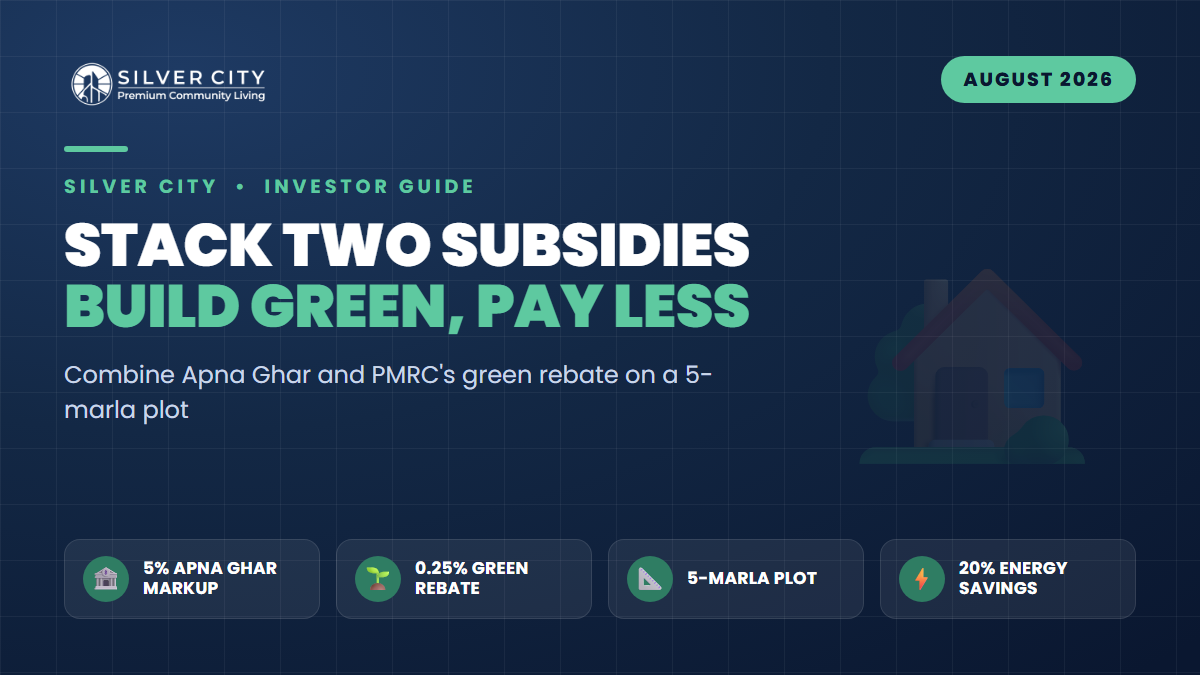
For years, the biggest hurdle for a middle-income family in Rawalpindi was not finding a plot — it was affording the construction on top of it. In 2026 two separate policy levers have changed that maths. The federal Wazir-e-Azam Apna Ghar Program now offers subsidised home-construction loans at a fixed 5% markup, while the Pakistan Mortgage Refinance Company (PMRC) rewards energy-efficient building with a 0.25% rebate on the financing rate. Layer them onto a 5-marla plot in an RDA-approved society like Silver City, and you have a genuinely affordable path to a modern, low-utility-bill home.
What the Apna Ghar 5% markup actually gives you
Launched by the Prime Minister in April 2026, the Rs321 billion Apna Ghar scheme is designed to finance 50,000 homes in its first phase and up to 500,000 over four years. The headline terms matter for anyone building on a plot they already own or are about to buy:
- Subsidised markup of 5% for the first 10 years, after which it converts to market pricing (1-Year KIBOR + 3%).
- Loans up to Rs10 million with tenures stretching to 20 years.
- 90:10 financing — the bank funds up to 90%, so you contribute as little as 10% equity.
- First-time homeowners only, with a valid CNIC and minimum net disposable income of around Rs37,000/month.
- No processing fees for eligible applicants, and State Bank-backed reforms targeting 15-day approvals.
Crucially, the scheme finances construction, not just outright purchase — which is exactly what you need when you are holding a plot and want to build.
Where the PMRC 0.25% green rebate fits
PMRC is the wholesale institution that refinances banks’ long-term mortgages. Its Green Mortgage Incentive passes a 0.25% rate rebate to borrowers who build to a recognised energy-efficiency standard — most commonly the IFC’s EDGE (Excellence in Design for Greater Efficiencies) certification. To qualify, a home must demonstrate at least 20% savings in energy, 20% in water, and 20% in embodied carbon of materials against a local baseline. In practice that means better insulation, cross-ventilation, efficient glazing, LED lighting, and often a small rooftop solar allowance.
Because PMRC operates at the refinancing layer, the rebate is applied through your participating bank rather than claimed separately. The concept of “stacking” is simple: borrow under Apna Ghar’s 5% umbrella, then have the green rebate shave the rate a further 0.25% — bringing your effective markup toward 4.75% on a qualifying, energy-efficient build.
Important caveat: the two programmes originate from different bodies, and formal integration is still evolving. Always confirm with your chosen bank in writing whether the green rebate can be applied on top of an Apna Ghar facility before you sign, as terms are being refined through 2026.
A worked example on a Silver City 5-marla plot
Silver City sits on Main Girja Road near the Thalian Interchange and the new Ring Road corridor — an RDA-approved scheme with gated security, parks and schools. Current 5-marla plot pricing ranges roughly from Rs1.5 million (on installments) to Rs20–23 lakh on resale. The table below is an illustrative stack, not a quote.
| Item | Standard build | Green (EDGE) build |
|---|---|---|
| 5-marla plot (Silver City) | Rs2,000,000 | Rs2,000,000 |
| Construction (approx.) | Rs6,000,000 | Rs6,400,000 |
| Total project cost | Rs8,000,000 | Rs8,400,000 |
| Your 10% equity | Rs800,000 | Rs840,000 |
| Financed amount (90%) | Rs7,200,000 | Rs7,560,000 |
| Effective markup | 5.00% | 4.75% |
| Approx. monthly instalment (20 yrs) | ~Rs47,500 | ~Rs48,900 |
| Est. monthly utility bill | ~Rs18,000 | ~Rs14,000 |
The green build costs slightly more up front (efficient fittings add roughly 5–8%), and finances a larger sum, so the raw instalment is a touch higher. But two things swing the outcome: the 0.25% rebate reduces markup paid across the whole tenure, and EDGE-level efficiency typically trims 15–20% off electricity and gas bills — often Rs3,000–5,000 a month in a Rawalpindi summer. Over a decade, the utility savings alone can exceed the incremental construction cost.
Step-by-step: how to line the two up
- Secure an RDA-approved plot. Financing bodies scrutinise the society’s legal status; Silver City’s RDA approval and clear title simplify the file.
- Confirm eligibility. CNIC, first-time-owner status, and the Rs37,000+ monthly income threshold.
- Choose a participating bank from the Apna Ghar panel and ask specifically about their PMRC green-refinance line.
- Design to EDGE from day one. Retrofitting for certification is expensive; efficient orientation, insulation and glazing must be in the original drawings.
- Engage an accredited EDGE assessor (e.g. through firms like SGS Pakistan) for the design-stage audit.
- Submit both requests together so the bank prices the green rebate into your Apna Ghar facility rather than as an afterthought.
Frequently Asked Questions
Can I definitely combine Apna Ghar’s 5% rate with the PMRC green rebate?
The mechanics allow it — Apna Ghar sets the subsidised markup and PMRC’s rebate lowers the refinancing rate for green builds — but the two are administered separately and integration is still being finalised in 2026. Treat stacking as a strong possibility to confirm in writing with your bank, not a guaranteed default.
Does my Silver City plot need to be fully paid off before I apply?
Not necessarily, but you must be able to demonstrate ownership or a clear path to it, and provide the 10% equity. Under the 90:10 model the financed portion can cover construction on a plot you already hold. Confirm whether your bank counts the plot’s value toward your equity contribution.
What does EDGE certification cost and is it worth it?
Design and audit fees are modest relative to the build, and efficient materials add roughly 5–8% to construction. Against that you get the 0.25% rebate over the full tenure plus 15–20% lower utility bills — a combination that typically pays back well within the loan period, especially given rising tariffs.
What happens to my rate after 10 years?
The 5% Apna Ghar markup is fixed for the first 10 years, then converts to 1-Year KIBOR + 3%. Budget for this step-up. A green home’s lower running costs give you extra monthly headroom precisely when the rate resets.
The takeaway
Stacking a subsidised 5% construction loan with a 0.25% green rebate turns an energy-efficient home from an aspirational upgrade into a financially sensible one — lower markup, lower bills, and a more resilient asset. A 5-marla plot in an RDA-approved, well-located scheme is the natural foundation for this strategy, and Silver City on Girja Road remains a credible, approval-backed option worth shortlisting as you plan your build. Verify every figure and eligibility detail with your bank before committing, and design green from the first drawing.