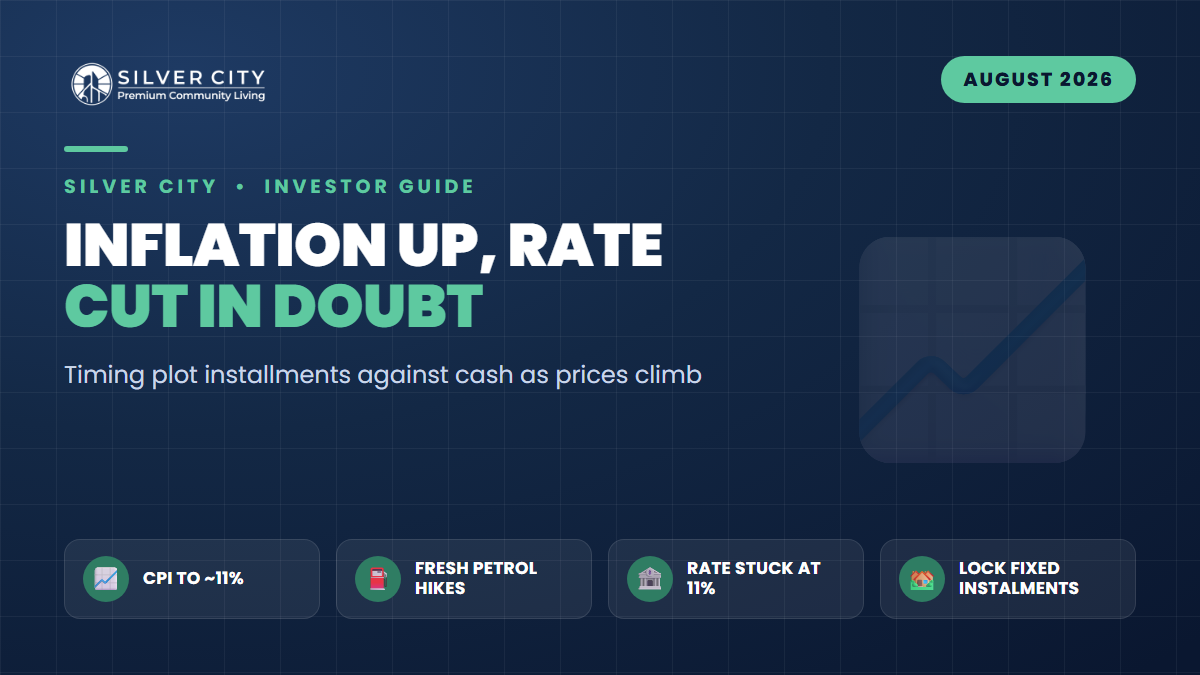
Two data points landed within days of each other and quietly changed the calculation for anyone sitting on cash and eyeing a plot in Rawalpindi. First, headline CPI is set to snap back to roughly 11% year-on-year in August, after cooling to 9.2% in July. Second, the government pushed through fresh petrol and diesel increases — petrol climbed to Rs341.59 per litre from late August, part of a run of back-to-back fortnightly hikes. Together, they have thrown cold water on the widely-hoped-for September policy-rate cut from the State Bank of Pakistan (SBP), which has held the rate at 11% through its recent meetings.
For property investors, this is not abstract macro noise. The gap between the cost of money, the pace at which the rupee loses value, and the way housing societies structure their instalment plans is exactly where your decision to finance now or hold cash gets made. Let’s break it down.
What Actually Changed This Month
Inflation had been trending down for most of the year, feeding market hopes that the SBP would resume cutting rates. The August reversal breaks that story. The projected jump to ~11% is driven largely by food prices, and — critically — by the very fuel hikes that also raise transport and construction-input costs. When petrol and high-speed diesel rise, the effect ripples into cement haulage, sand, steel delivery and labour movement, which is why fuel matters so much to plot developers and, eventually, to plot prices.
| Indicator | Recent reading | Direction |
|---|---|---|
| CPI (July, YoY) | 9.2% | Cooling |
| CPI (August, projected YoY) | ~11.0% | Snapping back up |
| Petrol (from late August) | Rs341.59/litre | Up (multiple hikes) |
| SBP policy rate | 11% | On hold |
The takeaway: a September cut is no longer the base case. If the SBP sees inflation re-accelerating and fuel adding fresh pressure, it is far more likely to hold at 11% to protect the rupee and its IMF-programme targets than to ease.
Why This Tilts the Math Toward Society Instalments
Here is the point most cash-holders miss. There are three “prices of money” in play, and they are not moving together:
- Bank mortgage financing is tied to KIBOR, which tracks the policy rate. With the rate stuck at 11%, home/plot loans stay expensive — you’d pay well into the mid-teens once the bank’s spread is added.
- Cash parked in T-bills or savings earns you roughly the policy rate (~11%), but that return is taxable and, after ~11% inflation, your real return is close to zero.
- Developer instalment plans from RDA-approved societies are typically interest-free — the “price” is fixed in rupees at today’s number and spread over 3–4 years.
That third option is the quiet winner in a high-inflation, high-rate environment. When you lock a fixed-rupee instalment schedule, every future payment is made in cheaper future rupees. If inflation runs near 11%, the real burden of an instalment due in 2027 is materially lighter than the same number paid today — and you are not paying a bank 15%+ for the privilege.
A Worked Example: Cash vs Instalments
Consider a 5 Marla plot at Silver City Rawalpindi, priced around Rs1,500,000. Compare paying in full versus a 3-year instalment plan.
| Component | Pay full (cash) | 3-year instalment plan |
|---|---|---|
| Down payment (25%) | Rs1,500,000 (all upfront) | Rs375,000 |
| Monthly instalment | — | Rs22,916 × 36 months |
| On possession | — | Rs300,000 |
| Total nominal outlay | ~Rs1,500,000 | ~Rs1,500,000 |
| Cash kept working meanwhile | Nil | ~Rs1,125,000 deployable |
Notice the nominal totals are almost identical — the developer isn’t charging interest. But on the instalment path you keep roughly Rs1.1 million not tied up on day one. That cash can sit in a ~11% instrument or fund a second entry point, while the plot itself continues to appreciate. In effect, you get exposure to the asset’s upside while the erosion of the rupee shrinks the real cost of your remaining payments. That is the opposite of taking a bank loan, where the lender captures the inflation premium instead of you.
When Holding Cash Still Makes Sense
This isn’t a blanket “borrow always” argument. Cash is the smarter hold if:
- Your income is not inflation-linked. Instalments are only “cheaper in future rupees” if your earnings roughly keep pace. Fixed-salary buyers should stress-test whether Rs22,916/month stays comfortable if food and fuel keep biting.
- You lack an emergency buffer. A missed instalment can trigger penalties or, in weaker projects, forfeiture. Keep 6–9 months of instalments in reserve before committing.
- You expect to redeploy cash at a genuinely higher return than the plot’s appreciation — rare in the current Rawalpindi market, where well-located approved societies are still moving.
The Timing Verdict for the Next Quarter
With the September cut in doubt and inflation re-accelerating, waiting for “cheaper financing” is a weak plan — bank money will stay costly, and plot prices tend to climb with inflation, not wait for it. The stronger play for most investors is to lock a fixed-rupee instalment schedule now on an RDA-approved project, put down the minimum sensible deposit, and let inflation do the heavy lifting on your future payments. Reserve cash for the buffer and for a possible second entry if a correction appears. Sitting fully in cash “until the rate cut” mostly guarantees you buy the same plot later at a higher sticker price.
Frequently Asked Questions
Will the SBP cut rates in September 2025?
It looks less likely than it did a month ago. With August CPI projected near 11% and fresh fuel hikes feeding further price pressure, the MPC has strong reasons to keep the policy rate at 11% rather than ease. Base your plan on a hold, not a cut.
Are housing-society instalments really interest-free?
Most RDA-approved developers, including Silver City, price the plot in rupees and spread it over 3–4 years without an explicit interest markup — unlike a KIBOR-linked bank loan. Always confirm there are no hidden “deferred payment” surcharges in the written payment plan before signing.
Does high inflation help or hurt an instalment buyer?
It helps, provided your income keeps pace. Because your instalments are fixed in nominal rupees, inflation steadily shrinks their real value while the underlying land typically appreciates. The risk is a fixed income that doesn’t rise with prices.
Should I wait for plot prices to drop first?
In an ~11% inflation environment, land in approved, well-connected societies rarely gets cheaper in nominal terms — it usually tracks or outpaces inflation. Timing the market perfectly is far less reliable than locking a fixed schedule and holding a sound asset.
Bottom line: when the cost of borrowing is stuck high and cash is quietly losing value, a fixed-rupee, interest-free instalment plan on solid, approved land is one of the cleaner hedges available to a Pakistani investor. Silver City — an RDA-approved society off Girja Road near the Thalian Interchange and Islamabad International Airport, with 3–4 year instalment options — is one worth putting on your shortlist as you weigh timing against holding cash.
@@END@@