The Gap Between 5% and 11.5% Is the Whole Opportunity
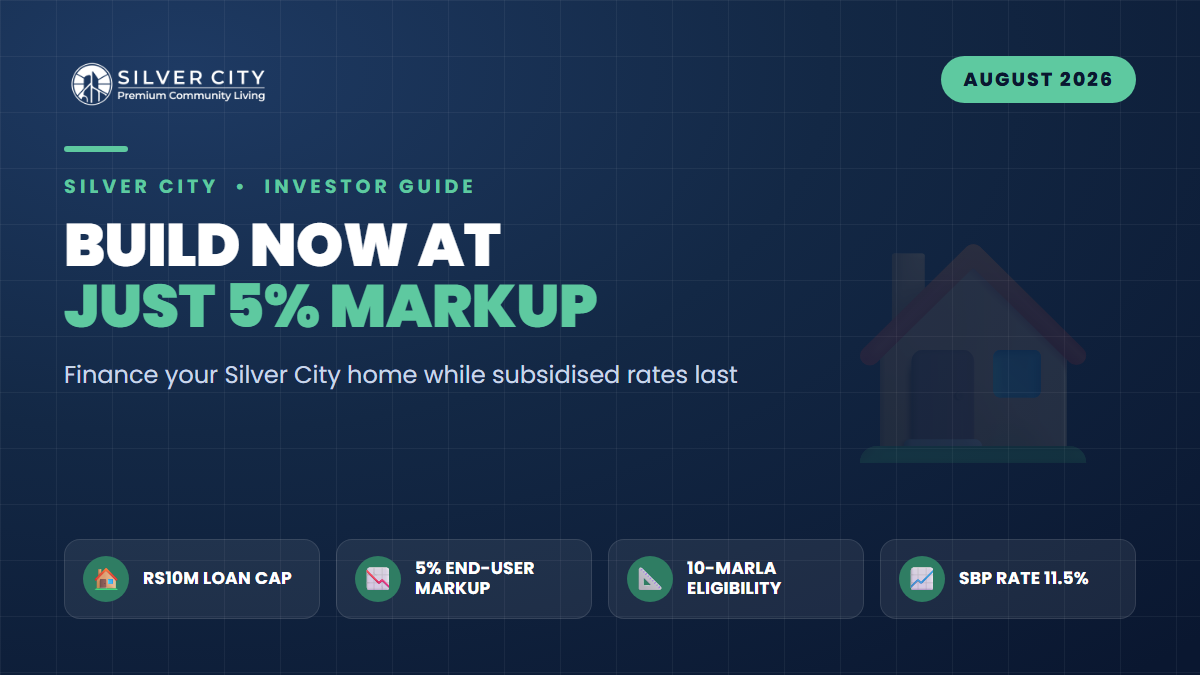
In February 2026 the Economic Coordination Committee (ECC) approved a revised version of the federal government’s flagship housing-finance programme, Mera Ghar Mera Aashiana (MGMA). Two changes matter most to anyone sitting on a residential plot: the end-user mark-up was cut to a uniform 5%, and the maximum loan size was raised to Rs10 million. Eligibility was simultaneously widened to cover houses of up to 10 marla or flats of up to 1,500 square feet — a meaningful jump from the earlier 5-marla / 1,360 sq ft ceiling.
Now place that 5% next to the cost of money everywhere else in Pakistan. On 28 July 2026 the State Bank of Pakistan (SBP) held its policy rate at 11.5% for the third consecutive meeting. Commercial home financing is priced off that rate, so an ordinary mortgage today lands well into the high teens. MGMA lets an eligible end-user borrow to build at less than half the policy rate. That spread — roughly 6.5 percentage points below SBP’s benchmark — is a subsidy the government is absorbing, and it is exactly why a plot that is currently doing nothing deserves a second look.
Why an Idle 5-Marla Plot Is a Weak Asset
A registered 5-marla plot in an RDA-approved society such as Silver City is a genuine store of value. But raw land has three quiet problems. First, it produces zero rental income while you hold it. Second, its appreciation depends almost entirely on the society maturing around it — roads, electricity, gas, occupancy. Third, in a high-rate environment, the “opportunity cost” of leaving capital parked in dirt is high, because that same capital could be servicing a subsidised loan that builds an income-producing or livable asset.
The revised MGMA is designed precisely for this situation. The scheme finances three things: buying a ready home, constructing on land you already own, or buying land plus construction. A plot holder falls squarely into the middle category. You are not being asked to find a house to buy — you already hold the most expensive input. The loan simply funds the structure on top of it.
The Scheme at a Glance
| Feature | Revised MGMA (2026) |
|---|---|
| End-user mark-up | 5% (down from 8%) |
| Maximum loan | Rs10 million |
| Eligible property size | House up to 10 marla or flat up to 1,500 sq ft |
| Eligible use | Purchase, construction on owned land, or land + construction |
| Loan tenure | Up to 20 years (subsidised mark-up for the first 10) |
| Applicant | First-time home owner, valid CNIC, age 18–65 |
| Programme target | ~500,000 units over four years |
| Applications filed | 10,500+ (over Rs32bn requested) |
| SBP policy rate (benchmark) | 11.5% (July 2026) |
Note that the 5% mark-up is subsidised for the first 10 years; after that the loan reverts toward market pricing for the remaining tenure. For most end-users the strategy is to build now, occupy or rent the home, and let a decade of cheap financing do the heavy lifting.
What the 5% Actually Saves You
The illustration below compares the annual mark-up cost on a Rs6 million construction loan under MGMA versus a commercial facility priced near the current policy rate. Figures are simplified for comparison and are not a formal amortisation schedule — your bank will confirm exact instalments.
| Loan amount | MGMA @ 5% | Commercial @ ~15%* | Indicative first-year gap |
|---|---|---|---|
| Rs3,000,000 | ~Rs150,000 | ~Rs450,000 | ~Rs300,000 |
| Rs6,000,000 | ~Rs300,000 | ~Rs900,000 | ~Rs600,000 |
| Rs10,000,000 | ~Rs500,000 | ~Rs1,500,000 | ~Rs1,000,000 |
*Commercial rate is indicative and moves with the SBP policy rate; actual bank pricing varies. The point is the direction and scale of the saving, not a fixed quote.
On a Rs10 million loan, the first-year mark-up gap approaches a million rupees. Compounded across several years, the subsidy can fund a meaningful share of your finishing and fixtures.
Why Move Before the Queue Grows
The scheme has an explicit ceiling — roughly half a million units over four years — and demand is building fast. Banks have already received more than 10,500 applications requesting over Rs32 billion, while only a few hundred loans worth around Rs810 million had been disbursed at the time of reporting. A subsidised programme with a fixed budget rewards early, well-prepared applicants. The longer you wait, the more you are competing against a larger pool for the same pot of concessional money, and the greater the risk that terms are tightened once uptake accelerates.
There is also a construction-cost argument. Cement, steel and labour do not get cheaper by waiting. Building now, financed at 5%, locks in today’s construction prices; holding the plot for “later” exposes you to both higher input costs and potentially higher financing costs if the subsidy narrows.
A Sensible Sequence for a Silver City Plot Holder
- Confirm your plot’s transfer, possession and approved building status with the society office.
- Check your eligibility: first-time home owner, valid CNIC, and a plan for a house within the 10-marla / 1,500 sq ft limit.
- Get an approved construction map and a realistic build estimate.
- Approach a participating bank, apply under MGMA for construction-on-owned-land, and match your loan size to the Rs10 million cap.
- Build, then occupy or rent — converting idle land into a serviceable, income-capable asset.
Frequently Asked Questions
Does my 5-marla plot qualify if the scheme mentions 10 marla?
Yes. The 10-marla / 1,500 sq ft figure is the maximum eligible property size, not a minimum. A 5-marla plot is comfortably inside the limit, and constructing on land you already own is one of the scheme’s three financed uses.
Is the 5% mark-up fixed for the whole loan?
The 5% end-user mark-up is subsidised for the first 10 years. The overall tenure can run up to 20 years, after which pricing moves toward market rates for the remaining period. Confirm the exact structure with your bank before signing.
Why borrow at all when I already own the land outright?
Because the cost of the borrowed money (5%) is far below both the SBP policy rate (11.5%) and typical commercial financing. Financing construction preserves your own cash while a government subsidy carries much of the mark-up — and you end up with a completed, usable or rentable home rather than empty land.
Who is eligible to apply?
The scheme targets first-time home owners with a valid CNIC, generally aged between 18 and 65, borrowing for a property within the size limits. Applications are processed through participating banks, so eligibility and documentation are verified at the bank stage.
The Bottom Line
The revised Mera Ghar Mera Aashiana turns a familiar problem — “I own a plot but haven’t built” — into a timed opportunity. With a 5% end-user mark-up, a Rs10 million cap and expanded 10-marla eligibility, the maths favours building now over holding idle land while the policy rate sits at 11.5%. For plot holders in an RDA-approved society like Silver City, Rawalpindi, where infrastructure and possession are already in place, this is a practical moment to convert land into a home. Verify the latest terms with a participating bank and the society office before you commit — but do not let a subsidy with a fixed budget quietly pass while your plot sits empty.
@@HTML@@