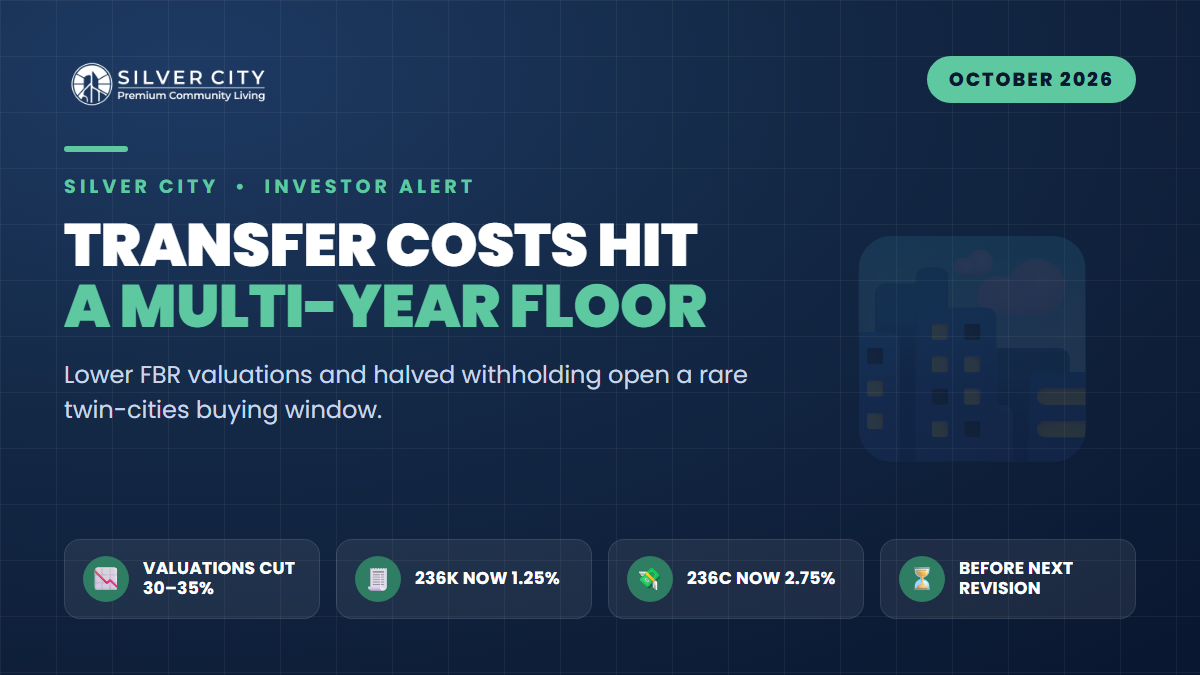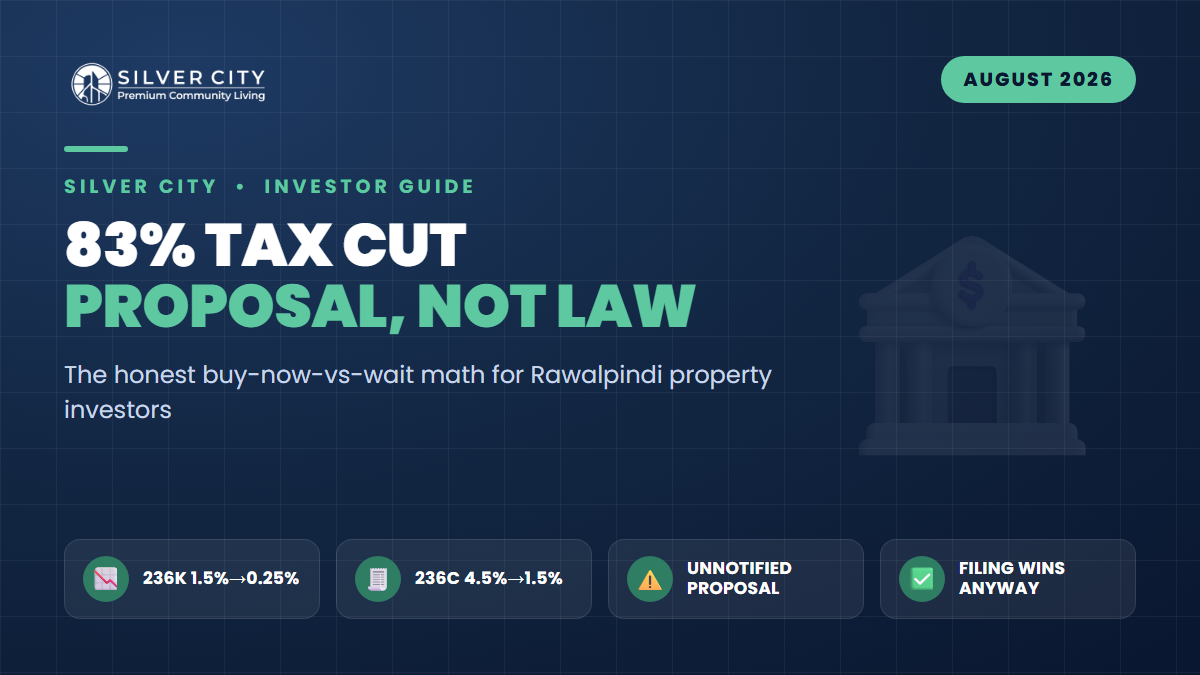
Headlines about an “83% property tax cut for filers” are everywhere, and Rawalpindi buyers are asking a simple question: should I wait for the cut before I transfer a plot? The honest answer starts with a fact many articles skip — this is still a proposal, not law. Before you delay a deal, understand exactly what has and hasn’t happened, and run the real numbers for your own transaction.
First, the fact-check: it is a proposal, not a notification
The talked-about reform would reduce the advance tax on property purchase under Section 236K from 1.5% to 0.25% for active filers, and the advance tax on property sale under Section 236C from 4.5% down to 1.5%. Those figures are real and widely reported — but they have been floated in budget discussion, not enacted through the Finance Act or notified by the FBR via an official SRO.
In Pakistan, a tax rate only becomes binding when Parliament passes it into the Finance Act and the FBR issues the corresponding notification. Until that happens, sub-registrars, housing-society transfer offices, and RDA-linked societies in Rawalpindi will keep charging the current 2025-26 rates. A budget speech, a committee recommendation, or a news leak changes nothing at the transfer counter.
What the numbers actually say: current vs proposed
Here are the rates in force today alongside the proposed FY27 figures. Note that the current rates are slab-based on property value, while the proposal collapses them to a single low rate for filers.
| Section | Property value | Filer — now (law) | Filer — proposed | Non-filer — now |
|---|---|---|---|---|
| 236K (buyer) | Up to Rs 50M | 1.5% | 0.25% | 10.5% |
| 236K (buyer) | Rs 50M–100M | 2.0% | 0.25% | 14.5% |
| 236K (buyer) | Above Rs 100M | 2.5% | 0.25% | 18.5% |
| 236C (seller) | Up to Rs 50M | 4.5% | 1.5% | 11.5% |
| 236C (seller) | Rs 50M–100M | 5.0% | 1.5% | 11.5% |
| 236C (seller) | Above Rs 100M | 5.5% | 1.5% | 11.5% |
Two things stand out. First, the cut only touches the filer column — non-filer rates are proposed to stay exactly where they are. Second, 236K and 236C are adjustable advance taxes: if you file returns, you can set them off against your annual income tax liability. For a genuine filer, the sticker rate overstates the true, final cost.
A real Rawalpindi example
Take a Rs 20 million plot — a realistic ticket for RDA-approved societies around Rawalpindi. As a filer under current law you pay Rs 300,000 (236K) as buyer; the seller pays Rs 900,000 (236C). Under the proposal those fall to Rs 50,000 and Rs 300,000. The combined headline saving of about Rs 850,000 is real — but only if the law passes, only for filers, and only on the day it is notified.
The honest buy-now-vs-wait math
Waiting is not free. Weigh the potential tax saving against four real costs of delay:
- Price appreciation. On a Rs 20M plot, even a modest 5% rise (Rs 1,000,000) over the wait wipes out the entire ~Rs 850,000 gross tax saving. In active Rawalpindi corridors, seasonal moves have historically outrun the tax delta.
- Adjustability. Because the tax is adjustable for filers, part of what you “save” by waiting is money you would have recovered at return-filing anyway. The true saving is the time-value and any unadjusted portion — not the full sticker figure.
- Passage risk. The rate could be enacted at a different number (a flat 2.75% has been discussed for 236C), delayed to a later fiscal year, or dropped under IMF revenue pressure. You cannot bank an unnotified rate.
- Deal risk. The specific plot, price, and seller in front of you today may not exist in three or six months.
Rule of thumb: wait only if the expected tax saving clearly exceeds expected appreciation plus deal risk over your wait horizon — and even then, size the saving using the adjusted cost, not the headline rate. For most owner-users and medium-term investors buying a good plot at a fair price, waiting on an unnotified rate is a bet, not a strategy.
Why the real decision is filing — regardless
Whether or not the cut ever arrives, the gap that actually moves money is filer vs non-filer. Look at the buyer side on our Rs 20M plot:
| Buyer status | 236K rate | Tax on Rs 20M | Extra vs filer |
|---|---|---|---|
| Filer (current law) | 1.5% | Rs 300,000 | — |
| Filer (if proposal passes) | 0.25% | Rs 50,000 | — |
| Non-filer | 10.5% | Rs 2,100,000 | Rs 1.8M–2.05M |
A non-filer already pays roughly seven times a filer’s rate — and the proposal only widens that chasm, because non-filer rates are untouched. Chasing a possible Rs 250,000 buyer-side saving from the cut while remaining a non-filer paying Rs 1.8 million extra is optimising the wrong number entirely. Getting on the Active Taxpayer List (ATL) is the single highest-return move available to a Rawalpindi property investor today, and it captures the future cut automatically if it lands.
What to watch before you decide
- The FBR notification / SRO — the only signal that the rate is actually live. Ignore speculation until then.
- Your ATL status on the transfer date; being on the list is what unlocks every filer rate.
- Punjab stamp duty, CVT and registration charges, which apply in Rawalpindi on top of 236K/236C and are unaffected by this proposal.
- FBR valuation tables for your area, since all these taxes are calculated on notified value, not just the deal price.
Frequently Asked Questions
Is the 83% filer tax cut currently in force?
No. As of writing it is an unnotified proposal. Rawalpindi transfers are charged at the current 2025-26 rates until the Finance Act enacts the change and the FBR notifies it. Treat any headline rate as tentative until you see the official notification.
Should I delay my Rawalpindi purchase to wait for the cut?
Usually not. The potential saving is easily erased by price appreciation, and much of it is recoverable anyway because 236K is adjustable for filers. Wait only if your expected saving clearly beats expected appreciation and deal risk over your specific horizon.
Does the cut help non-filers?
No. Non-filer rates are proposed to stay unchanged, so the reform only widens the filer–non-filer gap. The most valuable action is to become a filer and get on the ATL, which benefits you under both current and proposed rules.
Are 236K and 236C the only taxes on a Rawalpindi transaction?
No. Provincial stamp duty, CVT and registration fees also apply, calculated on FBR/DC notified valuation. Budget for these separately, as the proposed cut does not touch them.
Bottom line: don’t rearrange a sound purchase around a rate that isn’t law. File your returns, confirm your ATL status, and buy the right plot at the right price when it appears. If you’re looking for a secure entry point, an RDA-approved society such as Silver City in Rawalpindi is worth shortlisting — approved status reduces transfer and legal risk, and as a filer you capture the future tax relief automatically the day it is finally notified.
Sources: Clear Concept Academy, Pin92, TaxToday Pakistan, FBR. Rates are subject to official FBR notification; verify before transacting.