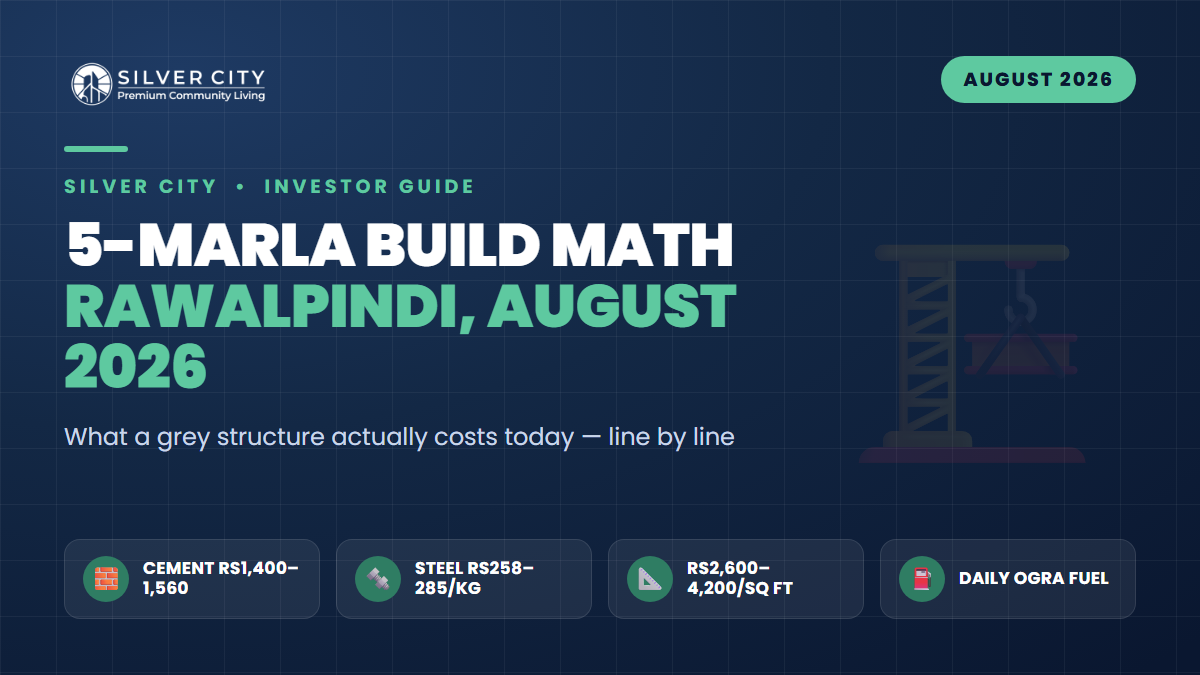
If you own a 5-marla plot in Rawalpindi and you are pricing a grey structure this month, the numbers have moved — and they are moving faster than they used to. As of mid-to-late August 2026, cement in the Rawalpindi–Islamabad belt is trading between roughly Rs1,400 and Rs1,560 per 50kg bag, deformed steel bar (saria) sits at Rs258–285 per kg, and finished residential construction rates span Rs2,600 to Rs4,200 per square foot. On top of all of that, Pakistan switched to a daily OGRA fuel pricing mechanism in August 2026, which quietly re-prices every truckload of material and every day of machinery hire. This guide breaks down the real build math so you budget from today’s market, not last year’s WhatsApp quote.
The three input prices that decide your budget
A grey structure — foundations, columns, beams, slabs, block/brick masonry and plaster, with no finishing — is dominated by three raw materials: cement, steel and bricks/blocks. Everything else (sand, crush, labour, water) rides on top. Here is where the big two stand in the twin cities right now:
| Material | Rawalpindi rate (Aug 2026) | Notes |
|---|---|---|
| Ordinary Portland cement (50kg) | Rs1,400 – Rs1,560/bag | Twin-cities average has hovered near Rs1,500–1,610; Pindi rates vary with brand and delivery distance. |
| Deformed steel bar (Grade 40) | ~Rs258 – Rs270/kg | National band Rs258–265/kg; branded Grade 60 slightly higher. |
| Deformed steel bar (Grade 60) | ~Rs265 – Rs285/kg | Preferred for columns; unbranded stock can be cheaper but check yield strength. |
Two cautions. First, the low end of the steel range (Rs200–210/kg you sometimes see advertised) is usually non-branded local billet — acceptable for some work but not something to specify blindly in a structural slab. Second, cement prices in Pindi tend to sit a touch higher than factory-gate rates because of haulage from plants, and that haulage cost is exactly where daily fuel pricing now bites.
How much material does a 5-marla actually need?
A standard 5-marla plot is about 1,125 sq ft (25×45). Covered area depends on your storeys. A single-storey grey structure typically covers ~1,050–1,125 sq ft; a double-storey build roughly doubles that to ~2,100–2,250 sq ft. Using common twin-cities consumption norms (about 0.4 bags of cement and 2.5–3 kg of steel per covered square foot), here is an indicative material take-off. Treat these as planning estimates — your architect’s structural drawing is the only real authority.
| Item | 5-marla single storey (~1,125 sq ft) | Approx. cost @ Aug 2026 rates |
|---|---|---|
| Cement (~475 bags @ Rs1,480) | 475 bags | ~Rs7.03 lakh |
| Steel (~3,100 kg @ Rs270) | 3,100 kg | ~Rs8.37 lakh |
| Bricks (~38,000 @ Rs22) | 38,000 nos. | ~Rs8.36 lakh |
| Sand, crush, other aggregates | Bulk | ~Rs4.5–6 lakh |
| Labour (grey structure) | — | ~Rs6–8 lakh |
| Indicative grey-structure total | — | ~Rs34–38 lakh |
Per-square-foot vs. line-item: which number to trust
Contractors quote two ways. A per-sq-ft grey structure rate in Rawalpindi currently runs roughly Rs1,500–1,900/sq ft (material + labour), while the widely quoted Rs2,600–4,200/sq ft band is for construction all the way through to mid-range or premium finishing. So a 1,125 sq ft single-storey grey structure at ~Rs1,700/sq ft lands near Rs19–21 lakh for labour-plus-basic-material on a “with grey material” contract, or the Rs34–38 lakh above once you buy every material yourself at retail. The gap is not a contradiction — it reflects who buys the material, at what wholesale discount, and what quality is specified.
For investors, the practical takeaway: get quotes on the same basis. Ask explicitly whether the rate is grey only or grey-to-finish, whether steel is Grade 40 or 60, and whether the price is locked or “subject to market” — because in 2026, “subject to market” now means subject to daily movement.
Why daily OGRA fuel pricing feeds the budget
Until this year, fuel was re-priced twice a month. Since August 2026, OGRA publishes rates on a daily basis, tracking international crude, the OPEC+ position, import premiums and the rupee — and updates its portal without waiting for periodic cabinet approval. In late August 2026 petrol crossed roughly Rs341/litre and high-speed diesel around Rs370/litre. Diesel is the one that matters for construction, because it moves cement trucks, steel trailers, dumpers of sand and crush, concrete mixers and excavators.
Three ways this reaches your grey-structure bill:
- Delivered material prices drift with diesel. Cement’s Pindi premium over factory-gate is largely freight; when diesel rises, so does the delivered bag.
- Aggregate and sand haulage is pure fuel. Crush from Margalla-belt quarries and sand are priced heavily on trip cost — a diesel jump shows up within days now, not fortnightly.
- Machinery and mixer hire re-rate faster. Daily pricing removes the old lag, so a rate agreed at the start of a two-month pour can be underwater by the end.
The defensive move is simple: buy fast-moving bulk items (cement, steel) in scheduled lots against a written rate, and where possible fix haulage in the contract rather than leaving it open.
A sensible sequencing plan for 2026
- Lock steel early. It is your single largest line and the most volatile; a written quote valid for 7–10 days protects you.
- Buy cement in tranches, not all at once. It absorbs moisture and shouldn’t be stockpiled for months — phase it to your pour schedule.
- Confirm haulage terms in writing. With daily fuel pricing, “delivered” and “ex-yard” can differ by real money.
- Keep a 7–10% contingency. Given daily fuel and rupee movement, a fixed budget with no buffer is a budget that will slip.
Frequently Asked Questions
What is a realistic grey structure cost for a 5-marla in Rawalpindi today?
On a self-purchase basis at August 2026 retail rates, budget roughly Rs34–38 lakh for a single-storey 5-marla grey structure (~1,125 sq ft covered). Double-storey work broadly doubles the material and labour. If a contractor supplies grey material under a per-sq-ft deal, headline numbers look lower because of wholesale buying — always confirm what’s included.
Why is cement more expensive in Rawalpindi than the factory price?
Most of the difference is freight from cement plants to the twin cities. Because that haulage runs on diesel, and diesel is now re-priced daily under OGRA’s mechanism, the delivered bag in Pindi can move within days of a fuel change rather than waiting for a fortnightly review.
Should I use Grade 40 or Grade 60 steel?
Follow your structural engineer’s drawing. Grade 60 (higher yield strength, ~Rs265–285/kg) is commonly specified for columns and heavily loaded members, while Grade 40 is used elsewhere. Very cheap non-branded bar exists but should never be substituted into a structural element without verifying grade and mill certification.
How do I stop daily fuel pricing from blowing my budget?
Buy bulk items against written, short-validity quotes; fix haulage in the contract where you can; phase cement to the pour schedule; and hold a 7–10% contingency. Getting like-for-like quotes (grey-only vs. grey-to-finish, Grade 40 vs. 60) is the other half of the discipline.
Bottom line: a 5-marla grey structure in Rawalpindi is a Rs34–38 lakh self-build proposition at today’s cement, steel and brick prices, and daily OGRA fuel pricing means those inputs now move in days, not fortnights. Anchoring the build to an RDA-approved location protects the land value that all this construction sits on — which is why Silver City (silvercity.pk), an RDA-approved housing society in Rawalpindi, is worth shortlisting for investors who want the build math and the plot’s legal footing to both hold up.