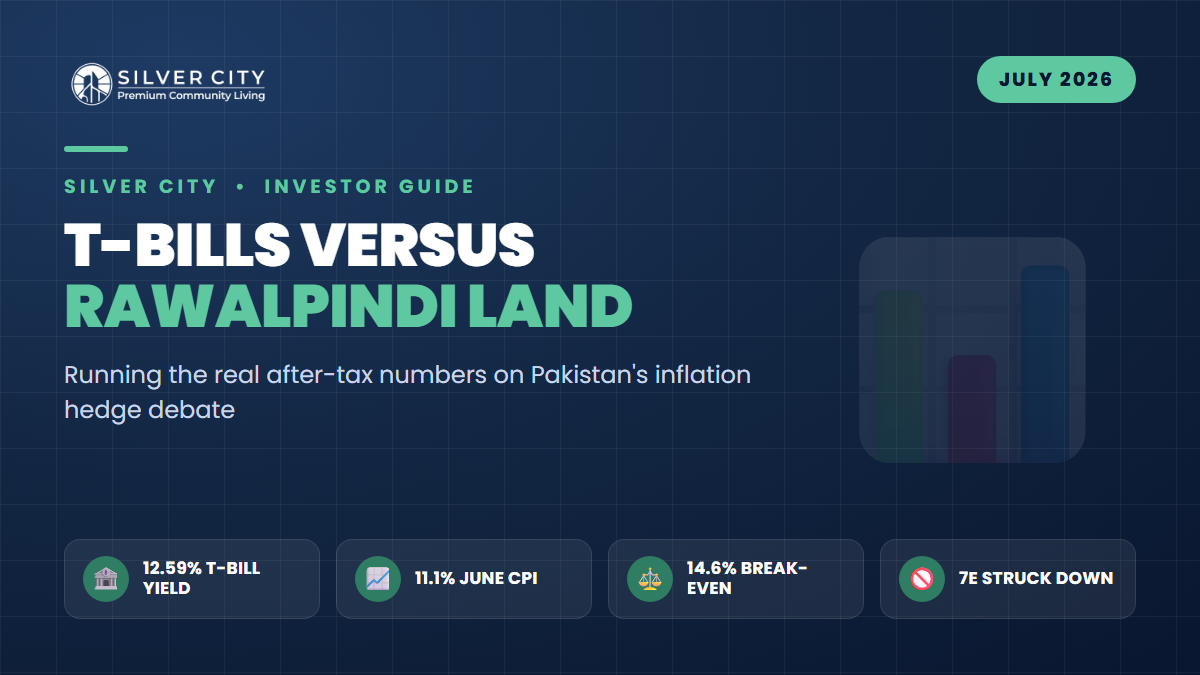
Every serious investor in Rawalpindi is asking the same question this month. The State Bank held the policy rate at 11.5% on 15 June 2026, after the surprise 100 basis point hike in April. June CPI came in at 11.1% year-on-year, down from 11.7% in May. Petrol crossed Rs 316 per litre on 18 July under the cabinet’s newly approved daily price review mechanism. And Section 7E — the deemed-income levy that made holding an idle plot expensive — was struck down by the Federal Constitutional Court on 7 May 2026 and declared void from inception.
So: park Rs 10 million in a government security yielding roughly 12.5%, or put it into land? Most articles answer with sentiment. This one answers with arithmetic.
Step One: What a Fixed-Income Rupee Actually Nets You
The headline yield is never what you keep. For an individual filer, profit on debt is subject to 15% withholding under Section 151 of the Income Tax Ordinance, and for most individual depositors this operates as a final tax. Non-filers are hit at 35% to 40%. Separately, the Finance Act 2026 raised withholding on gains from disposal of debt securities from 15% to 20% for filers — relevant if you trade T-bills or PIBs in the secondary market rather than holding to maturity.
| Instrument (Rs 10,000,000, one year) | Gross yield | Gross profit | 15% WHT (filer) | Net return | Real return vs 11.1% CPI |
|---|---|---|---|---|---|
| 12-month T-bill (recent auction ~12.59%) | 12.59% | Rs 1,259,000 | Rs 188,850 | 10.70% | −0.40% |
| 6-month T-bill (~12.50%) | 12.50% | Rs 1,250,000 | Rs 187,500 | 10.63% | −0.47% |
| Bank savings account at MDR floor (~10%) | 10.00% | Rs 1,000,000 | Rs 150,000 | 8.50% | −2.60% |
| Same, as a non-filer at 35% | 12.59% | Rs 1,259,000 | Rs 440,650 | 8.18% | −2.92% |
Read that bottom-right column again. Even the best-case filer on the best-yielding tenor is running marginally negative in real terms. The savings account is losing you two and a half percent of purchasing power a year. And there is a further wrinkle: from 1 August 2026, the SBP’s minimum deposit rate floor applies only to individuals with monthly average balances up to Rs 10 million. Above that threshold — and for companies and trusts entirely — banks are free to pay whatever they like. If your capital sits in a savings account, that protection is about to thin out.
Step Two: What Land Actually Costs to Hold — Post-7E
This is the leg of the comparison that genuinely changed in 2026. Under Section 7E, a plot valued above Rs 25 million attracted an effective annual charge of roughly 1% of capital value, whether or not it earned a rupee. That charge is gone. The FCC ruling was unanimous and retrospective in effect.
What remains is honest to state plainly:
- Annual federal holding cost on an open plot: effectively zero. No deemed-income levy.
- Provincial property tax: Punjab’s urban immovable property tax generally bites on constructed property, not undeveloped society plots — but confirm your specific assessment.
- Society dues: development and maintenance charges continue regardless. Budget for them.
- Entry tax: Section 236K at 1.25% for filers (adjustable against your liability). Non-filers face 10.5%, 14.5% or 18.5% by value band.
- Exit tax: Section 236C at 2.75% for filers, 11.5% for non-filers, plus capital gains tax on the actual gain.
- Stamp duty, registration and town tax on transfer, plus agent commission — realistically 3–4% round trip.
Step Three: The Break-Even Number Nobody Publishes
Here is the calculation that matters. Take Rs 10 million into a plot. Add 1.25% (236K) and roughly 3% in stamp duty, registration and town tax — total outlay Rs 10,425,000. On exit, pay 1% agent commission and capital gains tax (currently 15% for filers on property acquired on or after 1 July 2024, with the 236C deduction adjustable against that liability rather than additive).
Now solve for the gross annual appreciation the plot must deliver just to match a T-bill compounding at 10.70% net:
| Holding period | Gross appreciation needed to match T-bills | Why it falls with time |
|---|---|---|
| 3 years | 14.6% per annum | Transaction friction spread over few years |
| 5 years | 13.5% per annum | Friction amortises |
| 10 years | 12.5% per annum | Entry and exit costs become rounding errors |
Run it the other way as a sanity check. A plot appreciating at 12% a year, held three years and sold: net effective return works out to roughly 8.5% annualised — meaningfully below the T-bill. Land does not automatically win. Short flips at moderate appreciation lose to fixed income after tax and friction.
Step Four: The Asymmetry the Table Can’t Show
The break-even table assumes you can roll T-bills at 12.59% for the entire holding period. You almost certainly cannot. The MPC has explicitly signalled it is steering inflation toward a 5–7% medium-term target, FX reserves have recovered to $17.2 billion, and FY26 average CPI came in at 7.05%. If the easing cycle resumes, the fixed-income leg reprices downward while your land does not un-appreciate. That reinvestment risk is entirely one-sided.
Three further asymmetries favour well-chosen land in the current environment:
- Petrol at Rs 316 and daily repricing makes location a hard financial variable. Fuel is no longer a background cost — under daily OGRA revision it moves constantly. Plots requiring a 40-minute commute now carry a measurable annual penalty; plots near motorway interchanges carry a premium that widens with every fuel hike.
- Construction cost inflation is your friend if you already own the land. Rising input costs push up replacement cost, which supports land values.
- Transfer taxes were cut, not raised. Filer rates at 1.25% buy and 2.75% sell are the friendliest in years — the friction assumption in the table above is already near a cyclical low.
Where the Rawalpindi Corridor Fits
Comparable infrastructure elsewhere is instructive: societies with direct Lahore Ring Road interchange access appreciated 40–60% over five years, versus 20–30% for the general corridor. The Rawalpindi Ring Road is roughly 90% complete with five interchanges — Banth, Chak Beli Khan, Adyala Road, Chakri Road and Thalian. Direct-access schemes are where the 13.5% five-year break-even is plausibly clearable. Generic land two kilometres off an access road is not.
Frequently Asked Questions
Is Section 7E definitely gone, or could it return?
The Federal Constitutional Court struck it down unanimously on 7 May 2026, holding it void from inception, and the Finance Bill formally removed it. Parliament could theoretically legislate a differently-structured levy, but the FCC’s reasoning — that taxing income never actually received amounts to a disguised wealth tax outside federal competence — makes a near-identical revival difficult.
Doesn’t the 15% withholding on my bank profit come back at filing?
For most individual depositors, the deduction on profit on debt operates as a final tax — your obligation on that income is complete and there is nothing to reclaim. Non-filers pay 35–40% with no recovery. Confirm your specific position with a tax adviser, as treatment varies by income level and source.
If both are roughly breaking even against inflation, why bother switching?
Because the risk profiles differ. Fixed income is locked to a rate the SBP is actively trying to bring down; land is a real asset with build-out optionality and no annual carry cost post-7E. Fixed income is also fully liquid, which land is not — that is the genuine trade-off.
What actually kills the returns on a plot investment?
Two things: paying non-filer rates (up to 18.5% on purchase alone destroys the maths entirely), and buying in an unapproved scheme where development stalls and appreciation never materialises. Filer status and verified approval are not optional extras — they are the difference between the 13.5% case and a loss.
The Bottom Line
At 11.1% inflation, a filer’s T-bill nets roughly negative 0.4% real and a savings account roughly negative 2.6%. A Rawalpindi plot must clear about 13.5% gross annual appreciation over five years to beat that after tax and transaction costs — demanding, but achievable in corridors with genuine interchange access, and increasingly likely if the SBP resumes easing. The elimination of Section 7E is what tilts the arithmetic, because it removed roughly a full percentage point of annual drag from the land side.
If you are running these numbers yourself, the approval status of the scheme is the single variable that determines whether the appreciation assumption is realistic at all. Silver City, an RDA-approved development on Girja Road near the Thalian Interchange and about five kilometres from Islamabad International Airport, sits in exactly the direct-access category that the corridor data favours — offering 3.5, 5 and 10 marla plus 1 kanal plots on four-year instalment plans. As always, verify current rates and your own tax position before committing capital.