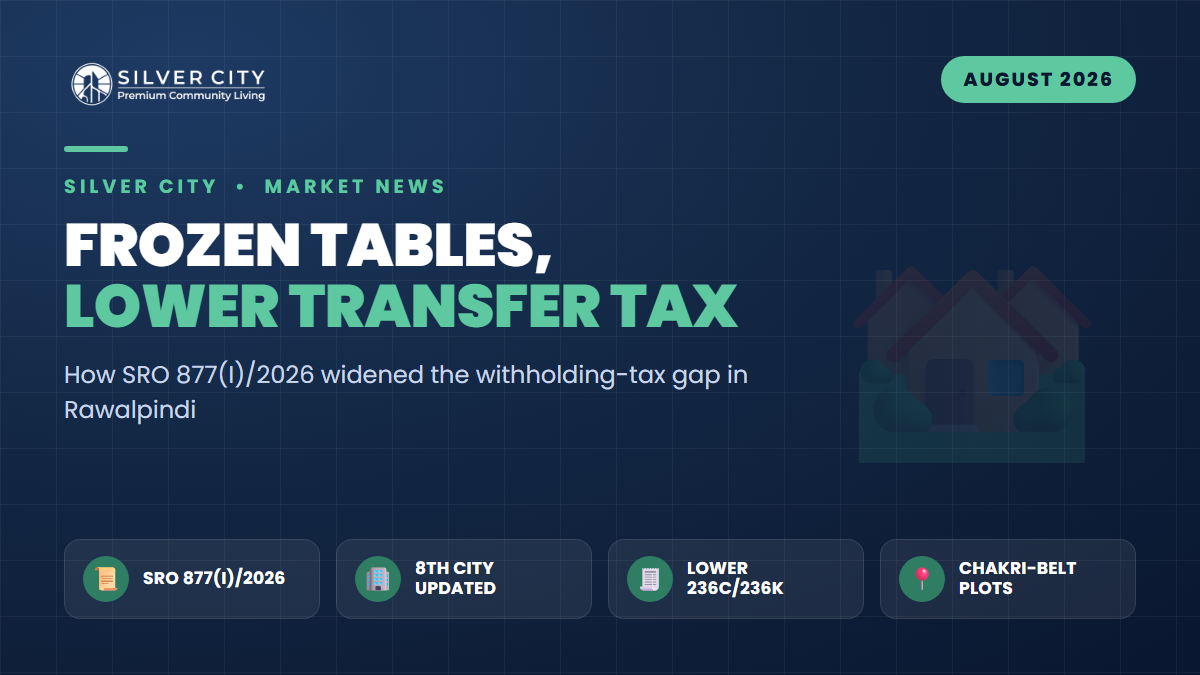
On 19 May 2026, the Federal Board of Revenue (FBR) notified S.R.O. 877(I)/2026, revising the official valuation of immovable property in the Defence Housing Authority (DHA) areas of Rawalpindi. With this notification, Rawalpindi became the eighth city brought under FBR’s updated valuation framework in the current round of revisions, following earlier exercises in Islamabad, Lahore and other major centres.
For property investors, the headline isn’t just that DHA numbers went up. It’s what happened to everything the FBR didn’t touch. Approved societies along the Chakri belt — the corridor near the M-2 motorway’s Chakri interchange, Thalian and Girja Road where Silver City sits — remain on their older, frozen valuation tables. Because withholding tax is charged as a percentage of the FBR’s notified value, a plot on a frozen table is now measurably cheaper to buy and transfer than a comparable DHA plot. This article explains exactly why.
How FBR valuation drives your transfer tax
When property changes hands in Pakistan, several federal and provincial charges are calculated not on the actual market price you negotiate, but on the FBR’s notified valuation for that locality (or the declared value, whichever is higher). The two big federal charges are:
- Section 236K — advance tax collected from the buyer/purchaser at the time of purchase or transfer.
- Section 236C — advance tax collected from the seller/transferor at the time of sale.
Both are adjustable advance taxes, credited against your annual income tax when you file your return. On top of these, Punjab levies provincial stamp duty and related transfer charges, again benchmarked to notified values. The key point: raise the notified value, and every one of these rupee amounts rises with it.
Under the rate structure in force for tax year 2025–26, active taxpayers (filers) pay meaningfully less than late-filers and non-filers. Indicative filer slabs are shown below.
| Notified value slab | 236K (buyer, filer) | 236C (seller, filer) |
|---|---|---|
| Up to Rs 50 million | 3% | 3% |
| Rs 50m – Rs 100m | 3.5% | 3.5% |
| Above Rs 100 million | 4% | 4% |
Late-filers pay roughly double these rates, and non-filers considerably more — so being on the Active Taxpayers List before you transact remains the single biggest lever on your bill.
Why the gap widened after SRO 877(I)/2026
SRO 877(I)/2026 pushed DHA Rawalpindi’s notified values upward. That means the same 236K and 236C percentages now apply to a higher base, so the rupee tax on a DHA transfer has gone up even though the tax rate itself hasn’t changed. Meanwhile, approved societies on the Chakri belt still use their earlier (2024-era) tables, so their tax base is unchanged. The percentage is the same; the number it’s multiplied by is much smaller.
The illustration below uses simplified, filer-only figures to show the mechanics. Actual notified values vary by exact block and plot, and provincial stamp/registration charges are additional — treat these as directional, not a quote.
| Item | DHA Rawalpindi plot (revised base) | Chakri-belt approved plot (frozen base) |
|---|---|---|
| Illustrative notified value | Rs 40,000,000 | Rs 6,000,000 |
| Buyer 236K @ 3% (filer) | Rs 1,200,000 | Rs 180,000 |
| Seller 236C @ 3% (filer) | Rs 1,200,000 | Rs 180,000 |
| Combined federal advance tax | Rs 2,400,000 | Rs 360,000 |
The rate is identical in both columns — the difference is entirely the valuation base. That is the “widening withholding-tax gap”: as revised cities climb and frozen tables stay put, the cost to enter or move a Chakri-belt plot looks increasingly attractive on a pure transaction-cost basis.
Where Silver City fits
Silver City is an RDA-approved housing society on Girja Road near the Thalian interchange, close to the New Islamabad International Airport and linked to both cities via the motorway and the emerging Ring Road network. It sits squarely in the Chakri belt whose notified valuations were not revised by SRO 877(I)/2026.
Beyond the tax angle, its entry ticket is a different order of magnitude from DHA. Publicly advertised plans include smaller categories on four-year installment schedules:
| Plot size | Indicative structure |
|---|---|
| 3.5 Marla | From roughly Rs 1.9 million total, small booking + monthly installments |
| 5 Marla | Entry pricing from the low-20-lakh range |
| 10 Marla & 1 Kanal | Available on similar ~4-year (42-installment) plans |
Always confirm the current payment plan, block availability and the exact FBR-notified rate for the specific block directly with the society or a verified dealer before booking — launch pricing and category availability change frequently.
Practical takeaways for investors
- File your return first. Filer status can halve your 236K/236C outlay versus a late-filer, and non-filers face both higher rates and purchase restrictions on higher-value property.
- Ask for the block-specific notified value in writing before you sign — that number, not the asking price, drives your tax.
- Act while tables are frozen. Frozen valuations aren’t permanent; FBR is working through cities sequentially, and today’s gap is a timing advantage, not a fixture.
- Keep proof of payment. 236K and 236C are adjustable — claim them at filing so they aren’t a dead cost.
Frequently Asked Questions
Does SRO 877(I)/2026 change taxes on Silver City plots?
No. The notification revised valuations for DHA areas of Rawalpindi. Approved societies on the Chakri belt, including Silver City’s locality, continue on their earlier notified tables, so their withholding-tax base is unchanged for now.
Is a lower FBR valuation actually good for a buyer?
For transaction costs, yes — 236K, 236C and provincial charges are all calculated on the notified value, so a lower base means a smaller upfront tax bill. It does not change the market price you negotiate with the seller.
Will the frozen tables stay frozen?
Unlikely indefinitely. FBR has updated eight cities in this round and continues to revise areas over time. The current cost advantage is best understood as a timing window rather than a permanent feature.
What’s the fastest way to cut my own transfer tax?
Get on the Active Taxpayers List before you transact. Filer rates are substantially lower than late-filer and non-filer rates, and the saving typically dwarfs the cost and effort of filing a return.
The bottom line
SRO 877(I)/2026 didn’t raise tax rates — it raised the DHA base those rates apply to, widening the rupee gap between revised DHA areas and the still-frozen Chakri belt. For investors weighing where to put money to work near the airport and Ring Road corridor, that makes an RDA-approved option like Silver City worth a serious look right now: a lower entry cost, a lower notified-value base, and a genuine window to transfer before the tables catch up. As always, verify the current payment plan, RDA status and block-level valuation before you commit.