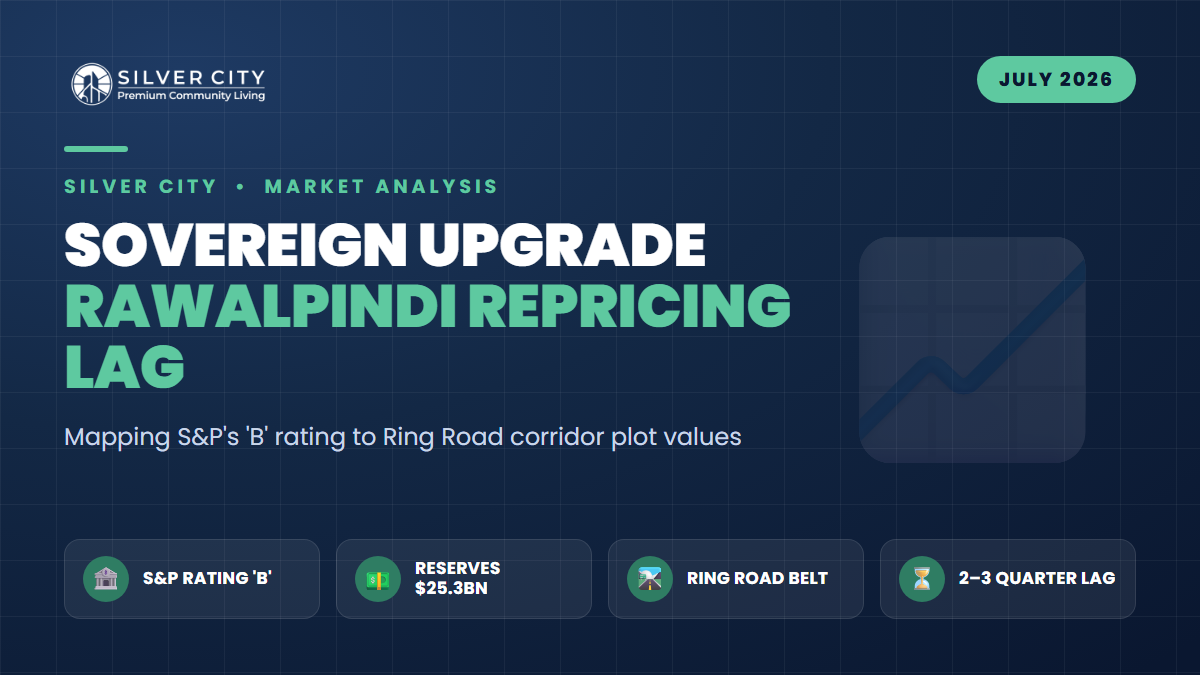
On 22 July 2026, S&P Global Ratings raised Pakistan’s long-term foreign and local currency sovereign credit rating to ‘B’ from ‘B-‘, with a stable outlook. The agency also lifted the transfer and convertibility assessment to ‘B’ and left the short-term rating at ‘B’. It is the first time Pakistan has held a ‘B’ from S&P since 2019, a genuine macro re-rating rather than an outlook tweak.
The natural question for anyone holding a file in Rawalpindi is simple: does my plot go up, and when? The honest answer is that sovereign upgrades do not move dealer rates on announcement day. They move the plumbing first (external financing costs, reserves, the rupee, and eventually the policy rate) and plot rates reprice at the end of that chain, typically two to three quarters later, and only in corridors where the marginal buyer is actually exposed to those variables.
What S&P Actually Said: and What It Didn’t
The upgrade rests on three verifiable pillars:
- Reserves rebuilt. S&P cited reserves of $25.3 billion as of end-June 2026, a figure that includes the central bank’s gold holdings, against a multi-year low of $6.7 billion in December 2022. Note that the weekly SBP-held liquid reserve number you see in the press (around $17-18.5bn through July 2026) is a narrower measure. Do not confuse the two.
- Fiscal consolidation. S&P projects a general government deficit near 4% of GDP for FY27, versus close to 8% in the crisis years of FY22-FY23.
- Programme discipline. The $7 billion IMF Extended Fund Facility approved in September 2024, with most targets met so far.
Equally important is what did not happen. Fitch affirmed Pakistan at ‘B-‘ with a stable outlook on 13 April 2026 (an affirmation, not an upgrade) and Moody’s still has Pakistan at Caa1 (stable) following its August 2025 action. Pakistan is not uniformly re-rated; S&P is currently the most generous of the three. A single-agency upgrade compresses spreads less than a synchronised one, which is precisely why the transmission lag exists.
The Sovereign Rating Timeline
| Date | Agency | Action | Rating |
|---|---|---|---|
| Dec 2022 | : | Reserves trough | $6.7bn |
| Aug 2024 | Moody’s | Upgrade | Caa3 → Caa2 |
| Sep 2024 | IMF | EFF approved | $7bn |
| Apr 2025 | Fitch | Upgrade | CCC+ → B- |
| 24 Jul 2025 | S&P | Upgrade | CCC+ → B- |
| Aug 2025 | Moody’s | Upgrade | Caa2 → Caa1 |
| Apr 2026 | Govt | Market return | $750m Eurobond + CNY 1.75bn panda bond |
| 13 Apr 2026 | Fitch | Affirmed | B- stable |
| 22 Jul 2026 | S&P | Upgrade | B- → B (stable) |
| 27 Jul 2026 | SBP | Policy rate held | 11.5% |
Look at the July 2025 precedent. S&P moved Pakistan to ‘B-‘ on 24 July 2025. Rawalpindi dealer rates did not jump in August or September 2025. What followed instead was a slow build through Q4 2025 and H1 2026, reserve accumulation, remittance records, and finally the April 2026 return to international capital markets after a four-year absence. That is the lag in practice: roughly two to three quarters from headline to visible transaction-level pricing.
Why the Lag Exists: The Transmission Chain
- Weeks 0-6: Spread compression on Pakistan’s dollar bonds and improved sentiment among overseas Pakistanis. No local price effect.
- Months 2-4: Cheaper external financing and stronger portfolio/remittance inflows support the rupee and reserves. Overseas buyers begin converting intent into bookings: Roshan Digital Account gross inflows had already reached $13.365 billion by end-June 2026, with roughly $8.4bn utilised inside Pakistan rather than repatriated.
- Months 4-7: Monetary easing becomes possible. The State Bank held the policy rate at 11.5% on 27 July 2026, a second consecutive hold, with June CPI at 11.1%. The next MPC is 14 September 2026. Rate cuts are the single biggest domestic trigger for plot demand, because they push savings out of T-bills and bank deposits and into land.
- Months 6-9: Developers relaunch, dealers widen quoted rates, and registry/transfer volumes rise. Only now does the “upgrade” show up in the price a buyer actually pays.
Which Rawalpindi Corridors Absorb Foreign Inflows First
Foreign-inflow-driven demand is not spread evenly. It concentrates where three conditions hold simultaneously: a low ticket size, high file liquidity, and a hard infrastructure catalyst. In Rawalpindi that points squarely at the western belt: Chakri Road, Girja Road and the Thalian side of the Rawalpindi Ring Road.
The Ring Road itself is a 38.6 km controlled-access corridor linking GT Road (N-5) near Rawat to the M-2 Motorway at Thalian, with interchanges at Baanth, Chak Beli Khan, Adiala, Chakri and Thalian. Reporting through mid-2026 put the project at roughly 85-90% completion with the main carriageway targeted for opening around mid-June 2026 and revised cost estimates near Rs50-53 billion. Verify the current operational status before you transact, dates on this project have slipped more than once.
Why the western belt moves first:
- Airport-linked demand. The Chakri and Thalian interchanges feed the New Islamabad International Airport corridor, the single most legible location story for an overseas buyer who cannot inspect the site personally.
- Small tickets, fast files. 5-marla and 10-marla files clear quickly, so sentiment converts to price faster than in 1-kanal or commercial segments.
- Interchange proximity is binary. A controlled-access expressway only adds value where there is direct access. Land 15 minutes from an interchange captures far less premium than land adjacent to one.
- Eastern GT Road/Rawat and Adiala Road typically follow one to two quarters later, driven more by local end-user and salaried demand than by dollar inflows.
Your Pre-Repricing Watchlist
| Indicator | Source & cadence | What confirms the thesis |
|---|---|---|
| SBP liquid reserves | SBP, weekly (Thursday) | Sustained build without heavy borrowing |
| Monthly remittances | SBP, ~10th of month | FY26 tracked toward ~$42bn vs $38.3bn in FY25 |
| Roshan Digital Account inflows | SBP, monthly | Rising share utilised locally, not repatriated |
| Policy rate | MPC, 14 Sep 2026 | First cut = strongest single buy signal |
| Eurobond yields | Market, daily | Spreads holding tighter post-upgrade |
| Fitch / Moody’s follow-through | Agency reviews | A second agency upgrade shortens the lag |
| Transfer volumes at Rawalpindi registries | Local, monthly | Volume rises before price: the earliest real signal |
| DC valuation rates | Punjab notifications | Rawalpindi rates were raised 10-20% across 1,056 mouzas |
Two practical cautions. First, watch volume before price: dealers quote aspirational rates long before deals close at them, so ask what actually transferred last month, not what is being asked. Second, transaction taxes matter more than a 2% rate move, proposals under Budget 2026-27 would cut buyer withholding under Section 236K from 1.5% to 0.25% and seller tax under 236C from 4.5% to 1.5% for active filers. Confirm the final enacted rates in the Finance Act before modelling your net return, and be on the ATL.
Frequently Asked Questions
Does a sovereign upgrade guarantee Rawalpindi plot prices will rise?
No. It improves the macro backdrop and lowers external financing costs, which historically supports land demand with a two-to-three quarter lag. But local supply, RDA approval status, infrastructure delivery and the policy rate all sit between the upgrade and your plot. An upgrade removes a headwind; it does not create a tailwind by itself.
Should I buy now or wait for the repricing?
The window between a sovereign upgrade and visible dealer repricing is exactly when accumulation happens, because sellers have not yet reset expectations. If you buy, prioritise approved projects with delivered infrastructure near a functioning interchange over speculative files in unapproved schemes, the latter fall hardest when sentiment turns.
How do I verify a society’s RDA approval before buying?
Check the Rawalpindi Development Authority’s own published lists of approved and unapproved schemes and confirm the layout plan approval number, then cross-check the specific block or phase, approval is often granted for part of a scheme, not all of it. Note that “RDA” in property discussions means the Rawalpindi Development Authority, while “RDA” in banking coverage means the Roshan Digital Account; the two are unrelated.
Which is the earliest reliable signal that repricing has started?
Rising transfer and registration volumes at the local registry, combined with narrowing gaps between asking and closing prices. Both move weeks ahead of any change in quoted dealer rates.
The Bottom Line
S&P’s ‘B’ is a real, verifiable improvement in Pakistan’s macro standing, the first since 2019, backed by $25.3bn in reserves and a fiscal deficit heading toward 4% of GDP. It is not a same-day price event for Rawalpindi land. Map the chain: spreads, then reserves, then the September MPC, then transfer volumes, then dealer rates. Investors who track those markers instead of headlines will be positioned before the repricing, not after it.
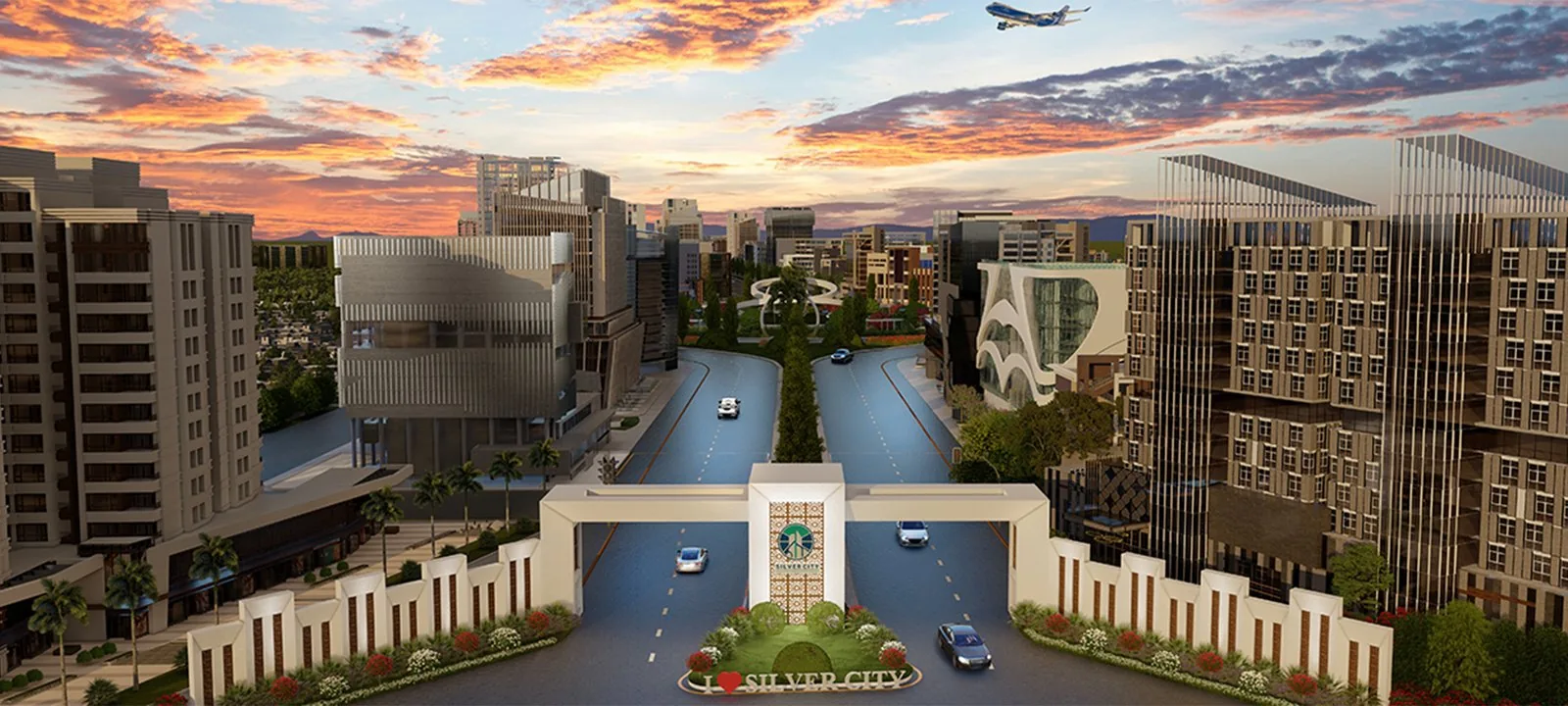
For those looking at the western Ring Road belt specifically, Silver City, an RDA-approved scheme on Girja Road near the Thalian interchange, offering 5-marla, 10-marla and 1-kanal residential plots alongside commercial options with instalment plans, is one of the approved options in this corridor worth adding to your shortlist. As always, verify current approval status, block-level details and pricing directly before committing.