
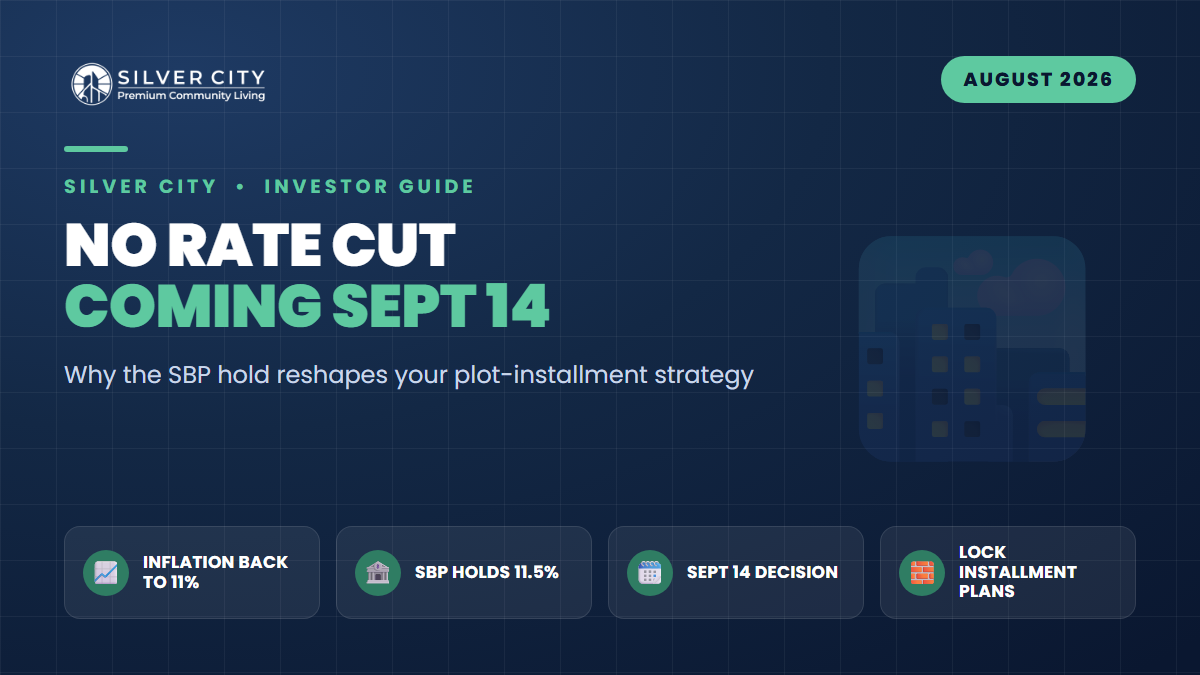
For most of the past year, Pakistani property investors had two comforting numbers to point to: single-digit inflation and a State Bank of Pakistan (SBP) policy rate that had been falling steadily from its 22% peak. Both of those comforts are now under pressure. Headline inflation is projected to have jumped back into double digits (around 11% year-on-year in August 2026) driven almost entirely by food and fuel. And with the next Monetary Policy Committee (MPC) meeting scheduled for 14 September 2026, the market consensus is that the SBP will hold the policy rate at 11.5% rather than deliver the cut many plot buyers were hoping for.
If you are budgeting an installment file in Rawalpindi or Islamabad, this matters. Below, we break down why the pause is happening, what it does not mean, and how a “higher-for-longer” rate environment should reshape the way you time your down payments and monthly installments.
The single-digit streak is over: and it’s food and fuel doing the damage
After dipping into single digits earlier in the fiscal year, the Consumer Price Index (CPI) has rebounded. Brokerage estimates put August 2026 inflation in the 10.75%-11.4% range, up sharply from July. The drivers are the same ones that squeeze every Pakistani household:
- Food: Perishables led the surge, onions, eggs, wheat and pulses all posted double-digit monthly jumps, pushing food inflation well into the teens.
- Fuel and transport: Successive increases in motor spirit (petrol) and high-speed diesel prices fed straight into the transport index, which analysts pegged near 19-20% year-on-year.
- Base effect: A large part of last year’s low readings came from a favourable comparison with 2024’s very high prices. That statistical cushion has now unwound, so the same rupee prices show up as a bigger percentage rise.
Why no rate cut is coming on 14 September
The SBP has already held at 11.5% twice, in its June and July 2026 reviews. Expect a third straight hold, for four connected reasons:
- The real rate cushion is the whole point. The SBP wants the policy rate to sit meaningfully above expected inflation (a “positive real rate”) to keep the rupee stable and savings attractive. With inflation back near 11%, a rate cut would shrink that cushion at exactly the wrong moment.
- The IMF programme demands discipline. Pakistan remains inside an IMF arrangement that prioritises reserve-building and a tight monetary stance. Cutting into a food-and-fuel inflation spike would look premature to the Fund.
- The target is 5-7%, and we’re not there. The SBP’s medium-term inflation target is 5-7%, which it expects to reach gradually by mid-2027. At 11%, the job isn’t done.
- External and fiscal risks. A stable-to-firm current account, oil-price uncertainty and the rupee all argue for patience over a growth-friendly cut.
Recent SBP policy-rate timeline
| MPC Meeting | Decision | Policy Rate |
|---|---|---|
| Oct 2025 | Hold | 11.0% |
| Early 2026 reviews | Adjusted | 10.5% → 11.5% |
| 15 Jun 2026 | Hold | 11.5% |
| 27 Jul 2026 | Hold (2nd consecutive) | 11.5% |
| 14 Sep 2026 | Expected hold (3rd) | 11.5% |
What a pause actually does to plot investors
Here is the crucial point many buyers miss: a plot-installment plan is a fixed-rupee contract, not a floating-rate loan. When you book a file, your monthly instalment and total price are set in rupees. They do not automatically rise or fall when the SBP moves the policy rate. So the rate decision affects you indirectly, through three channels.
| Channel | Effect of a 11.5% hold | What it means for you |
|---|---|---|
| Bank financing / mortgages | Stays expensive | Leveraged buying remains costly; cash and structured instalments look smarter |
| Developer pricing | Little pressure to cut | Don’t expect fire-sale discounts; but new-launch pricing stays disciplined too |
| Competing assets (savings, T-bills) | Still yielding ~11%+ | Cash isn’t idle: plots must beat a real return, so buy on genuine value |
The takeaway: a hold is neither a green light to over-leverage nor a reason to sit out. It is a signal to favour self-financed, instalment-based entry over bank-financed purchases, because the interest you would pay a bank stays punishingly high while a developer’s instalment plan carries no such markup.
How the pause reshapes your installment timing
With rates flat and inflation elevated, the smart moves are about sequencing, not speculation:
- Lock rupee prices now, pay over time. Inflation near 11% erodes the real value of your future instalments. A three-to-four-year plan booked at today’s price means you repay in progressively “cheaper” rupees, inflation quietly works for the instalment buyer.
- Front-load the down payment if you hold idle cash. Because savings yields are attractive, keep enough in a high-yield deposit to cover instalments, but deploy lump sums into booking discounts and lower per-marla rates that developers offer for larger down payments.
- Prefer possession-linked and balloted plots. In a no-cut environment, capital-gain timelines lengthen. Plots closer to development milestones or possession protect you from carrying a non-yielding file for years.
- Avoid stretching into bank finance. At an 11.5% policy rate, a home/plot loan can price well into the mid-to-high teens. An instalment plan from a credible society is almost always the cheaper leverage.
Indicative installment timing framework
| Investor profile | Best entry now | Rate-hold rationale |
|---|---|---|
| Cash-rich, long horizon | Larger down payment, short 2-3 yr plan | Capture booking discounts; inflation erodes remaining instalments |
| Salaried, steady income | Low down payment, 4-5 yr plan | Fixed rupee instalments beat costly bank finance |
| Short-term flipper | Balloted/possession plots only | No-cut cycle lengthens gain timelines; liquidity matters |
Frequently Asked Questions
Will the SBP definitely hold the rate on 14 September 2026?
No decision is guaranteed until announced, but the consensus strongly favours a hold at 11.5%. With inflation rebounding to around 11% on food and fuel, and the SBP targeting a 5-7% range only by mid-2027, a cut would be premature and out of step with the IMF programme.
Does a higher policy rate make my existing plot installments more expensive?
No. A developer instalment plan fixes your price and monthly amount in rupees when you book. It is not linked to the policy rate, so a hold or a hike does not raise your existing instalments. It only affects new bank financing and the wider pricing environment.
Is it better to wait for a rate cut before buying a plot?
Waiting carries its own cost. Elevated inflation means rupee land prices tend to drift upward, and a cut may not arrive until 2027. Booking a fixed-price instalment plan now lets inflation erode the real value of your future payments, often a better outcome than waiting for cheaper credit that mainly benefits leveraged buyers.
Should I use a bank loan or a society installment plan in this environment?
In a high-rate cycle, a society instalment plan is almost always cheaper. Bank plot and home financing is benchmarked off the policy rate and can price into the mid-to-high teens, whereas a credible developer’s instalment plan carries no such interest markup.
The bottom line for Rawalpindi-Islamabad buyers
The end of the single-digit inflation streak and a likely third straight rate hold tell the same story: cheap credit isn’t returning soon, but disciplined instalment buying still works, arguably better than before, because inflation quietly discounts your fixed future payments. The winning strategy is to enter on genuine value, favour self-financed instalment plans over costly bank leverage, and prioritise plots with clear development or possession timelines. In that context, an RDA-approved society such as Silver City (silvercity.pk) in Rawalpindi (with legally cleared status and structured instalment options) is worth shortlisting as you lock in today’s rupee prices ahead of the September policy decision.