For three years, holding dollars was the safest trade in Pakistan. Every rupee that slid against the greenback made idle foreign currency look smarter. But the arithmetic that rewarded dollar-hoarders is quietly reversing — and the two macro signals driving that reversal both landed in early October 2026. If you are an overseas Pakistani or a local investor sitting on dollar balances, this is the moment to re-examine whether those dollars are still working for you.
The Two Signals That Changed the Math
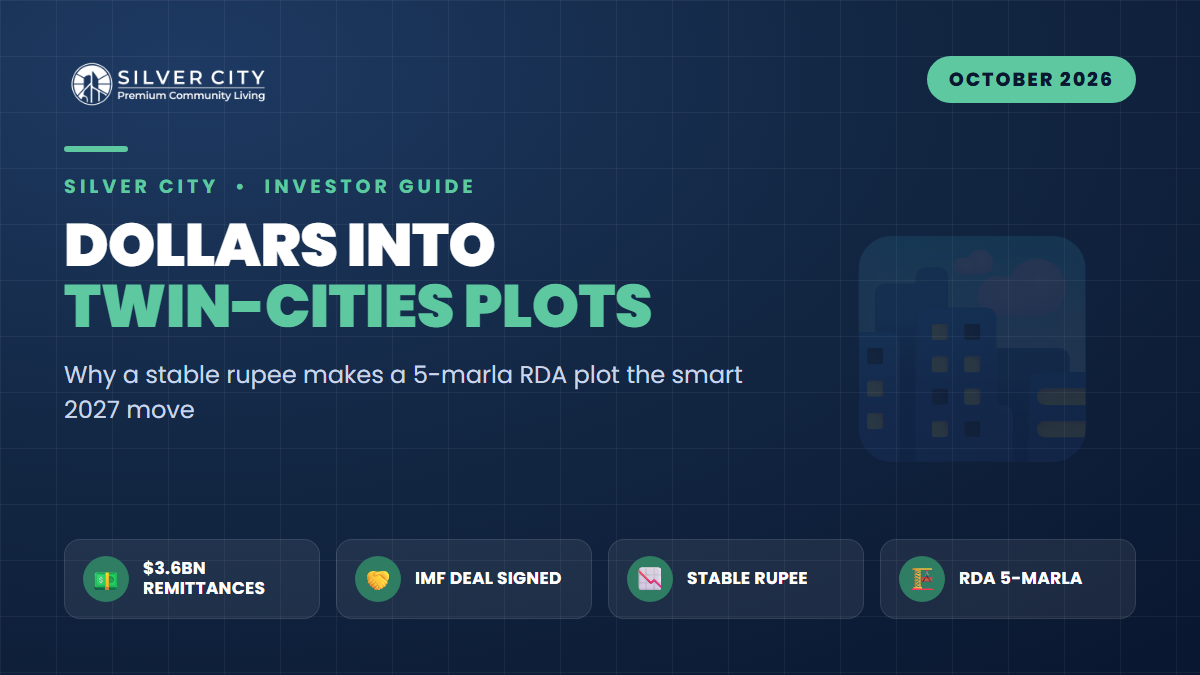
First, remittances. The State Bank of Pakistan reported that workers’ remittances reached roughly $3.59 billion in September 2026 — up about 12.7% from $3.18 billion a year earlier. More importantly, the full first quarter of FY27 (July–September 2026) brought in $10.88 billion, around 14% higher than the $9.54 billion recorded in the same quarter of FY26. All three months cleared the $3.5 billion mark ($3.63bn in July, $3.66bn in August, $3.59bn in September), lifting the monthly average to roughly $3,625 million — comfortably above the FY26 full-year average of $3,465 million.
Second, the IMF. On 7 October 2026, following talks that ran from 23 September, Pakistan and the Fund reached a staff-level agreement on the fourth review of the Extended Fund Facility (EFF) and the third review of the Resilience and Sustainability Facility (RSF). Subject to IMF Executive Board approval, this unlocks about $1.2 billion (roughly $1 billion under the EFF and $210 million under the RSF), taking total disbursements under the two arrangements to about $5.7 billion.
Together, strong remittance inflows and a continuing IMF programme are the two pillars of a well-supplied foreign exchange market. That is exactly why the rupee has held firm: the interbank rate has hovered around Rs 276–277 per US dollar through mid-October 2026, actually stronger than the six-month average near Rs 278. Stability, not depreciation, is now the base case into 2027.
What a Stable Rupee Does to the Dollar Trade
The appeal of holding dollars was never the dollar itself — it was the expectation that the rupee would keep falling, so your dollars would buy more rupees later. Remove that expectation and idle dollars become what they always were: a low-yield balance that earns little while a stable rupee quietly erodes the upside.
Meanwhile, hard assets priced in rupees — particularly well-located residential plots — carry on compounding. When the currency is volatile, property and dollars compete. When the currency steadies, property wins, because real estate also captures development gains, rental potential and genuine scarcity. A 5-marla plot in an approved twin-cities (Rawalpindi–Islamabad) society is the cleanest way for a mid-sized investor to make that rotation.
Why 5-Marla, and Why the Twin Cities
The 5-marla (≈125 sq yd) plot is the workhorse of Pakistani real estate for good reason: it is the most liquid residential size, the easiest to resell, and the sweet spot for both end-users and investors. In the Rawalpindi belt, an RDA-approved 5-marla plot typically trades between roughly Rs 2.0 million and Rs 3.5 million depending on society and block, with entry-level societies along the Girja Road corridor quoting around 20–27 lakh, often on 3–4 year installment plans.
The word that matters most there is RDA-approved. The Rawalpindi Development Authority has intensified its crackdown on unapproved schemes, publishing lists of illegal societies and warning buyers away from them. That regulatory pressure is a structural tailwind for compliant societies: as capital concentrates in projects that already hold approvals, their prices find firmer support while unapproved plots stagnate or get stuck in litigation.
Illustrative Rotation: Dollars to a 5-Marla Plot
| Step | Detail | Approximate Figure (Oct 2026) |
|---|---|---|
| Idle balance | Dollars held in account | $11,000 |
| Convert at interbank | ~Rs 276.5 / USD | ≈ Rs 3.04 million |
| Target asset | RDA-approved 5-marla plot | Rs 2.0m – 3.5m |
| Entry route | Lump sum, or ~25–30% down + 3–4 yr plan | Rs 5–9 lakh down |
| Legal check | Verify NOC & approval status with RDA | Before payment |
These are indicative figures for illustration, not an offer; confirm live rates and current plot prices before committing.
Timeline: How the Case Builds Into 2027
| Period | Signal | Implication for Investors |
|---|---|---|
| Sept 2026 | Remittances ~$3.6bn; Q1 FY27 ~$10.88bn (+14% YoY) | Strong, steady FX supply |
| 7 Oct 2026 | IMF staff-level agreement (~$1.2bn) | Reform anchor, external buffer |
| Oct 2026 | Rupee ~Rs 276–277/USD | Depreciation bet weakens |
| Into 2027 | IMF Board approval + continued inflows | Base case: currency stability |
Risks to Weigh Before You Rotate
No thesis is one-directional. The IMF agreement is still subject to Executive Board approval, and programme conditions (fiscal targets, energy-sector reform) must hold. Remittances can soften — September itself was down 1.9% month-on-month from August. Global oil prices, regional tensions and import pressure can all move the current account. Treat currency stability as the probable path, not a guarantee, and never over-leverage into installment commitments you cannot service if your income currency weakens.
Within real estate, the single biggest controllable risk is choosing an unapproved scheme. That is entirely avoidable with basic due diligence.
Frequently Asked Questions
Is now really a good time to convert dollars to rupees for property?
The case is stronger than it has been in years. With remittances running near $3.6bn a month and the October IMF agreement reinforcing the external position, the rupee’s base case is stability around Rs 276–277/USD rather than steep depreciation. That removes much of the reason to sit in idle dollars. Still, convert only what you can commit for a multi-year horizon, and keep an emergency buffer.
Why a 5-marla plot instead of a larger plot or an apartment?
5-marla is the most liquid and widely demanded residential size in the twin cities, making it easier to resell and finance. It needs less capital than a 10-marla or 1-kanal plot, and plots generally carry lower maintenance and holding costs than apartments while capturing land appreciation. For a first rotation out of dollars, it is the lowest-friction entry.
How do I confirm a society is genuinely RDA-approved?
Ask for the project’s No Objection Certificate and layout approval, then verify directly with the Rawalpindi Development Authority rather than relying on the seller’s word. RDA periodically publishes lists of approved and illegal schemes. Cross-check the specific block you are buying in, since approval can be phased. Engage a property lawyer to review the file before any payment.
What if the IMF Board delays approval?
A staff-level agreement is a strong signal but not final disbursement. A short delay would not, on its own, reverse the remittance-driven FX strength, but a breakdown in the programme could add pressure. This is why the smart approach is a real asset you intend to hold for years — a well-chosen plot rides through short-term policy noise far better than a leveraged currency bet.
The Bottom Line
The two numbers that matter — $3.6 billion in September remittances and a $1.2 billion IMF agreement — point the same direction: a rupee that is more likely to hold than to tumble into 2027. That quietly dismantles the old logic of hoarding dollars and strengthens the case for rotating into a tangible, appreciating rupee asset. An RDA-approved 5-marla plot in the twin cities is the most accessible way to make that move. Among the compliant options worth putting on your shortlist is Silver City, an RDA-approved housing society on the Rawalpindi side of the twin cities — exactly the kind of approved, liquid, 5-marla-friendly project that benefits most as capital leaves idle dollars and concentrates in legally secure land. Do your own due diligence, verify approvals, and let a steadier rupee work for you rather than against you.