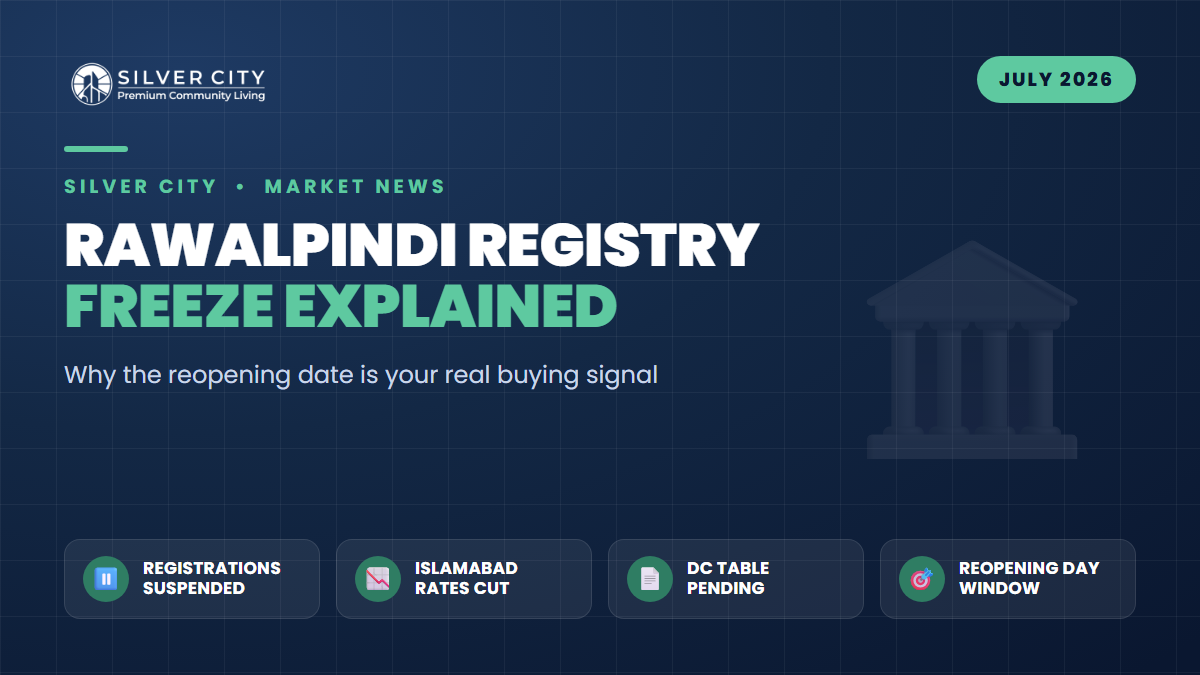
Rawalpindi’s property registration machinery has been at a near-complete standstill since the start of FY2026-27 on 1 July 2026. The reason is not a court order, a ban, or a policy crackdown. It is a missing document. The district administration has not yet notified the revised Deputy Commissioner (DC) valuation table for 2026-27, and the Federal Board of Revenue has not issued its updated valuation tables for Rawalpindi either. Without both, sub-registrars cannot compute stamp duty, stamp vendors cannot issue stamp papers, and Green Property Certificates cannot be generated.
As reported by The Express Tribune on 13 and 20 July 2026, the freeze had already run close to three weeks. In a normal week, Rawalpindi district records roughly 350-400 property registrations and 150-250 powers of attorney every working day. Since 1 July, that pipeline has been effectively zero. Industry and revenue officials have put the daily loss to the exchequer at around Rs 500 million.
Why the Table Is Late
The valuation schedule is meant to be finalised by 30 June and notified on 1 or 2 July each year. According to Hasan Shah, Vice President of the Property Dealers Association, that cycle simply did not hold this year. The revised list was reportedly finalised but sent back for review following the appointment of a new Deputy Commissioner. A notification was expected around 15 July; it did not arrive on schedule.
The caution is understandable in context. Over the past three fiscal years, Rawalpindi’s DC valuations rose anywhere from 20% to 500% depending on the locality, and several of those revisions were challenged in the Lahore High Court. A new DC signing off on a table without re-examining it invites the same fight again. But the cost of caution is being paid by ordinary buyers, sellers, and overseas Pakistanis who flew in specifically to complete transfers.
The Islamabad Contrast: SRO 644(I)/2026
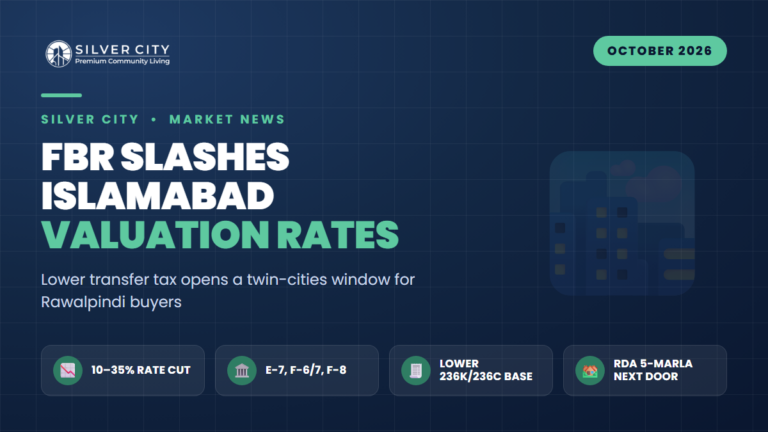
The frustration is sharper because the federal capital moved in the opposite direction (downward) months ago. Through SRO 644(I)/2026, issued in April 2026, the FBR cut fair market values for immovable property in Islamabad by roughly 10% to 30% (some categories reported closer to 35%).
| Category (Islamabad) | Previous FBR Value | Revised under SRO 644(I)/2026 | Approx. Cut |
|---|---|---|---|
| Superstructure, building up to 5 years old | Rs 3,000 / sq ft | Rs 2,500 / sq ft | ~17% |
| Superstructure, building over 5 years old | Rs 1,500 / sq ft | Rs 1,200 / sq ft | 20% |
| Occupied residential plots, B-17 & C-14 | Rs 30,000 / sq yd | Rs 21,000 / sq yd | 30% |
| Unoccupied plots, B-17 | Rs 15,000 / sq yd | Rs 10,500 / sq yd | 30% |
Rural Islamabad was left on the DC rates fixed on 1 July 2025, with the higher of the two values applying in case of dispute. Because withholding tax under sections 236K and 236C is calculated on FBR value, a 30% cut in the notified value translates directly into a 30% cut in the cash a buyer or seller hands over at transfer. That is the benchmark Rawalpindi is currently being measured against, and why sentiment in Pindi is impatient rather than merely inconvenienced.
What Transaction Taxes Look Like Right Now
The freeze is happening in a year when the tax structure itself has become materially friendlier. Under the Finance Act 2026, transfer taxes were cut roughly in half:
| Levy | Filer / ATL | Non-filer |
|---|---|---|
| Section 236K (buyer, advance tax) | 1.25% | 2.5% |
| Section 236C (seller, advance tax: now a flat rate) | 2.75% | 5.5% |
| Stamp duty (Islamabad Capital Territory) | Reduced from 4% to 1% | |
Section 7E, the deemed-income tax on immovable property, was also repealed in this budget round, and federal excise duty on property transfers is no longer in the picture. Overseas Pakistanis holding a valid POC or NICOP continue to qualify for filer-equivalent rates under 236C and 236K even without a Pakistani filing history, a concession that dates to the Finance Act 2023 and remains in force.
Punjab’s own stamp duty and registration fee structure is separate from ICT’s, and is applied to the DC value. Which is precisely the number nobody in Rawalpindi has right now. Confirm the applicable Punjab rate with your registrar or lawyer at the time of execution.
Why the Reopening Date Is the Real Signal
Here is the part most buyers are missing. A freeze does not destroy demand; it stores it. Three weeks of suspended activity in a district that normally clears 350-400 registrations a day means somewhere in the range of 5,000-8,000 transactions are queued behind a single notification.
The moment the table is notified, three things happen almost simultaneously:
- A backlog surge. Registrars, stamp vendors, and Green Property Certificate desks get hit at once. Expect queues, token systems, and slower turnaround for the first two to four weeks.
- Price re-anchoring. Whatever the new DC values are (flat, up 10-20%, or partially revised downward in line with the federal direction) the entire market instantly reprices its cost of transfer. Deals negotiated on old assumptions get renegotiated.
- A short arbitrage window. Sellers who have been sitting on deals for a month are motivated. Buyers who did their paperwork during the freeze can execute in days; buyers who start from scratch will be behind several thousand files.
That third point is the whole argument. The reopening date is not a date to start looking. It is a date to close on work you did while everyone else was waiting.
A Practical Checklist for the Freeze Period
- Do not pay full consideration on an unregistered promise. Structure a token or earnest-money agreement with an explicit clause tying the balance payment and transfer to notification of the FY2026-27 valuation table.
- Put a cost-sharing clause in writing. The new DC values are unknown. Agree now, in the sale agreement, who absorbs any increase in stamp duty and registration fee if the table lands higher than expected, and add a walk-away threshold.
- Complete due diligence. Verify the approval status of the society with RDA, confirm the seller’s title chain and NOC, run a Fard Malkiat, and check for encumbrances. None of this requires a valuation table.
- Get on the ATL. The gap between filer and non-filer is 2× on both 236K and 236C. If you are not on the Active Taxpayers List, fix that before the market reopens. It is the single largest controllable cost in the transaction.
- Overseas buyers: get the POC/NICOP paperwork in order. Filer-equivalent treatment is only useful if the documentation is ready at the counter.
- Arrange funds in advance. Banker’s cheques, pay orders, and remittance clearances take days. On reopening day, liquidity is the difference between closing and queuing.
- Track the notification directly. Watch the Punjab Board of Revenue and e-Stamp Punjab portals rather than relying on dealer WhatsApp forwards, which routinely circulate draft tables as final.
Frequently Asked Questions
Can I register a property in Rawalpindi right now?
No. Sub-registrars across Rawalpindi district cannot process sale deeds without the notified FY2026-27 DC valuation table, and stamp papers are not being issued. Powers of attorney are affected as well. Agreements to sell remain legally possible, but registration itself has to wait.
Will Rawalpindi’s rates be cut like Islamabad’s under SRO 644(I)/2026?
Not necessarily. SRO 644(I)/2026 applies to FBR valuations in Islamabad Capital Territory only. Rawalpindi’s DC table is issued by the Punjab district administration and is a separate exercise; the FBR’s own Rawalpindi tables are separate again. The federal direction of travel is downward, but no reduction is confirmed for Rawalpindi until the notification is actually issued.
Should I sign a sale agreement during the freeze or wait?
Signing with the right protections is usually stronger than waiting. Lock the price, make the balance payment conditional on notification, include a cost-sharing clause for any duty increase, and complete all verification in the meantime. You get first-mover position on reopening day without carrying open-ended valuation risk.
Does the freeze affect files and open-form plots in housing societies?
Largely no. Society-level file transfers are handled by the developer’s transfer office and do not require a sub-registrar or a DC valuation table. This is why file activity in approved societies has kept moving while registry-based transactions in older, already-transferable stock have stopped.
The Bottom Line
The freeze is an administrative bottleneck, not a market signal. Rawalpindi’s fundamentals (the Ring Road corridor, the new Islamabad International Airport catchment, and continued demand from overseas remitters) are unchanged. What has changed is that a well-prepared buyer now has a few weeks of quiet to do work that is normally rushed.
Use it. Verify approvals, get on the ATL, arrange funds, and negotiate on paper. And if you are weighing where to deploy, RDA-approved options in the Chakri Road and Ring Road corridor (Silver City among them) are worth shortlisting precisely because approval status is one of the few things you can confirm today, while the valuation table is still pending. When the notification lands, the buyers who did their homework during the freeze will be at the front of the queue.