A Tale of Two Valuation Tables Sharing One Boundary
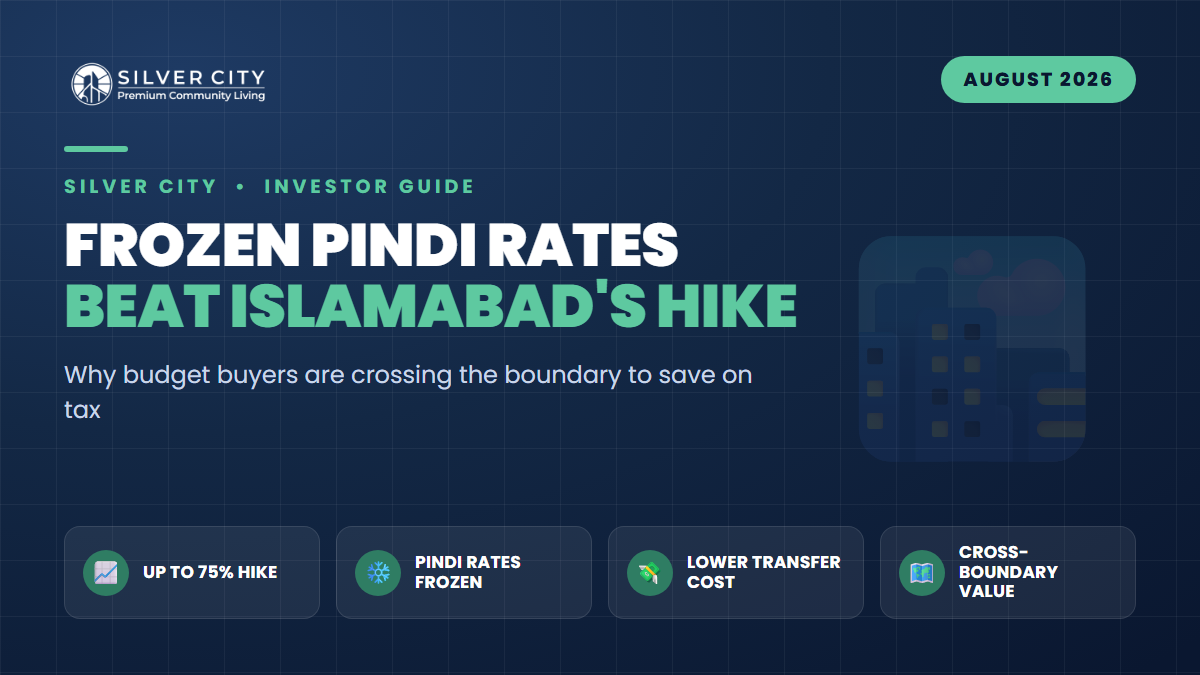
Islamabad and Rawalpindi are functionally one metropolis split by an administrative line, but their tax “cost bases” have just diverged sharply. In December 2025 the Federal Board of Revenue (FBR) notified fresh valuation tables for the Islamabad Capital Territory (ICT), lifting assessed property values by an average of 15% to 75% across most sectors and societies. After stiff objections the rates were suspended and then re-issued under SRO.163(I)/2026, which fixed the fair-market value of residential and commercial superstructure at Rs3,000 per square foot for buildings up to five years old and Rs1,500 per square foot for older structures.
Meanwhile, across the Faizabad line, Rawalpindi’s official valuation rates have effectively stayed frozen. After a month-long registration standstill caused by a delay in notifying revised values, the district administration decided to retain the existing benchmarks for the new fiscal year. The result is a rare, clean arbitrage window: the same rupee buys a lower taxable value in Pindi than it does a few kilometres away in the capital.
Why “Notified Value” Is the Number That Actually Costs You Money
In Pakistan, federal withholding taxes on property transfers are not charged on your declared sale price. They are charged on the FBR-notified valuation (or the district DC rate, whichever governs). The two headline federal levies are:
- Section 236K — advance tax paid by the buyer at transfer.
- Section 236C — advance tax paid by the seller at transfer.
Both are a percentage of the notified value, and the non-filer rate is roughly three times the filer rate. Because the tax is a percentage of an official number, the official number is the lever. Raise the valuation table by 75% and you raise every buyer’s and seller’s cash tax outlay by 75% on the same physical plot — before a single brick moves. Freeze the table, and that cost stays put.
The Arbitrage in Rupees: A Worked Example
Consider a filer buyer purchasing a plot the FBR would value at Rs10,000,000 in an Islamabad society. If the new ICT table pushes that assessed value up 50%, the taxable base becomes Rs15,000,000 — and the withholding, stamp duty and registration fees all scale with it. A comparable plot in a frozen-rate Rawalpindi society keeps its lower base. The illustration below uses a simplified filer transfer-cost bundle (advance tax plus provincial stamp/registration, rounded) to show the direction and rough size of the gap.
| Item | Islamabad plot (post-hike table) | Rawalpindi plot (frozen table) |
|---|---|---|
| Notified/DC value used for tax | Rs15,000,000 | Rs10,000,000 |
| Buyer 236K (filer, ~3%) | ~Rs450,000 | ~Rs300,000 |
| Provincial stamp + registration (~3%) | ~Rs450,000 (ICT) | ~Rs300,000 (Punjab) |
| Approx. buyer-side transfer cost | ~Rs900,000 | ~Rs600,000 |
| Indicative buyer saving | — | ~Rs300,000 |
Figures are illustrative and rounded to show the mechanism; your exact liability depends on the applicable notified value, filer status, holding period and current provincial rates. Always confirm live figures with a lawyer or tax adviser before signing.
The point is structural, not the exact decimal: when one side of the boundary reprices its base upward and the other holds, the cheaper base wins on entry cost — and on the seller’s exit tax later, too.
Who This Actually Favours
- Budget and first-time buyers stretching to afford a plot file. A lower base cuts the upfront cash needed to close.
- Overseas Pakistanis keeping filer status, who already enjoy reduced rates and now compound the saving with a lower valuation table.
- Short-to-medium hold investors who care about the round-trip tax drag on both purchase and sale.
- End-users chasing the airport corridor, where new Ring Road and Thalian access is pulling development toward Pindi’s western edge anyway.
Caveats: Arbitrage Is Not a Free Lunch
Frozen valuation rates are a policy choice, not a permanent law of nature. Three risks deserve a clear head:
- The freeze can end. Punjab could notify revised Rawalpindi values in any coming budget cycle, closing part of the gap overnight. The window is real but not guaranteed to be wide open next year.
- Society approval status matters more than tax. A tax saving is worthless if the file is in an unapproved or litigation-heavy scheme. Verify RDA (or relevant authority) sanction and layout approval first.
- Federal taxes still apply on both sides. 236K/236C, and any applicable Federal Excise Duty on first allotment/transfer, are federal — the boundary changes the base, not whether federal tax exists.
A Practical Checklist Before You Cross the Line
- Get the current notified/DC value for the exact block and plot size in writing before negotiating.
- Confirm your filer status is active on the ATL — it typically halves your withholding.
- Compare total transfer cost (tax + stamp + registration + society transfer fee), not just headline plot price.
- Verify the society’s approval and NOC status directly with the development authority, not only the dealer.
- Model your exit tax under 236C for your expected holding period, so the round-trip math is honest.
Frequently Asked Questions
Did FBR really raise Islamabad valuation rates by 75%?
Yes. The December 2025 ICT notification raised assessed values by roughly 15% to 75% depending on sector, with superstructure later set at Rs3,000 per square foot (up to five years old) under the revised SRO.163(I)/2026. Some areas such as DHA were treated separately. Confirm the rate for your specific location, as tables vary block by block.
Are Rawalpindi’s valuation rates guaranteed to stay frozen?
No guarantee. The district retained existing rates for the current fiscal year after a delay stalled registrations, which is what created today’s gap. Provincial authorities can revise them in a future cycle, so treat the advantage as a present window rather than a permanent feature.
Does a lower valuation reduce every tax on the deal?
It reduces the taxes and fees that are calculated as a percentage of the notified value — advance withholding under 236K/236C, plus stamp duty and registration. It does not remove federal levies entirely; it lowers the base they are applied to. Filer status remains the single biggest controllable variable.
Is buying in Rawalpindi worse for lifestyle or connectivity?
Not necessarily. Western Rawalpindi’s airport-corridor belt near the Thalian Interchange and Ring Road alignment sits minutes from Islamabad International Airport and links back into the capital’s road network, so many buyers get capital-adjacent access at a lower tax base.
The Bottom Line
When one side of a shared metropolis reprices its tax base upward and the other holds it flat, budget-conscious capital tends to migrate toward the cheaper base — and that is exactly what the ICT hike versus Pindi’s frozen rates has set up. If you are shopping this arbitrage, prioritise legally secure, approved schemes so the saving isn’t offset by title risk. Among the RDA-approved options on Rawalpindi’s airport corridor, Silver City on Girja Road near the Thalian Interchange — developed by Laraib Associates & Developers and the SAREMCO Group, with flexible installment plans — is one worth adding to your shortlist as you compare total transfer cost, approval status and long-term connectivity.
@@END@@