For most Pakistani savers, 2026 has been a tug-of-war between a central bank trying to engineer an easing cycle and an energy bill that refuses to cooperate. As of mid-October, the energy side is winning — and that has direct consequences for anyone sitting on idle rupees waiting for “the right time” to deploy.
What Actually Changed in October 2026
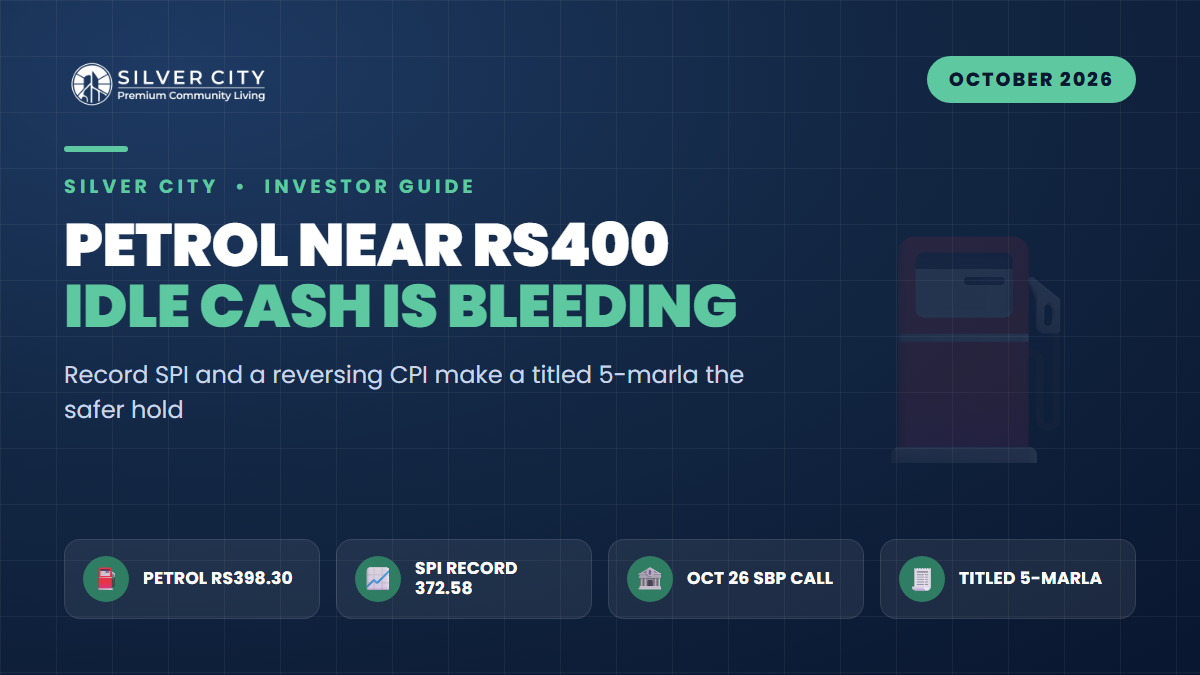
Three numbers tell the story. First, petrol has climbed into the Rs394–400 band: OGRA’s fortnightly revisions took the rate from roughly Rs393.64 on 6 October to Rs396.65 on 8 October, settling around Rs398.30 per litre for the 10–12 October window. Second, the weekly Sensitive Price Indicator (SPI) hit an all-time high of 372.58 for the week ended 8 October 2026 — up 0.57% week-on-week and 11.97% year-on-year — with wheat flour, chicken and fuel doing most of the damage. Third, headline CPI, which had cooled to 10.3% year-on-year in September (down from 11.1% in August), is now facing fresh upward pressure as those same energy and food costs feed through.
In plain terms: the September easing is stalling and starting to reverse, and it is energy-driven. That matters because it changes the calculus for the State Bank of Pakistan (SBP) just as its next decision approaches.
Snapshot: The Numbers Investors Are Watching
| Indicator | Latest reading | Context |
|---|---|---|
| Petrol price | ~Rs398.30/litre (10–12 Oct 2026) | Up from ~Rs393.64 on 6 Oct; near the Rs400 ceiling |
| Weekly SPI | 372.58 (week ended 8 Oct 2026) | Record high; +0.57% WoW, +11.97% YoY |
| Headline CPI | 10.3% YoY (September 2026) | Well above SBP’s 5–7% target; October pressure building |
| SBP policy rate | 11.5% | Held since the 100bps hike on 27 Apr 2026 (holds in Jul & Sep) |
| Next SBP decision | 26 October 2026 | Rate-cut hopes fading on the energy shock |
Why Rate-Cut Hopes Are Fading Before 26 October
The SBP’s Monetary Policy Committee meets on 26 October 2026 with the policy rate at 11.5% — a level unchanged since the surprise 100-basis-point hike on 27 April, followed by holds on 27 July and 14 September. Through the summer, many investors assumed the next move would be a cut, on the logic that inflation was trending back toward target.
That assumption is now shaky. A central bank does not cut into a fresh energy-led inflation spike, because doing so risks un-anchoring expectations. With petrol near Rs400, electricity charges up double digits year-on-year, transport costs surging, and the SPI printing records, the realistic base case has shifted toward another hold rather than the cut savers were hoping for. For anyone parked in cash expecting falling rates to be offset by capital gains elsewhere, the window keeps sliding further out.
The Hidden Cost of Sitting in Cash
Here is the uncomfortable arithmetic. If prices are rising around 10–12% a year and your money is sitting in a current account or at home, your purchasing power is shrinking by roughly that much annually. Even a conventional savings vehicle rarely clears inflation after tax. The longer the easing cycle is delayed, the longer idle rupees quietly lose ground.
Consider a simple illustration of what a sustained ~11% erosion does to Rs2.7 million of idle cash held purely as currency:
| Time held as idle cash | Nominal amount | Approx. real purchasing power (at ~11% inflation) |
|---|---|---|
| Today | Rs2,700,000 | Rs2,700,000 |
| After 1 year | Rs2,700,000 | ~Rs2,432,000 |
| After 2 years | Rs2,700,000 | ~Rs2,192,000 |
| After 3 years | Rs2,700,000 | ~Rs1,975,000 |
This is illustrative, not a forecast — but it shows the direction of travel. Cash is not “safe” in a high-inflation economy; it is a slow, certain leak.
Why a Titled 5-Marla Behaves Differently
Real assets with legal title tend to track or outpace inflation over time, precisely because the same cost pressures pushing up petrol and food — fuel, cement, steel, labour, transport — also push up land development and replacement costs. A titled 5-marla residential plot in an RDA-approved society has several properties that idle cash lacks:
- Inflation linkage: plot values in established, approved schemes have historically risen alongside construction and input costs rather than being eroded by them.
- Legal certainty: a clear title and an approval from the relevant development authority reduce the risk of disputes, demolition notices, or stalled possession that plague unapproved files.
- Affordability at entry: 5-marla is the sweet spot for salaried and overseas buyers — small enough to enter with modest capital, liquid enough to resell.
- Installment access: structured payment plans let you lock in today’s price while spreading the cost, which itself hedges against future rupee depreciation.
None of this makes land risk-free — plots can be illiquid in a slow market, and location and approval status matter enormously. But against a backdrop of record SPI and a fading rate-cut, a titled plot is a store of value, whereas idle cash is a guaranteed slow loss.
How to Act Sensibly, Not Impulsively
- Verify the approval. Confirm the society is RDA-approved and the specific sector/phase is included in that approval — not just “NOC applied for.”
- Insist on clean title. Check that the file is transferable and the plot is balloted/located, not a speculative “open form.”
- Match the plan to your cash flow. A 3–4 year installment plan only hedges inflation if you can comfortably service it; a default forfeits your edge.
- Mind the FBR timeline. Filer status and valuation tables materially change transfer costs — buy as a filer and factor in current FBR valuations.
Frequently Asked Questions
Will the SBP cut rates on 26 October 2026?
The policy rate is 11.5% and has been held since April. With petrol near Rs400, a record SPI and CPI pressure building, the energy shock makes an immediate cut less likely than a hold. Treat a cut as a hope, not a plan, and do not time your savings around it.
Is cash really losing value right now?
Yes, in real terms. With headline inflation around 10.3% and weekly SPI running near 12% year-on-year, idle rupees lose purchasing power faster than most low-risk deposits can replace. That erosion is the quiet cost of waiting.
Why a 5-marla plot specifically?
Five marla is the most affordable and most liquid residential size in the Rawalpindi–Islamabad market, typically trading around Rs2.55–2.75 million in approved societies. That keeps the entry point accessible for salaried and overseas investors while leaving a broad resale pool.
What makes “titled” so important?
A titled, balloted plot in an approved scheme carries legal certainty — clear ownership, transferability and lower dispute risk. Unapproved files may look cheaper but expose you to possession delays and regulatory action that can wipe out any paper discount.
The Takeaway
The macro signal for October 2026 is clear: energy is pushing inflation back up, the easing cycle is stalling, and idle cash is the asset most exposed to that squeeze. A titled plot in a legally approved society is one of the more straightforward ways Pakistani investors have historically preserved value through exactly this kind of environment. On that score, Silver City — an RDA-approved society on Girja Road near the Thalian interchange on the Rawalpindi Ring Road corridor, with accessible 5-marla options on structured installment plans — is worth putting on your shortlist to evaluate against your own budget and due-diligence checklist.