
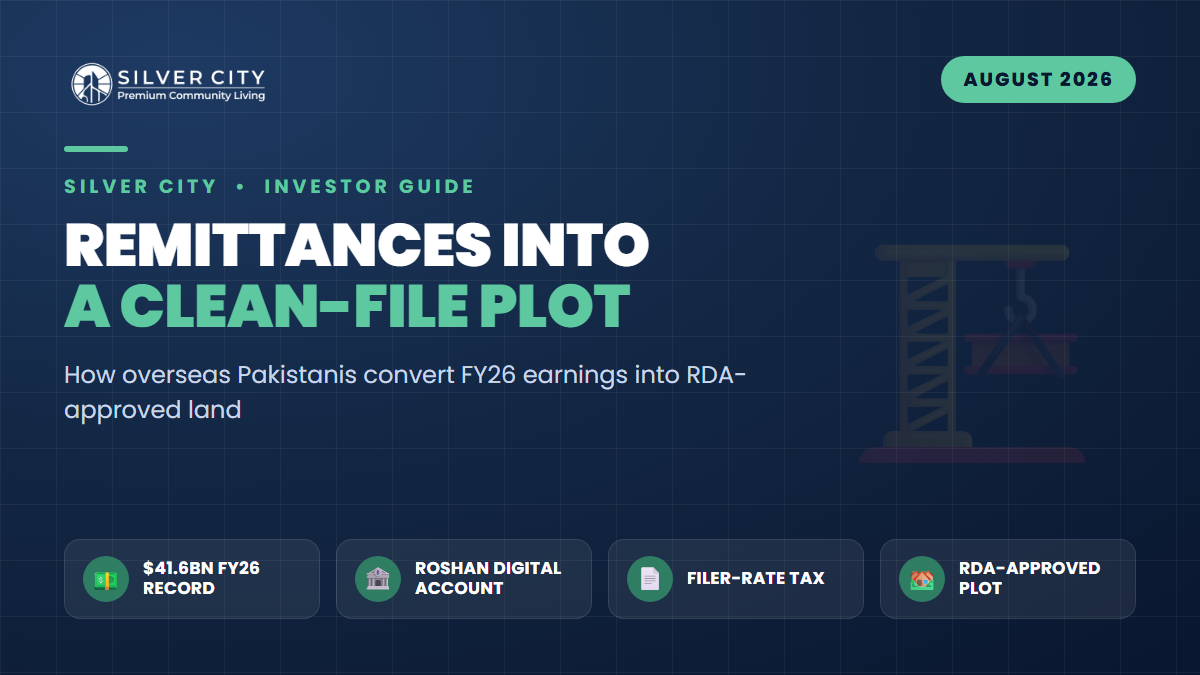
Fiscal year 2025-26 rewrote the record books. Pakistan received a historic USD 41.6 billion in workers’ remittances during FY26, up 8.6% from USD 38.3 billion the year before, with a single-month peak of USD 4.25 billion in May 2026. Saudi Arabia, the UAE, the UK and the United States led the corridors sending money home. For millions of overseas Pakistanis, the question now is not whether to remit, but how to turn those hard-earned dollars, dirhams and pounds into a real, documented asset back home.
Property remains the default answer. But only if it is done correctly. A plot bought through undocumented cash channels creates a “dirty file” that triggers non-filer tax rates, FBR scrutiny and resale problems. This guide walks you through building a genuinely clean-file, RDA-approved plot holding, step by step, using the same formal channels that helped push FY26 to its record.
Why “Clean File” Matters More Than the Plot Itself
A clean file simply means your money trail is fully documented from your foreign salary account to the developer’s account, and your tax status is settled. Under the Finance Act 2026, the gap between compliant and non-compliant buyers is now large enough to change your returns:
- Section 236K (buyer’s advance tax): a flat band of roughly 1.25%-1.5% of fair market value for those on the Active Taxpayers List (ATL). But sharply higher for non-filers.
- Section 236C (seller’s advance tax): around 2.75% for filers and eligible overseas Pakistanis, versus up to 11% for non-filers.
- The overseas exemption: holders of NICOP or POC who qualify as non-resident (typically 182+ days abroad) may pay at filer/ATL rates under 236C and 236K even if they have not filed a Pakistani return, provided the purchase is made through a documented banking channel such as a Roshan Digital Account. Pay in cash or through an undocumented account and you forfeit this benefit and are treated as a non-filer.
The Step-by-Step Playbook
Step 1: Open a Roshan Digital Account (RDA)
The RDA, offered by most major banks (Meezan, HBL, Bank AL Habib, UBL and others), is the backbone of a clean file. It can be opened entirely online from abroad using your NICOP/POC and takes only a few working days. Fund it directly from your foreign salary or savings. This creates the first verifiable link in your money trail.
Step 2: Secure your remittance proof (FRC / PRC)
Ask your bank for the digital certificate that proves your funds arrived as a foreign remittance. RDA holders are generally issued a Foreign Remittance Certificate (FRC) on request, while inflows into conventional accounts generate an electronic Proceeds Realization Certificate (PRC / e-PRC). These carry unique IDs and are verifiable online by the FBR, SBP and Customs. Keep every certificate. It is your single most important document at file-closing and resale.
Step 3: Confirm the society is RDA-approved and pick the plot
Verify the housing scheme’s No Objection Certificate directly with the Rawalpindi Development Authority before paying a rupee. In the Silver City belt on Girja Road near the Thalian Interchange, Silver City is a scheme sanctioned by the RDA and developed by Laraib Associate & Developers (Pvt) Ltd with the SAREMCO Group, a useful reference point for the kind of documented, authority-approved project overseas buyers should shortlist.
Step 4: Pay only through banking channels
Transfer the booking and instalments from your RDA (or documented non-resident account) straight to the developer’s official company account, never to an agent’s personal account or in cash. Insist on stamped receipts that match your bank debits rupee-for-rupee.
Step 5: Get on the ATL (optional but smart)
Even though non-resident NICOP/POC holders can access filer rates, filing a simple return and appearing on the ATL removes any ambiguity, protects you on future transactions, and makes eventual resale to local buyers frictionless.
Step 6: Transfer and file the plot in your name
Complete the transfer through the society office, pay the 236K advance tax at the correct rate, and store the allotment/transfer letter with your FRC/PRC bundle. Your file is now clean, documented and audit-ready.
Indicative Costs & Timeline
| Plot size | Indicative price* | Typical entry | Instalment tenure |
|---|---|---|---|
| 3.5 Marla | Budget entry tier | ~PKR 200,000 booking | Monthly (~PKR 20,000) |
| 5 Marla | ~PKR 1.5 million | ~PKR 375,000 down | Up to 36-48 months |
| 10 Marla | ~PKR 2.55 million | ~PKR 315,000 booking | Up to 48 months |
| 1 Kanal | On request | On request | Up to 48 months |
*Figures are indicative developer numbers seen in 2025-26 market listings and change with promotions, category (residential/commercial) and location within the scheme. Always confirm the current payment plan in writing before booking.
| Stage | Realistic timeframe |
|---|---|
| Open & fund RDA | 3-7 working days |
| Obtain FRC/PRC | Same day to a few days |
| NOC verification & plot selection | 1-2 weeks |
| Booking to transfer letter | 2-6 weeks (developer-dependent) |
Common Mistakes That Ruin a Clean File
- Sending money to an agent’s personal account instead of the company account.
- Paying any portion in cash “to save time”. It breaks the documented chain.
- Discarding FRC/PRC certificates after payment.
- Booking in an unverified scheme on the promise of a future NOC.
- Assuming overseas status is automatic. You must transact through a banking channel to claim filer rates.
Frequently Asked Questions
Do overseas Pakistanis really pay lower tax than local non-filers?
Yes. NICOP or POC holders who qualify as non-resident can pay 236C and 236K advance tax at filer/ATL rates even without filing a Pakistani return. But only if the purchase runs through a documented channel such as a Roshan Digital Account. Cash purchases lose this benefit.
What is the difference between an FRC and a PRC?
Both prove your money came in as a foreign remittance. RDA holders are typically issued a Foreign Remittance Certificate (FRC), while conventional-account inflows generate a Proceeds Realization Certificate (PRC/e-PRC). Either one, verifiable online, anchors your clean file.
Can I buy a plot on instalments from abroad?
Yes. Most RDA-approved schemes in the Silver City belt offer 3-4 year instalment plans. Pay each instalment from your RDA so every payment stays documented, and keep the matching bank record and society receipt.
How do I confirm a society is genuinely RDA-approved?
Ask the developer for the NOC reference and verify it directly with the Rawalpindi Development Authority, do not rely on marketing brochures or an agent’s word alone.
The Takeaway
FY26’s record $41.6 billion proves overseas Pakistanis trust formal channels more than ever. Extending that same discipline into your property purchase (RDA in, FBR filer rates locked, FRC/PRC filed) is what separates a stress-free asset from a future headache. Among the authority-approved options in the Rawalpindi corridor, Silver City on Girja Road is an RDA-approved scheme worth shortlisting as you plan your first clean-file plot. Verify the current NOC and payment plan, transact through documented channels, and let your remittances build something that lasts.