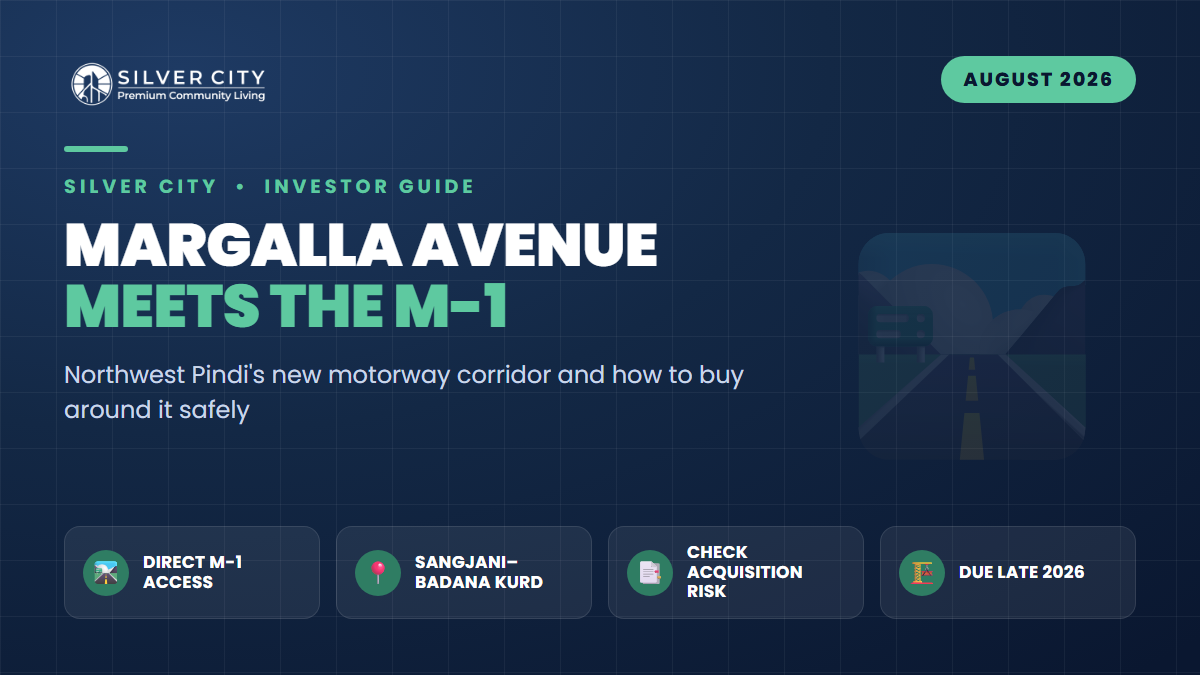
For years, traffic from Islamabad’s F, G and H sectors (and the fast-developing societies along the GT Road (N-5) belt) had only one clumsy way onto the Islamabad-Peshawar Motorway (M-1): loop back through Srinagar Highway or the IJP Road. The Capital Development Authority’s (CDA) new link joining the western end of Margalla Avenue to the M-1, anchored by the Sangjani interchange, changes that geometry. It hard-wires a short, signal-free corridor between northern Islamabad and the motorway that runs independently of the long-delayed Rawalpindi Ring Road. For property investors watching northwest Pindi, that independence is the whole story.
What Is Actually Being Built
According to CDA project documents and reporting confirmed through 2026, the alignment was finalised after survey and demarcation and spans roughly 3.4 kilometres of new link, about 1.6 km falling inside Islamabad territory and 1.8 km inside Rawalpindi district. Within this, CDA is executing a carriageway package that includes dual three-lane sections, a two-lane service road, two underpasses and a bridge, while the extension pushing through to the motorway near Sangjani is being coordinated with the Punjab government and highway authorities.
The scheme was originally approved at around Rs 5.45 billion (covering both construction and land acquisition), and the 2026-27 federal budget earmarked a further Rs 2 billion to push it toward completion. The Sangjani interchange on GT Road was given a hard mid-2026 target for early traffic relief, with the wider link programmed for completion by late 2026. Land acquisition is the critical-path item: a total of roughly 181 kanals is required (about 51 kanals in Sangjani (Islamabad side) and 130 kanals in Badana Kurd (Rawalpindi side)) with the acquisition process already under way and compensation to affected landowners being processed.
| Component | Detail |
|---|---|
| Total new link length | ~3.4 km (≈1.6 km Islamabad + ≈1.8 km Rawalpindi) |
| Key structures | Dual carriageway, service road, 2 underpasses, 1 bridge, Sangjani interchange |
| Land under acquisition | ~181 kanals total: ~51 kanals Sangjani, ~130 kanals Badana Kurd |
| Approved cost | ~Rs 5.45 billion (plus Rs 2b in FY2026-27 budget) |
| Sangjani interchange | Prioritised for mid-2026 relief |
| Full link completion | Targeted late 2026 |
Why This Is a Ring-Road-Independent Re-Rating
The Rawalpindi Ring Road has been the standard justification for buying in the western and southern Pindi belts. But the Ring Road is a huge, phased undertaking whose value is priced years ahead of delivery. The Margalla Avenue-M-1 link is different: it is short, cheap by comparison, already funded, and physically under construction. When a piece of infrastructure moves from “announced” to “under acquisition and building,” the discount the market applies for execution risk narrows sharply. That is where re-rating comes from, not the road existing one day, but the market’s confidence that it will.
Practically, the corridor gives the following belts a genuinely new value driver, independent of any Ring Road timeline:
- Sangjani and the immediate N-5 / GT Road belt, the interchange itself becomes a motorway on-ramp, boosting frontage plots, commercial nodes and warehousing-style land.
- Badana Kurd and adjoining mauzas (Rawalpindi side), land directly touched by, or bordering, the alignment. High upside and high acquisition risk (see below).
- Northwest societies drawing off Margalla Avenue’s extension, schemes that previously felt “far” because motorway access meant a detour now sit minutes from an M-1 ramp.
- The D-12 / northern-sector edge of Islamabad, indirectly, as the whole Margalla Avenue spine finally connects end-to-end.
How to Check Land-Acquisition Exposure Before You Buy
This is the single most important due-diligence step in this corridor, and it is where most retail buyers get hurt. A plot inside an acquisition line pays government compensation rates (often below open-market value and slow to release) not the price you paid. Conversely, a plot just outside the line captures the connectivity upside cleanly. Do not rely on a dealer’s verbal assurance. Verify in this order:
- Get the khasra/khewat and mauza name in writing. Every parcel sits in a revenue estate (mauza) with a khasra number. For this corridor, treat any land in or adjoining Badana Kurd and Sangjani as acquisition-sensitive until proven otherwise.
- Pull the revenue record (fard) and check for acquisition notifications. Under the Land Acquisition Act 1894, look specifically for a Section 4 (intent) and Section 5/17 notification against the khasra. Punjab’s online land record system (PLRA) and the local patwari/tehsildar office can confirm whether your exact number is notified.
- Cross-check the CDA/notified alignment. Ask to see the project’s demarcation drawing. The alignment has been surveyed and pegged on the ground, physically walk it and see whether your plot’s corners fall inside the marked right-of-way.
- Verify society legality on the RDA portal. If you’re buying inside a housing scheme, confirm it appears on the Rawalpindi Development Authority’s official approved-schemes list. RDA has roughly 80-plus approved private schemes; anything not listed carries planning and acquisition risk of its own.
- Confirm no overlap between the society and the road reservation. Even approved societies can have blocks clipped by a later public-purpose acquisition. Ask the developer for written confirmation that your specific block/plot is outside any notified road or interchange reservation.
- Use a property lawyer for the final title and encumbrance check. A few thousand rupees of legal review is trivial against a plot that turns out to be inside a compensation line.
A Sensible Investor Playbook
Favour plots that are near the interchange and the new ramps but demonstrably outside the notified acquisition width. Prioritise RDA-approved schemes with clear title over raw agricultural land in the affected mauzas unless you are an experienced land player who understands compensation timelines. Buy on confirmed, funded, under-construction connectivity (as here) rather than on a brochure promise. And always price in the reality that infrastructure targets in Pakistan slip: treat “late 2026” as a direction of travel, not a guarantee, and don’t overpay for a completion date that hasn’t happened yet.
Frequently Asked Questions
Does the Margalla Avenue-M-1 link depend on the Rawalpindi Ring Road?
No. That is precisely its appeal. It is a separate, smaller, already-funded CDA-led corridor with its own alignment and interchange at Sangjani. Its value case doesn’t hinge on the Ring Road’s much longer timeline.
If my plot is in Badana Kurd, will it definitely be acquired?
Not necessarily. Only about 130 kanals in Badana Kurd fall under acquisition for this project, and it follows a specific alignment. Your exposure depends on your exact khasra number. Check it against Section 4/5 notifications through the patwari and PLRA record before assuming either outcome.
Will land compensation match the market price?
Usually not in full, and payment can be slow. Government compensation under the Land Acquisition Act is assessed on notified rates, which typically lag open-market values. This is exactly why buying just outside the acquisition line (capturing the connectivity uplift without the compensation haircut) is the smarter play.
When will investors actually feel the price impact?
Some re-rating has already occurred on the announcement and start of works. Expect a second leg as the Sangjani interchange opens and the ramps become usable, and a further step once the full link is trafficked. Buying before functional milestones, in verified-clean plots, captures the most upside.
The Takeaway
The Margalla Avenue-M-1 link is one of the cleaner infrastructure bets in the twin cities right now: short, funded, under construction, and independent of the Ring Road’s uncertainties. The winners will be plots with genuine motorway proximity and clean title, not land sitting inside a compensation line. If you’d rather capture the corridor’s upside without decoding raw revenue records yourself, an RDA-approved, properly documented option such as Silver City (silvercity.pk) in the northwest Pindi growth path is worth shortlisting, approval status verifiable on the RDA portal, and title clarity that lets you focus on the connectivity story rather than acquisition risk. Verify everything, buy just outside the line, and let the new ramps do the re-rating for you.