Timing is the quiet variable that separates a good property decision from an average one. For most of 2024 and 2025, Pakistani investors faced a punishing combination: elevated borrowing costs, record fuel prices feeding into construction and transport, and a heavy property-tax burden that ate into every buy-and-hold calculation. In July 2026, three of those pressures have eased at the same time — and for buyers focused on Rawalpindi and its ring-road corridor, that overlap has created a genuinely unusual cost-of-entry window.
This article breaks down what actually changed, why the three factors matter together rather than in isolation, and how a disciplined investor can read the moment without falling for hype.
The Three Levers That Moved at Once
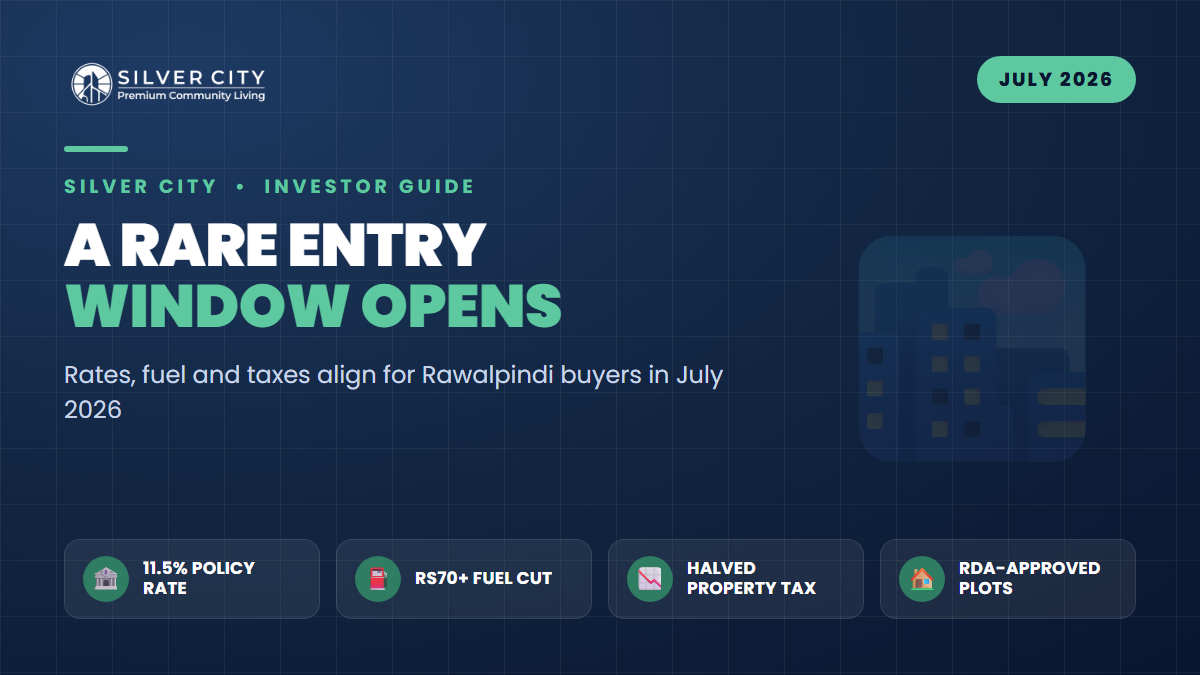
What makes mid-2026 notable is not any single headline — it is the alignment. Here is the verified snapshot as of July 2026:
| Lever | Where it stands (July 2026) | Why it matters for buyers |
|---|---|---|
| SBP policy rate | Held at 11.5% (unchanged at the 15 June 2026 MPC meeting) | Rate stability removes uncertainty and signals a plateau rather than a fresh tightening cycle |
| Fuel prices | Petrol ~Rs297.5/litre; diesel ~Rs309.5/litre — down sharply from an April peak above Rs458 | Lower transport and construction input costs ease pressure on development and material prices |
| Property taxes | Buyer and seller withholding taxes roughly halved for filers in Budget 2026-27 | Directly reduces the transaction cost of entering (and later exiting) a plot |
Lever 1: A steady 11.5% policy rate
The State Bank of Pakistan raised the policy rate by 100 basis points to 11.5% on 27 April 2026 — its first hike since 2023 — as inflation climbed back into double digits and Middle-East-driven oil volatility clouded the outlook. Crucially, the Monetary Policy Committee then held the rate at 11.5% on 15 June 2026. For an investor, a pause matters as much as a cut. It tells you the tightening cycle has likely peaked, so the risk of a sudden jump in financing costs or a fresh liquidity squeeze has receded. That predictability is what lets you commit to a 3-to-5-year installment plan with confidence.
Lever 2: Back-to-back fuel cuts of Rs70+
Fuel is the hidden input in every property price. It moves the cost of cement, steel, sand transport, machinery and labour commutes. After petrol peaked above Rs458 per litre in early April 2026, global crude eased and the government passed on a series of reductions — including a headline cut of roughly Rs74 per litre effective 20 June 2026, on top of two earlier Rs4 reductions in June. By the July 4–10 review, petrol sat near Rs297.5 and diesel near Rs309.5 per litre. That is a swing of well over Rs150 from the peak and a single fortnight’s relief exceeding Rs70. Lower diesel in particular feeds straight into development-phase costs for housing societies, which supports steadier plot pricing.
Lever 3: Property taxes cut in Budget 2026-27
The federal Budget 2026-27, effective from 1 July 2026, delivered the most direct saving of all — a reduction in transaction taxes on immovable property for active tax filers:
| Tax | Applies to | Before | Budget 2026-27 (filers) |
|---|---|---|---|
| Section 236K (advance tax on purchase) | Buyer | 2.5% | 1.25% |
| Section 236C (advance tax on sale) | Seller | 5.5% | 2.75% |
| Section 7E (deemed-income tax on property) | Owner | Applied | Omitted |
Halving the buyer’s withholding and the seller’s withholding, plus removing the 7E deemed-income levy, meaningfully lowers the friction of both entering and eventually exiting a position. On a Rs2 million plot, the buyer-side withholding alone drops from roughly Rs50,000 to about Rs25,000 for a filer — a direct, immediate saving before you factor in the exit benefit. Note that these reliefs are structured to reward filers; non-filers continue to face higher rates, which is one more reason to regularise your tax status before transacting.
Why the Overlap Is Rare — and Why It Favours Rawalpindi
Each lever helps on its own. Together they compress the total cost of ownership from three different directions at the same time: financing sentiment, input costs, and transaction taxes. That kind of simultaneous alignment does not happen often, and it tends not to last — fuel prices are reviewed fortnightly, the policy rate is revisited every few weeks, and tax reliefs can be tightened in the next finance act.
Rawalpindi is well placed to benefit. The Rawalpindi Ring Road and the Thalian Interchange corridor have redrawn the map of accessible, appreciating land near the twin cities, pulling demand toward RDA-approved societies along Girja Road and the wider ring-road belt. When entry costs fall while a genuine infrastructure catalyst is maturing, the risk-reward for patient buyers improves.
A simple cost-of-entry illustration
- Lower transaction tax: A filer buying a Rs2 million plot saves roughly Rs25,000 up front from the 236K cut alone.
- Lower carrying pressure: Cheaper diesel supports steadier development charges and material costs during the build-out of a society.
- Rate certainty: A held 11.5% rate lets you lock a multi-year installment plan without fearing a mid-plan cost shock.
How to Act Without Overpaying for the Story
- Confirm approval status. Buy only in RDA-approved (or clearly NOC-cleared) schemes. Approval protects your title and your resale liquidity.
- Become a filer first. Nearly every tax relief in Budget 2026-27 is reserved for active filers — the gap versus non-filers is now the biggest lever you personally control.
- Verify live numbers on the day. Fuel prices reset fortnightly and society payment plans update; confirm current rates before you commit.
- Match the plan to the phase. Installment plots in developing phases carry more upside but need patience; developed plots cost more but transact faster.
Frequently Asked Questions
Is July 2026 actually a good time to buy property in Rawalpindi?
The conditions are unusually favourable: the policy rate is holding at 11.5% (removing the fear of fresh hikes), petrol and diesel have fallen sharply from their April peak, and Budget 2026-27 halved filer withholding taxes from 1 July. That combination lowers your total cost of entry. It is not a guarantee of returns — always match the purchase to your own horizon and cash flow — but the friction of buying is lower than it has been in some time.
How much do the new property taxes actually save me?
For active filers, the purchase withholding under Section 236K fell from 2.5% to 1.25%, and the sale withholding under Section 236C fell from 5.5% to 2.75%. The Section 7E deemed-income tax was also omitted. On a Rs2 million plot, that is roughly Rs25,000 saved on the buy side alone, with a larger benefit realised when you sell.
Do falling fuel prices really affect plot prices?
Indirectly but meaningfully. Diesel drives transport of construction materials and site machinery, so sustained lower fuel eases development-phase costs for housing societies. It also lifts general consumer sentiment, which supports transaction volumes. It won’t move raw land prices overnight, but it reduces upward cost pressure across the sector.
Will this window stay open?
Probably not indefinitely. Fuel is reviewed every fortnight, the SBP revisits the policy rate every few weeks, and tax reliefs can be revised in the next budget. The value of the current alignment is precisely that all three are favourable at once — a state that historically has been temporary.
The Takeaway
July 2026 has handed Rawalpindi buyers something they rarely get: a steady rate, cheaper fuel and lighter transaction taxes all pulling in the same direction. Investors who move deliberately — verifying live figures, filing their taxes, and sticking to approved schemes — stand to enter at a lower all-in cost than they would have a year ago. Among the RDA-approved options along the Thalian/Girja Road ring-road corridor, Silver City is one worth putting on your shortlist for a closer look, with flexible installment plans and RDA approval that protects both your title and your eventual resale liquidity. As always, confirm the latest prices and plan terms directly before you commit.