What the Green Property Certificate Actually Is
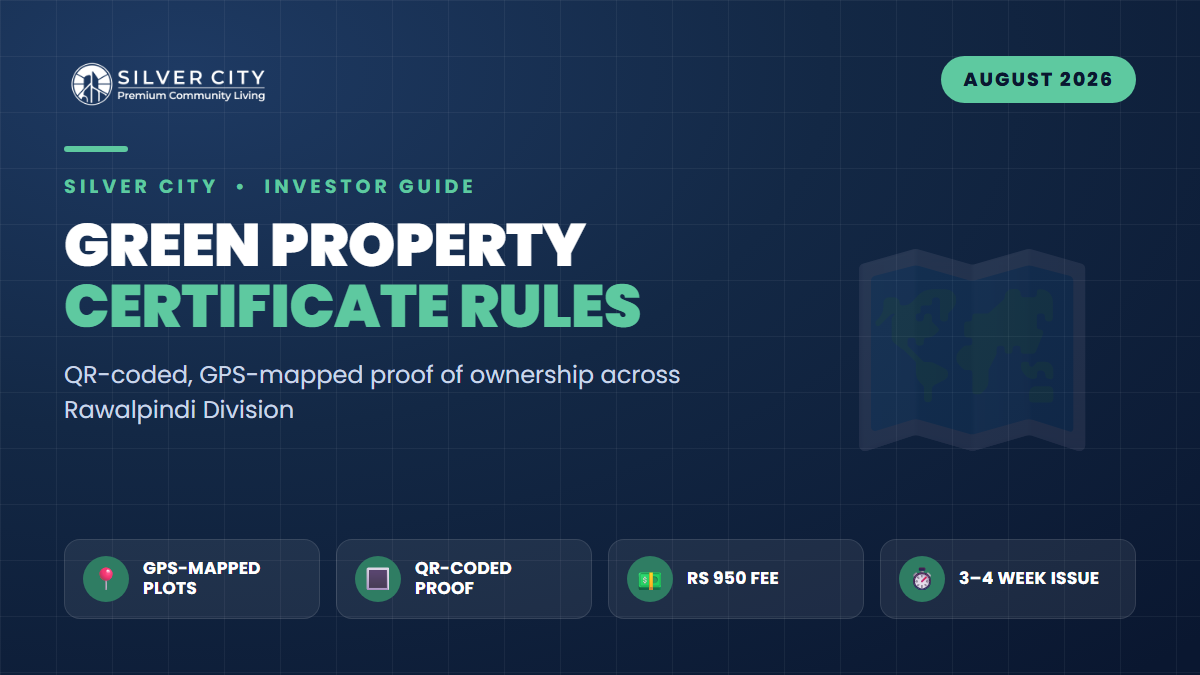
In 2026 the Punjab Land Records Authority (PLRA), working alongside the Rawalpindi Development Authority (RDA), rolled out the Green Property Certificate (GPC) — a digitally signed, QR-coded ownership document that confirms a specific plot is legally registered, physically GPS-boundary-mapped, and free of court stay orders, bank mortgages, unpaid dues and disputed ownership. It was positioned as the modern replacement for the centuries-old manual Fard-e-Bai and patwari register, part of the World Bank–supported drive to digitise land records across all of Punjab’s districts.
The GPC became mandatory for property transfers in Rawalpindi Division from 1 July 2026, covering the districts of Rawalpindi, Attock, Jhelum and Chakwal. The original policy line was blunt: no GPC, no legal transfer.
Important: The Rule Was Softened in July 2026
Every serious investor needs to know what happened next, because a lot of online content still repeats the old headline. Within days of the province-wide launch, PLRA issued a follow-up notification (widely reported on 11 July 2026) clarifying that buyers and sellers would not be strictly required to produce a GPC to complete a sale, purchase, mortgage or gift. Transactions can still be executed using the traditional Fard (Record of Rights) or a certified copy of the official land record.
So as of today, the practical position is this: both documents are accepted. The GPC is available, encouraged, and being pushed toward full adoption — but the “you literally cannot transfer without it” stage was walked back to avoid choking the market with backlog and delays. Treat the GPC as strongly recommended and increasingly expected, not as an absolute blocker at the registry today.
Why You Should Still Get a GPC Before Selling
Even though it is no longer a hard gate, a GPC is a genuine selling advantage:
- Buyer confidence: A scannable QR code lets any buyer, lawyer or bank verify ownership and encumbrances in real time — that reduces haggling and speeds closing.
- Clean boundaries: The GPS survey fixes your plot’s exact measurements and corners, cutting the risk of later boundary disputes or “double-selling.”
- Financing: Banks processing mortgage or construction finance increasingly prefer the digital certificate over a paper Fard.
- Future-proofing: PLRA’s clear direction of travel is toward digital-first records, so getting ahead avoids a rush later.
Cost, Timeline and How to Apply
The GPC process is deliberately low-cost and centralised. Here are the current figures reported for Punjab, including Rawalpindi Division:
| Item | Detail |
|---|---|
| Government fee | Rs 950 (fixed) |
| Payment channels | Bank of Punjab counter at any Arazi Record Centre (ARC), or PLRA e-Pay online |
| Standard processing | Approx. 3–4 weeks (assuming no objections) |
| Fast route | e-Khidmat Markaz — submit and receive in about 2–3 days after verification |
| Where to apply | PLRA online portal, nearest Arazi/Land Record Centre, or e-Khidmat Markaz |
| Identity check | CNIC + biometric verified through NADRA |
| Final authority | Assistant Director Land Records (ADLR) authenticates the certificate |
Typical documents requested include your CNIC, the existing Fard / registry or transfer deed, the society or authority allotment/transfer letter, and prior tax/dues clearance. Requirements can vary slightly by tehsil, so confirm at your local centre before you file.
Step-by-Step: What a Current Plot Holder Should Do Before Selling
- Pull your existing record first. Obtain a fresh Fard / certified copy so you know exactly how the plot is recorded and in whose name.
- Clear all dues. Settle outstanding society charges, property tax and any utility/authority arrears — unpaid dues can trigger objections that stall the GPC.
- Resolve encumbrances. Ensure there are no bank mortgages, court stay orders or family/inheritance disputes attached to the plot.
- Apply for the GPC. Use the PLRA portal or an Arazi Record Centre; pay the Rs 950 fee and complete NADRA biometric verification.
- Allow the GPS survey. A surveyor physically maps your plot boundaries — be available and make sure boundary walls or markers match your documents.
- Collect the QR certificate. Once the ADLR authenticates it, download or receive the QR-coded GPC.
- Sell with the strongest paperwork. Present the GPC (plus your Fard) to buyers — a scannable, dispute-free document commands trust and often a better price.
Timeline at a Glance
| Date | What Happened |
|---|---|
| Early–mid 2026 | PLRA/RDA roll-out and surveys begin in Rawalpindi Division |
| 1 July 2026 | GPC made mandatory province-wide, including Rawalpindi Division |
| ~11 July 2026 | PLRA clarifies GPC not strictly required; Fard / certified record still valid |
| Now (mid-2026 onward) | Both GPC and Fard accepted; digital-first adoption continuing |
Frequently Asked Questions
Is a GPC legally required to sell my plot in Rawalpindi right now?
Not as an absolute rule today. After the 1 July 2026 mandate, PLRA clarified in July that a Fard (Record of Rights) or certified copy of the land record can still be used for transfers. The GPC is accepted and encouraged, but it is not the sole document that makes a sale valid at present. Always confirm the latest position at your local Arazi Record Centre before you transact.
How much does the Green Property Certificate cost and how long does it take?
The government fee is fixed at Rs 950, payable via Bank of Punjab at an Arazi Record Centre or through PLRA e-Pay. Standard issuance takes roughly 3–4 weeks; an e-Khidmat Markaz can turn it around in about 2–3 days once verification is complete.
What is the difference between a Fard and a GPC?
A Fard is the traditional record of rights extracted from the land register. A GPC is a digital, QR-coded certificate that bundles ownership, a GPS boundary survey, and a live encumbrance check (mortgages, disputes, dues) into one scannable document. The GPC is designed to be harder to forge and faster to verify.
Does the GPC apply to private housing societies too?
Yes — the reform covers immovable property across the division, and RDA-approved societies fall within the digital-records push. If your society maintains its own transfer system, you will typically still need the underlying record clean and dues cleared before a GPC or transfer can proceed.
The Bottom Line for Investors
The GPC represents the direction Rawalpindi’s property market is heading: GPS-mapped, QR-verifiable, dispute-free ownership. Even with the mandatory requirement softened in July 2026, getting your plot documented digitally is a smart, low-cost move that makes it easier — and often more profitable — to sell. When you buy new, that same logic favours RDA-approved, properly documented schemes. This is where a project like Silver City (silvercity.pk), an RDA-approved housing society, is worth considering: clean approvals and transparent records position both current owners and future buyers well for the digital land-record era. Always verify the current PLRA/RDA rules and your own plot’s status before any transaction.