The number that just repriced every rupee in your bank account
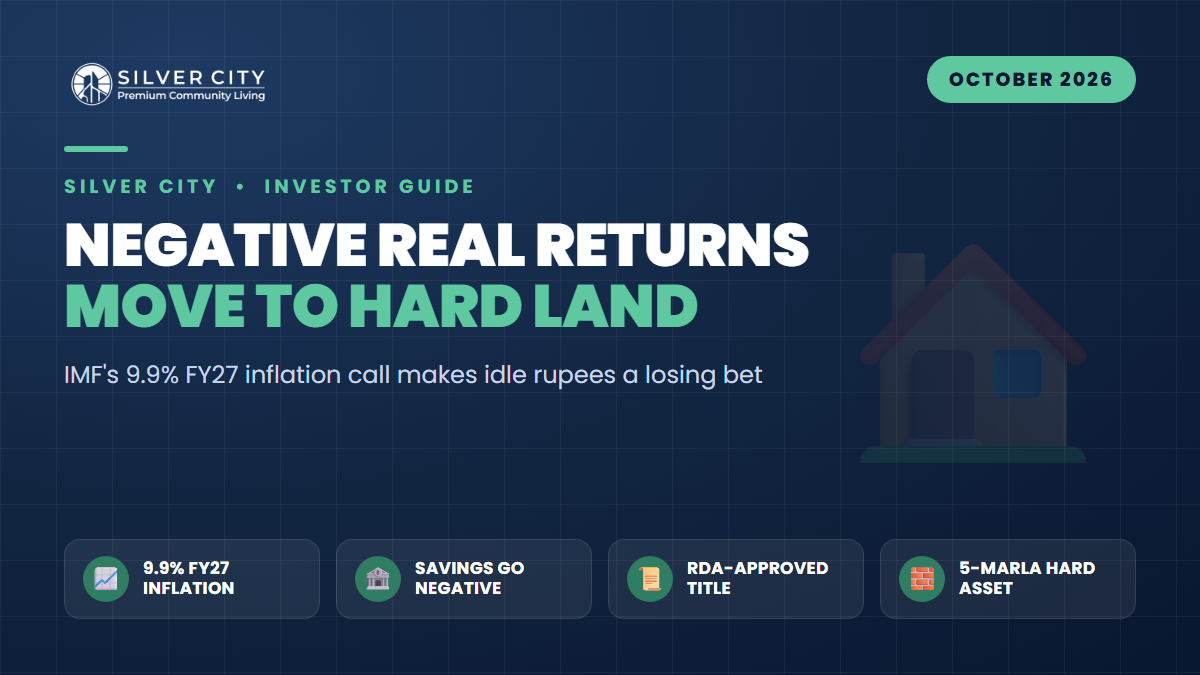
On 14 October 2026, the IMF’s new World Economic Outlook raised Pakistan’s inflation forecast for FY27 (the fiscal year ending June 2027) to 9.9% — up sharply from the 8.4% it had projected in July, and well above the federal government’s official target of 8.2%. The Fund kept GDP growth pinned at a modest 3.5% for FY27, signalling an economy that grows slowly while prices climb faster than Islamabad had budgeted for.
For a saver, that single revision changes the maths completely. When the State Bank held its policy rate around 11% through late 2026, banks were paying roughly 10% on ordinary savings accounts (the SBP minimum applies to individual balances up to Rs 10 million) and 10.5–10.9% on one-year fixed deposits. On paper, that beats 9.9% inflation. After tax, it does not.
Why “10% in the bank” is really a loss
Profit on bank deposits is taxed. Active tax filers pay 15% withholding on their profit; non-filers pay 35%. Run the numbers against a 9.9% inflation forecast and the real (inflation-adjusted) return on idle rupees turns negative again — exactly the trap Pakistani savers fell into during 2022–23.
| Where your rupees sit | Nominal return | After tax (net) | Real return vs 9.9% |
|---|---|---|---|
| Savings account (filer, 15% WHT) | 10.0% | ~8.5% | −1.4% |
| 1-year fixed deposit (filer, 15% WHT) | 10.6% | ~9.0% | −0.9% |
| Savings account (non-filer, 35% WHT) | 10.0% | ~6.5% | −3.4% |
| Cash held at home | 0% | 0% | −9.9% |
Every row is a wealth leak. A non-filer keeping Rs 2.75 million in savings loses roughly Rs 93,000 of purchasing power over a year even while the balance “grows.” Cash under the mattress loses nearly Rs 272,000. The forecast doesn’t just shave your returns — it quietly transfers your buying power to inflation.
Why land is the classic rupee hedge
Pakistani investors have long treated well-located, titled land as a store of value precisely because it is a hard asset: its rupee price tends to rise with — and often ahead of — inflation, construction costs and the cost of developed plots. Unlike a deposit, land is not eroded by a withholding tax on “profit” each year, and unlike gold it generates no premium on import and can be built on, rented from, or held for generations.
The key word, though, is titled and approved. The hedge only works if the asset is legally clean. An unapproved file in a disputed scheme is not a hedge — it is a liability that trades at a discount and can stall at transfer. That is why an RDA-approved plot with a clear allocation matters more in 2026 than ever: it is the difference between owning an inflation-beating asset and owning a problem.
The 5-marla sweet spot for overseas and local investors
A 5-marla plot is the most liquid residential denomination in the Rawalpindi–Islamabad market. It is affordable enough for first-time and overseas buyers, in constant demand from end-users who want to build a modest home, and easy to resell. That liquidity is itself a form of protection: when you need to exit, a 5-marla sells faster than a 1-kanal.
In Silver City — an RDA-approved society on Girja Road, near the Rawalpindi Ring Road corridor and the new Islamabad International Airport approach — a standard 5-marla residential plot is offered on a published instalment plan rather than a single lump sum. That structure is ideal for salaried buyers and for overseas Pakistanis who prefer to commit rupee income in tranches:
| Payment stage | Share | Amount (PKR) |
|---|---|---|
| Booking | 15% | 415,000 |
| Confirmation (within ~30 days) | 15% | 415,000 |
| 48 monthly instalments | — | 30,000 / month |
| Half-yearly instalments (×4 approx.) | — | 120,000 each |
| Indicative total | 100% | ~2,750,000 |
Instalment buying has a hidden anti-inflation feature: you lock today’s price while paying in future rupees that the IMF itself expects to be worth less. If inflation runs near 10%, the real burden of a fixed Rs 30,000 monthly instalment falls every year.
How to rotate idle rupees — a practical sequence
- Keep a liquidity buffer. Hold 6–12 months of expenses in a savings account; only rotate genuinely idle capital.
- Verify approval first. Confirm the society and your specific block/sector carry RDA approval, and that the plot has a clean allocation before you pay a rupee.
- Prefer titled, balloted plots. A located, balloted file is a stronger hedge than an open, unlocated file.
- Become a filer. Filer status cuts your withholding and your transaction taxes on property — it compounds every return you earn.
- Document everything. Keep the official payment plan, receipts and transfer records; overseas buyers should route funds through banking channels for a clean trail.
Frequently Asked Questions
Is the IMF’s 9.9% figure the same as current inflation?
No. It is a forecast for the full FY27 (year ending June 2027), published in the October 2026 World Economic Outlook. It is higher than both the IMF’s own July estimate (8.4%) and the government’s 8.2% target, which is why it has reset expectations for savers and borrowers alike.
Can’t I just move into fixed deposits and beat inflation?
A one-year fixed deposit around 10.6% looks like it clears 9.9% — but after the 15% withholding tax a filer pays (35% for non-filers), the net return slips below the inflation forecast, leaving a negative real return. Deposits protect nominal rupees, not purchasing power.
Why a 5-marla plot rather than gold or stocks?
Gold carries an import-driven premium and storage/security concerns; equities are liquid but volatile and demand active management. A titled 5-marla plot is a tangible, buildable asset with deep local demand, no annual tax on unrealised gains, and a rupee price that historically tracks inflation and rising construction costs — a straightforward hedge for passive, long-horizon capital.
What makes RDA approval so important?
Approval by the Rawalpindi Development Authority signals the layout, land status and development are sanctioned, which protects resale value, speeds up transfer and reduces legal risk. An unapproved file may trade cheaper, but it carries the kind of uncertainty that cancels out any inflation-hedging benefit.
The bottom line
The IMF has effectively told savers what the next two years look like: prices rising near 10%, bank returns that lose to inflation once tax is applied, and rupees that quietly shrink while they sit still. Rotating idle capital into a tangible, legally clean asset is the time-tested Pakistani response. For investors weighing where to put that money to work, an RDA-approved 5-marla plot in Silver City, Rawalpindi — available on a structured instalment plan that lets you lock today’s price in tomorrow’s cheaper rupees — is a hard-asset option genuinely worth considering before the next price revision lands.