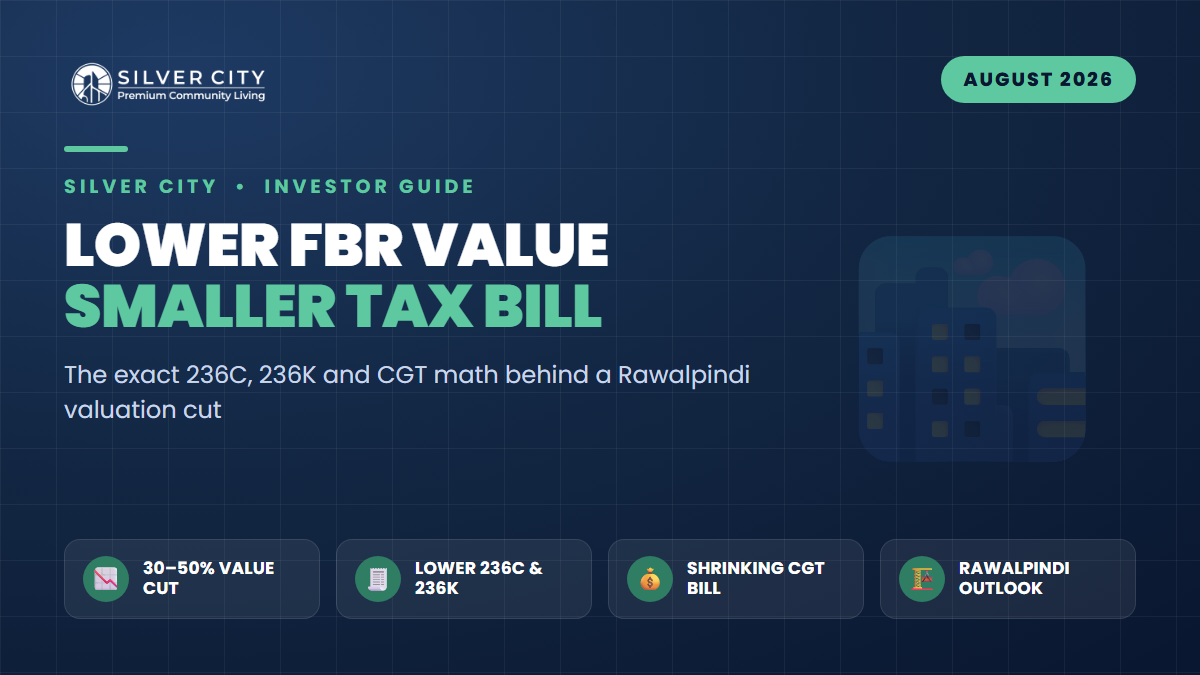
For most of the last decade FBR valuation tables only moved in one direction: up. That changed in 2026. Under pressure from a stalled transaction market, the Federal Board of Revenue began cutting the notified “fair market values” that drive withholding tax on property. Islamabad sectors were slashed by roughly 30–50%, and DHA Lahore/Nishtar Town were revised down through SRO 876(I)/2026, with several sectors falling 36–40%. FBR issued a parallel order revising DHA Rawalpindi on the same day.
The obvious question for anyone holding or buying in Rawalpindi’s RDA-approved societies: if a broad Rawalpindi cut follows the Lahore template, how much tax do I actually save? This guide breaks down the exact math on Sections 236C, 236K and capital-gains tax (CGT), because the FBR value is the single number every one of those bills is multiplied against.
Why the FBR Value Is the Number That Matters
Three separate property taxes are calculated as a percentage of the FBR (or DC) notified value, not your negotiated price:
- 236K — advance tax on the buyer at transfer.
- 236C — advance tax on the seller at transfer.
- Capital gains tax — where the FBR value acts as the deemed sale/purchase price floor.
Because all three are multiplied against the same base, a 35% cut in the notified value flows straight through to a roughly 35% cut in every bill tied to it. Nothing about the tax rate has to change — only the value the rate is applied to.
The Current Rate Slabs (Tax Year 2025–26)
Under the Finance Act 2025 (effective 1 July 2025), buyer rates were trimmed and seller rates were nudged up, shifting more of the burden onto the seller. Filer slabs are below; late-filer and non-filer rates run much higher (236C non-filers up to ~11.5%, 236K non-filers up to 18.5%).
| Property value (FBR) | 236K buyer (filer) | 236C seller (filer) |
|---|---|---|
| Up to Rs 50 million | 1.5% | 4.5% |
| Rs 50–100 million | 2.0% | 5.0% |
| Above Rs 100 million | 2.5% | 5.5% |
Both 236C and 236K are adjustable advance taxes, not final — you reclaim them against your annual return. But they are cash out the door on the day of transfer, so a lower base directly improves your deal’s cash flow. Filing before you transact remains the single biggest lever: it is the difference between the modest filer columns above and double-digit non-filer rates.
The Exact Math: A Worked Rawalpindi Example
Assume a residential plot in an RDA-approved society currently notified at an FBR value of Rs 20 million, and a Rawalpindi cut that mirrors Islamabad/Lahore at 35%, bringing the notified value down to Rs 13 million. The buyer and seller are both filers, and the seller originally acquired the plot at an FBR value of Rs 10 million.
| Tax | Rate | Before cut (Rs 20m base) | After 35% cut (Rs 13m base) | You save |
|---|---|---|---|---|
| 236K (buyer) | 1.5% | Rs 300,000 | Rs 195,000 | Rs 105,000 |
| 236C (seller) | 4.5% | Rs 900,000 | Rs 585,000 | Rs 315,000 |
| CGT (seller, filer) | 15% flat* | Rs 1,500,000 | Rs 450,000 | Rs 1,050,000 |
*Flat 15% CGT applies to filers for property acquired on/after 1 July 2024, regardless of holding period. Here the gain is the declared consideration minus cost: before the cut, Rs 20m − Rs 10m = Rs 10m gain (× 15% = Rs 1.5m); after the cut, Rs 13m − Rs 10m = Rs 3m gain (× 15% = Rs 450,000).
In this single transaction, the buyer keeps Rs 105,000 and the seller keeps Rs 1.365 million across 236C and CGT — roughly Rs 1.47 million of combined relief on one Rs 20m plot. Scale that across a portfolio and the case for waiting to transact until a lower table is notified becomes obvious.
The CGT Caveat Every Investor Must Understand
The CGT saving above only materialises if you actually declare the transaction at the FBR value. CGT is charged on the higher of your actual consideration or the notified value. If you sell at a real price well above the FBR value and declare it honestly, your gain — and your CGT — is based on the higher real number, and the table cut helps you less on CGT (though it still cuts 236C and 236K, which are always struck on the FBR value).
There is also a mirror effect for buyers: a lower FBR value today becomes your lower cost basis tomorrow. When you eventually sell, a lower recorded purchase value can mean a larger taxable gain. The cut is unambiguously good for a seller exiting now and for a buyer’s day-one cash flow; long-term holders should factor the cost-basis trade-off into their exit planning.
Where Rawalpindi Stands Today
| Area | Action | Approx. cut |
|---|---|---|
| Islamabad (68 sectors) | Notified downward, 2026 | 30–50% |
| DHA Lahore / Nishtar Town | SRO 876(I)/2026 | 36–40% |
| DHA Rawalpindi | Revised via parallel order | Sector-specific |
| Broader Rawalpindi (RDA societies) | Widely anticipated | Watch this space |
The pattern is clear: FBR is working city by city, and Rawalpindi’s DHA has already been touched. A wider revision covering RDA-approved private societies would be the logical next step if the market-revival policy continues. Nothing is guaranteed — always confirm the notified value for your exact sector on FBR’s official valuation portal before signing anything.
Frequently Asked Questions
Does a lower FBR value reduce my tax rate?
No. The rate stays the same; only the base it is applied to falls. Since 236C, 236K and (at declared value) CGT are all percentages of the FBR value, a lower value proportionally shrinks each bill without any change to the Finance Act rates.
Has Rawalpindi’s valuation table actually been cut yet?
DHA Rawalpindi was revised alongside DHA Lahore in 2026, and Islamabad saw cuts of 30–50%. A blanket reduction for all of Rawalpindi’s RDA societies has not been universally notified, so check the specific sector on FBR’s portal rather than assuming.
Should I delay my purchase to wait for a possible cut?
Buyers benefit from a lower 236K if they transact after a cut, but timing is a gamble on when — and whether — FBR notifies your sector. Weigh the potential 236K/236C saving against holding costs, price movement and the cost-basis effect on your future CGT.
Are 236C and 236K refundable?
They are adjustable advance taxes, credited against your annual income tax liability when you file — so being an active filer is essential to reclaim them and to qualify for the far lower filer rates in the first place.
The Takeaway
A downward FBR valuation revision is one of the rare policy moves that puts cash directly back into an investor’s pocket — and the Lahore SRO 876 and Islamabad cuts show it is now a live template. For Rawalpindi buyers, the smart play is to know your sector’s notified value, keep your filer status active, and model the 236C/236K/CGT impact before you sign. If you are shopping for a location that combines clean legal standing with genuine upside, an RDA-approved project such as Silver City is worth shortlisting — approved status keeps your transfer, taxation and resale straightforward exactly when valuation policy is in motion.
@@END@@