For years, Pakistani property investors treated the government’s transaction-cost cuts with healthy suspicion. Rates get announced in June; by the time you reach the registrar’s office, somehow the bill looks the same. This time is different — and we don’t have to take anyone’s word for it. The Federal Board of Revenue’s own first-quarter collection data for FY27 is the receipt that proves the discount is genuinely being passed to buyers and sellers right now.
What the FBR Numbers Actually Say
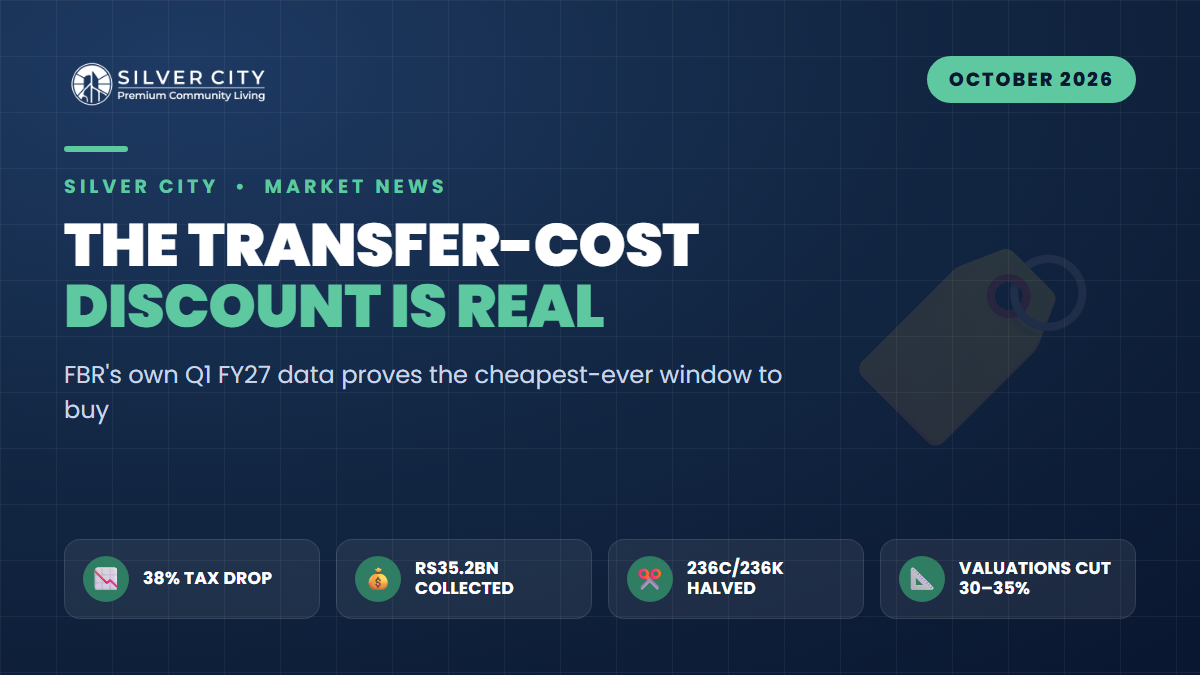
According to FBR’s provisional figures, income-tax collection from the real-estate sector fell 38% year-on-year to Rs35.2 billion in the first quarter of FY27 — roughly Rs22 billion less than the same quarter a year earlier. Crucially, transaction volumes did not collapse by anything close to 38%. When the tax take drops far faster than activity, there is only one explanation: the per-transaction cost has come down.
The breakdown makes it even clearer. Advance tax collected on property sales (Section 236C) fell about 42% to roughly Rs23 billion, while advance tax on purchases (Section 236K) dropped about 31% to around Rs12.2 billion. These are not forecasts or promises from a brochure — they are money that did not leave buyers’ and sellers’ pockets.
Two Cuts Stacking on Top of Each Other
The savings come from two separate policy moves working together:
- Rate cuts on 236C and 236K. The advance-tax rates for active filers on both the buyer and seller side were reduced to roughly half of the elevated levels that applied in the prior regime.
- Valuation tables cut 30–35%. Because 236C, 236K, stamp duty and CVT are all charged on the FBR-notified value (or the declared value, whichever is higher), lowering the notified value shrinks the base that every percentage is applied to.
This is the key insight most buyers miss: it is a double discount. A lower rate applied to a lower base compounds. Even charges whose percentage did not change still cost less in rupees because the value they sit on was reduced.
A Worked Example: 5-Marla RDA Plot
Consider a 5-marla plot in an RDA-approved Rawalpindi society. The table below is illustrative — your exact figures depend on the society, block and current notified rate — but it shows how the “before vs now” math works for an active filer.
| Item | Prior regime | Current FY27 window |
|---|---|---|
| FBR notified value (base) | Rs 4,000,000 | Rs 2,700,000 (approx. −32%) |
| Buyer advance tax — 236K (filer) | ~3.0% = Rs 120,000 | ~1.5% = Rs 40,500 |
| Seller advance tax — 236C (filer) | ~4.0% = Rs 160,000 | ~2.0% = Rs 54,000 |
| Stamp duty + CVT (on base) | Charged on Rs 4.0m | Charged on Rs 2.7m |
| Combined buyer + seller tax | ~Rs 280,000 | ~Rs 94,500 |
In this scenario the pure 236C/236K burden falls by roughly two-thirds once both the halved rates and the lower valuation base are applied. Add the reduction in stamp duty and CVT (which also ride on the notified value) and the total frictional cost of moving a 5-marla plot is at its lowest in years.
Why “Filer” Is Non-Negotiable
Every favourable number above assumes you are an active taxpayer on the FBR filer list. Non-filers still face dramatically higher 236K slabs (into double digits), and under Section 114C a non-filer can be blocked from registering higher-value property at all. The window is cheap if you are a filer. If you are not, becoming one before you transact is the single highest-return step you can take — it costs a return filing and unlocks the entire discount.
Why This Window May Not Last
A 38% drop in a revenue line is exactly the kind of number that attracts attention inside the FBR and the IMF programme, where revenue targets are binding. Historically, when a relief measure visibly undershoots collection, the policy response is to claw it back — through a mini-budget, a valuation-table “revision” upward, or a quiet rate adjustment at the next Finance Act. The current softness in collection is precisely what makes the window attractive to buyers and precarious as policy.
That asymmetry is the investor’s case: the downside of acting now is small (you locked in low costs), while the downside of waiting is that the discount is re-tightened before you move. For a long-hold plot buyer, saving six figures on entry costs is permanent alpha that no future price appreciation can reverse.
A Simple Decision Timeline
- Confirm filer status now — check the FBR Active Taxpayer List; file a return if needed.
- Pull the current notified value for your target society and block before negotiating.
- Get the full cost sheet in writing — 236C, 236K, stamp duty, CVT, registration and society transfer fee.
- Execute while the lower valuation table is in force rather than waiting for a possible revision.
Frequently Asked Questions
Does the 38% collection drop mean property prices are falling?
No. The Rs35.2bn figure measures tax collected on transactions, not market prices. The decline reflects lower tax rates and a reduced valuation base, not a crash in plot values. In fact, lower transaction costs tend to support demand because they make entering and exiting a position cheaper.
Who benefits more from the cuts — the buyer or the seller?
Both, but differently. The buyer’s 236K and the seller’s 236C are separate advance taxes, and both were reduced. The FBR data shows the seller-side 236C collection fell faster (about 42%) than buyer-side 236K (about 31%), so sellers saw a slightly steeper rate relief — while buyers also gain from the lower valuation base on stamp duty and CVT.
Is 236C/236K a final tax or can I adjust it later?
Both are adjustable advance taxes for filers, meaning they can be offset against your final tax liability (including capital gains) when you file your annual return. Keep every challan and the transfer deed so your tax adviser can claim the credit. Non-filers generally cannot adjust these amounts the same way — another reason to be on the filer list.
What should I verify before trusting a society’s “low tax” claim?
Confirm three things: that the society is formally RDA-approved (so the transfer is legally registrable), the exact FBR notified value for the specific block, and a written, itemised cost sheet. Approval status determines whether you can register at all; the notified value determines what every tax percentage is actually charged on.
The Bottom Line
The FBR’s Q1 FY27 numbers turn a marketing claim into a verifiable fact: the transaction-cost discount on Pakistani real estate is real and active today, built from halved 236C/236K rates stacked on valuation tables cut 30–35%. For a 5-marla plot, that can mean saving well into six figures on entry costs — savings that are permanent and independent of future price moves. If you are weighing where to deploy, an RDA-approved option such as Silver City in Rawalpindi is worth shortlisting while this window remains open: confirm filer status, pull the current notified value, and transact before the policy is inevitably re-tightened.