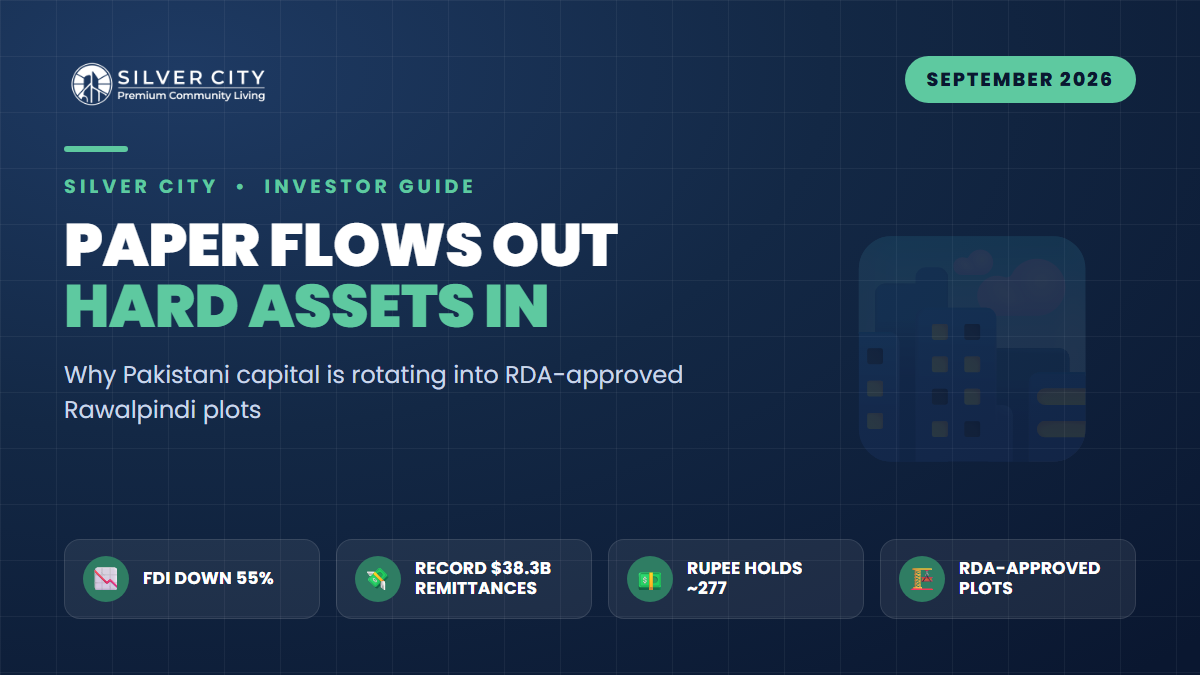
Two numbers released in autumn 2025 tell a story every Pakistani investor should read carefully. In September 2025, net foreign direct investment (FDI) into Pakistan fell to just $185.6 million, down roughly 55% from about $417.4 million a year earlier — a collapse in the “smart money” that global capital is supposed to represent. In the same window, remittances from overseas Pakistanis closed FY2025 at a record $38.3 billion, up about 27% year-on-year, while the rupee held remarkably steady near 277 to the dollar.
Put those side by side and a pattern emerges. Foreign portfolio and direct capital — the flighty, “paper” money that chases yield and can leave overnight — is retreating. But the money earned by hard-working Pakistanis abroad is pouring home in record volumes. The question that matters for your wallet: where does that $38.3 billion actually go once it lands?
The Great Rotation: From Paper to Bricks
Historically, a large slice of remittance inflows and domestic savings ends up in one place — real estate, and specifically residential plots. There are structural reasons for this that have only intensified in 2025:
- Falling returns on paper instruments. As the State Bank’s policy rate has eased from its 2024 peaks, the eye-watering double-digit returns on T-bills and savings accounts have compressed. Money that parked in fixed income is now hunting for the next store of value.
- A stable rupee changes the maths. When the currency was in freefall, holding dollars was the trade. With the rupee holding near 277, that hedge has lost urgency — and rupee-denominated hard assets look more attractive again.
- FDI’s retreat signals caution, not opportunity, in equities. When foreign direct investors pull back, domestic sentiment toward the stock market often cools too. Land, by contrast, is tangible, understood, and doesn’t get margin-called.
- Remittances are recurring, not one-off. At roughly 20 times the size of annual FDI, remittances are the real engine of Pakistan’s external accounts — and overseas families overwhelmingly prefer to convert that income into property back home.
Why Rawalpindi, and Why RDA-Approved
Not all property captures this rotation equally. The twin-city region of Rawalpindi–Islamabad remains the country’s most resilient plot market, anchored by federal employment, the new Islamabad airport, and the long-anticipated Rawalpindi Ring Road, which is reshaping accessibility along the Girja Road and Thalian Interchange corridor.
But the single most important filter in 2025 is legal status. After repeated crackdowns on illegal and unapproved schemes, the dividing line for investors is whether a society is approved by the Rawalpindi Development Authority (RDA) and holds a valid NOC. Approved land protects you from demolition risk, transfer disputes, and the liquidity trap of owning a file no bank or buyer will touch.
Paper Flows vs. Hard Assets: A Side-by-Side
| Factor | Paper flows (equities/FDI-linked) | RDA-approved plots |
|---|---|---|
| Volatility | High — sentiment-driven | Low — sticky, illiquid in a good way |
| Currency exposure | Sensitive to rupee swings | Rupee hard asset; land keeps pace with inflation |
| Entry ticket | Variable | From ~Rs 2.75m (5 Marla) |
| Financing | Rarely instalment-based | Long 3–4 year instalment plans |
| Overseas-friendly | Requires active management | Buy-and-hold; family can oversee |
| Key risk | Capital flight, drawdowns | Buying an unapproved scheme |
What Entry Actually Costs Today
The appeal of the plot market for remittance-funded buyers is the low, staged entry point. In an RDA-approved society such as Silver City on Main Girja Road (near the Thalian Interchange), indicative 2025 pricing looks like this:
| Plot size | Indicative price (2025) | Typical structure |
|---|---|---|
| 3.5 Marla | Entry-level residential | Down payment + 48 monthly instalments |
| 5 Marla | From ~Rs 2.75 million | ~15% down, 3–4 year plan |
| 10 Marla | Mid-tier residential | Down payment + instalments |
| 1 Kanal | Around ~Rs 10.35 million | Down payment + instalments |
Prices are indicative and move with location within the scheme, development stage, and Ring Road progress. Always confirm the current payment plan directly before committing.
A Practical Playbook for 2025–26
- Verify approval first, price second. Ask for the RDA approval and NOC status in writing and cross-check it. A cheap plot in an unapproved scheme is the most expensive mistake in this market.
- Buy the corridor, not the hype. Proximity to the Ring Road interchanges and established access roads drives real end-user demand — the kind that lets you exit later.
- Use the instalment structure to average in. Staged payments let remittance-funded buyers deploy monthly inflows without timing the market in one lump.
- Match the plot to the buyer. 3.5–5 Marla suits first-time and overseas investors seeking liquidity; 10 Marla and 1 Kanal suit end-users and larger tickets.
- Keep documentation clean. For overseas Pakistanis, ensure transfers route through banking channels — it protects both your tax position and the remittance-inflow story that keeps the rupee stable.
The Bottom Line
The macro signals of late 2025 are not contradictory — they’re complementary. FDI’s ~55% slide to $185.6 million shows foreign paper capital is cautious. A record $38.3 billion in remittances and a rupee anchored near 277 show that domestic and diaspora capital is abundant and looking for a home. When paper flows retreat and hard-asset inflows surge, the historical response in Pakistan is a rotation into land — especially legally secure, well-located plots.
Frequently Asked Questions
Does falling FDI mean Pakistani real estate is risky right now?
Not necessarily. FDI measures foreign appetite for direct business investment; it’s a different pool of money from the remittances and domestic savings that fund the plot market. With remittances at a record $38.3 billion and the rupee stable near 277, the domestic capital feeding real estate is actually stronger, not weaker.
Why does “RDA-approved” matter so much?
RDA approval and a valid NOC confirm the land is legally sanctioned for development in Rawalpindi’s jurisdiction. Unapproved schemes carry demolition, transfer, and resale risks — and are hard to sell or finance. Approval is the single biggest factor separating a safe plot from a speculative file.
Is a stable rupee good or bad for plot investors?
Broadly good. A stable rupee near 277 reduces the incentive to hoard dollars and restores confidence in rupee-denominated hard assets like land, which tend to preserve value against inflation over multi-year holds.
How much do I need to start?
Entry is accessible: a 5 Marla plot in an approved Rawalpindi society can start from around Rs 2.75 million, often with roughly 15% down and the balance over a 3–4 year instalment plan — well-suited to buyers deploying monthly remittance income.
Wrap-up: If you’re looking to rotate savings or overseas earnings out of volatile paper and into a tangible, legally secure asset, an RDA-approved scheme on the Rawalpindi Ring Road corridor deserves a close look. Silver City (silvercity.pk), an RDA-approved society on Main Girja Road near the Thalian Interchange, is one such option worth considering — but as always, verify current approvals and payment plans directly before you commit.