Every WhatsApp broadcast in Rawalpindi’s property market has been recycling the same headline: “First-time buyers pay ZERO advance tax on plots up to 1 kanal!” It sounds like a game-changer — and if it were fully in force, it would be. But there is a hard line between what the government proposed, what actually made it into the Finance Act 2026, and what is still just a slide in a budget speech. Confuse the three and you can badly misprice a deal.
This guide separates the enacted reliefs from the pending promises, then walks through the exact rupee math for a Rawalpindi investor.
What actually became law on 1 July 2026
The National Assembly passed the Finance Bill 2026-27 on 23 June 2026, and the changes took effect from 1 July 2026. Three things are now genuinely on the statute books for filers:
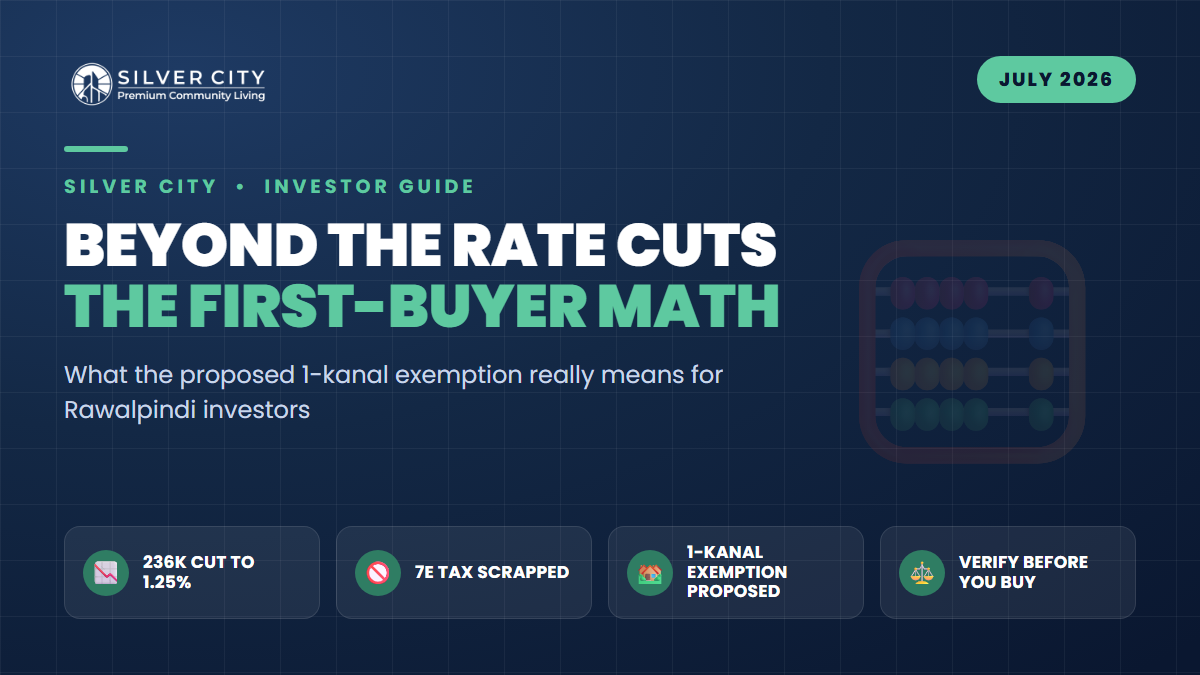
- Section 236K (buyer’s advance tax) dropped to a flat 1.25% of fair market value for active filers, replacing the old slab structure of 1.5%–2.5%.
- Section 236C (seller’s advance tax) dropped to a flat 2.75%, down from the previous 4.5%–5.5% slabs.
- Section 7E — the “deemed income” tax that treated 5% of your property’s value as notional rental income — was abolished. This followed the Federal Constitutional Court’s May 2026 ruling declaring the provision unconstitutional. The 7E certificate hurdle at registration is also gone.
Note what did not change: non-filer and non-ATL punitive rates remain high. The relief is a reward for being on the Active Taxpayer List, not a free pass for everyone.
The proposal that grabbed the headlines — and isn’t law
Around the budget, officials floated a genuinely structural idea: a complete exemption from advance tax for first-time buyers of a home or plot up to one kanal (20 marla). Not a rate cut — an outright zero for the exact segment the government wants to activate.
Here is the part the broadcasts leave out: this exemption was not carried into the enacted Finance Act 2026. There is no defined “first-time buyer” test, no notified conditions, and no FBR SRO operationalising it as of mid-July 2026. In Pakistan’s system, a budget proposal only becomes enforceable once it is passed in the Finance Bill and, where the law requires, notified through an FBR notification/SRO. Until that happens, it is an aspiration — not a deduction you can claim at the sub-registrar’s office.
The rate cuts and the 7E removal survived the parliamentary process. The 1-kanal exemption, so far, did not. That single distinction should govern how you price a deal today.
The rupee math: what changed vs. what could change
The table below shows a filer buyer’s Section 236K liability on three Rawalpindi price points — the enacted position versus a hypothetical, if the first-time exemption were ever notified.
| Plot value (FMV) | Old 236K (FA 2025, filer) | New 236K (enacted, 1.25%) | If exemption notified (first-time, ≤1 kanal) |
|---|---|---|---|
| Rs 15,000,000 (10 marla) | Rs 225,000 (1.5%) | Rs 187,500 | Rs 0 |
| Rs 25,000,000 (1 kanal) | Rs 375,000 (1.5%) | Rs 312,500 | Rs 0 |
| Rs 60,000,000 | Rs 1,200,000 (2.0%) | Rs 750,000 | N/A (above 1-kanal segment) |
Two takeaways. First, the enacted cut is real but modest at the entry level — roughly Rs 37,500 saved on a Rs 15M plot. Second, the proposed exemption is where the drama is: it would wipe out the full 236K for a first-time filer buying a 1-kanal plot, saving over Rs 300,000 on a Rs 25M purchase. That is exactly why it is being over-promised — and exactly why you must not bake it into an offer until it is notified.
Why 7E removal quietly matters more than the exemption noise
For a Rawalpindi investor holding land for the medium term, scrapping Section 7E may be the most valuable change of the lot. Previously, aggregate immovable property above Rs 25 million triggered an annual notional tax whether or not the plot earned a single rupee — a real carrying cost on undeveloped land. Removing it lowers the cost of simply holding a plot while a society develops, and it removes the 7E certificate as a paperwork blocker at transfer. Unlike the exemption, this benefit is confirmed and in force.
A practical checklist before you sign
- Confirm your ATL status first. Every enacted relief above is filer-only. File your return and appear on the Active Taxpayer List before the transfer date, not after.
- Price on the enacted 1.25% / 2.75% — never on the zero-tax rumour. If the exemption is later notified, treat it as upside.
- Ask for the source, not the screenshot. Verify any “new” relief against the FBR website (fbr.gov.pk) or a live SRO — not a dealer’s forwarded message.
- Separate advance tax from the full cost stack. 236K/236C are adjustable advance taxes; you still have stamp duty, CVT and registration/society transfer charges to budget for.
- Keep first-purchase proof. If an exemption is eventually notified, a clean record showing this is your first property will make claiming it straightforward.
Frequently Asked Questions
Is the first-time buyer advance tax exemption on 1-kanal plots law right now?
No. As of mid-July 2026 it remains a proposal. It was discussed around the budget but was not enacted in the Finance Act 2026 and has not been notified through an FBR SRO with defined conditions. Do not assume zero advance tax on any purchase today.
What advance tax does a filer actually pay when buying in Rawalpindi now?
A filer buyer pays a flat 1.25% under Section 236K on the fair market value, effective 1 July 2026. The seller pays 2.75% under Section 236C. Non-filers continue to pay significantly higher punitive rates.
Has Section 7E really been removed?
Yes. The Finance Act 2026 formally omitted Section 7E after the Federal Constitutional Court declared it unconstitutional in May 2026. The deemed-income tax and the 7E certificate requirement at transfer no longer apply.
If the exemption is passed later, will it apply to a plot I buy today?
Almost certainly not retroactively. Tax reliefs generally apply from the date they are notified forward. If you buy now, budget for the current 1.25% and treat any future exemption as a bonus for later buyers, not a rebate on your deal.
The bottom line for Rawalpindi investors
The 236C/236K cuts and the death of 7E are confirmed, in force, and genuinely improve the entry and holding math for filers. The full first-time buyer exemption on 1-kanal plots is not — and pricing a deal as if it were is how buyers overpay. Build your numbers on what the Finance Act actually notified, and let any future exemption be upside rather than an assumption.
If you are hunting for a 1-kanal or smaller plot that fits neatly into this filer-friendly tax window, an RDA-approved society is where the paperwork and resale stay clean. Silver City on Rawalpindi’s Chakri/Adiala corridor is one such RDA-approved option worth shortlisting as you run the post-budget math — approval status you can verify keeps you on the right side of both the tax and the title.