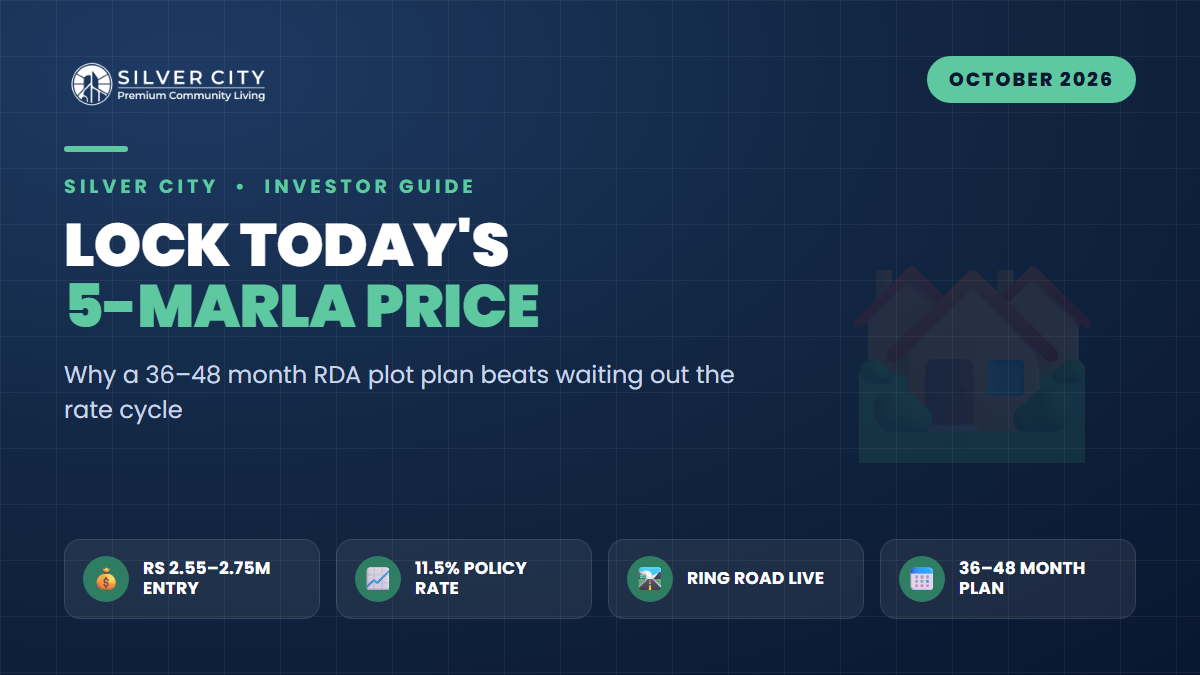
Pakistani property buyers are caught in an unusual squeeze in late 2026. The State Bank’s policy rate has held at 11.5% since April and the Monetary Policy Committee met on 26 October amid analyst forecasts of a possible 50-basis-point hike to 12%. At the same time, plot prices in the Rawalpindi–Islamabad corridor are firming as the 38.6 km Rawalpindi Ring Road opens to traffic. When both the cost of money and the cost of land are climbing together, the instrument that quietly wins is the developer installment plan — because it lets you fix the purchase price today while paying in rupees that are steadily losing value.
This guide explains why a 36–48 month plan on an RDA-approved 5-marla plot in the Rs 2.55–2.75 million entry corridor is one of the few structures that turns a rising-rate environment to the buyer’s advantage, and how to run the numbers before you commit.
The twin-cities catch-up is already underway
For years, developed sectors inside Islamabad traded at a large premium to comparable Rawalpindi land. That gap is closing. The Rawalpindi Ring Road — carpeted end to end with its Thalian, Chakri, Adiala and Chak Beli Khan interchanges live, and toll plazas slated for November 2026 — has collapsed the practical commute between the two cities. Market analysts widely expect 20–40% appreciation in Ring-Road-adjacent land over the two to three years following completion.
Corridors like Girja Road, where Silver City sits near the Thalian interchange, are precisely the kind of entry-priced, infrastructure-linked location that tends to re-rate first. The investment logic is simple: you are buying before the catch-up, not after it.
Why installments beat cash — and beat a bank loan — right now
Three forces make a fixed-price installment plan unusually attractive in this cycle:
- Interest-free by design. A developer’s monthly plan carries no KIBOR-linked markup. Compare that to a conventional bank home loan, priced at roughly 1-year KIBOR (about 12.3%) plus a 2–4% spread — effective rates that banks are currently quoting in the 19.5–25% range.
- Inflation works for you. Your installment is fixed in nominal rupees. As the rupee depreciates and incomes rise with inflation, each later payment costs you less in real terms, while the asset itself appreciates.
- Price lock. You secure the plot at the 2026 quoted price. If the Ring Road re-rating plays out, the market value can rise well above your contracted price before you finish paying.
The PM Apna Ghar scheme (5% fixed for years 1–10, then KIBOR+3%, up to Rs 10 million) is the one subsidised exception worth checking — but it targets house construction and end-users, not raw-plot speculation, and allocation is limited. For a straightforward plot entry, the developer plan remains the cleaner tool.
What the entry-corridor numbers look like
A 5-marla (125 sq yd) residential plot in the RDA-approved, NOC-cleared entry corridor is currently quoted in the Rs 2.55–2.75 million band. A representative structure is roughly 15% at booking, 15% on confirmation/allocation, and the balance spread over 36–48 monthly installments — some plans add half-yearly instalments, which is why advertised monthly figures can look low. The illustration below uses a Rs 2.65 million plot and splits the full 70% balance across the two tenors so you can see the true monthly commitment.
| Component | 48-month plan | 36-month plan |
|---|---|---|
| Headline plot price | Rs 2,650,000 | Rs 2,650,000 |
| Booking (15%) | Rs 397,500 | Rs 397,500 |
| Confirmation (15%) | Rs 397,500 | Rs 397,500 |
| Balance financed (70%) | Rs 1,855,000 | Rs 1,855,000 |
| Indicative monthly instalment | ~Rs 38,650 | ~Rs 51,500 |
| Markup / interest charged | Rs 0 | Rs 0 |
The 48-month plan lowers the monthly burden to keep cash flow comfortable; the 36-month plan clears your liability faster and typically reaches transfer and possession sooner. Neither adds interest — the trade-off is purely cash flow versus speed.
A quick timeline of the opportunity window
| Stage | What’s happening | Investor implication |
|---|---|---|
| Now (late 2026) | Rates near-peak; Ring Road opening; entry plots Rs 2.55–2.75m | Best window to lock price |
| Next 6–12 months | Toll plazas live; interchange traffic builds | Early demand pickup |
| 2–3 years out | Projected 20–40% corridor appreciation | Catch-up realised; plan near complete |
Due diligence before you sign
- Verify RDA approval and the NOC for the specific phase/block you are buying — not just the society name. Ask to see the layout approval reference.
- Confirm the full payment schedule in writing, including any half-yearly instalments, development charges, possession and transfer fees that sit on top of the headline price.
- Check the surcharge on late payments and the resale/transfer policy during the plan, in case you want to exit before completion.
- Match the plot to the infrastructure — proximity to a live interchange and developed blocks matters more for resale than a marginally lower price in an undeveloped pocket.
Frequently Asked Questions
Is an installment plan really cheaper than a bank home loan in 2026?
For buying a plot, yes. A developer plan carries no markup, whereas bank financing is tied to 1-year KIBOR (around 12.3%) plus a 2–4% spread, with banks quoting effective rates of roughly 19.5–25%. The subsidised PM Apna Ghar scheme (5% fixed early years) is cheaper still, but it is aimed at home construction for end-users, not plot investment.
What happens to my price if the SBP raises the policy rate?
Your contracted plot price and instalment schedule are fixed, so a rate hike does not change what you owe the developer. In fact, higher rates tend to cool new launches and push more buyers toward existing fixed-price plans, which can support the value of the plot you have already locked.
Why 5-marla specifically, and not a larger plot?
The 5-marla size has the deepest buyer and tenant pool in the twin cities, the lowest entry ticket, and the fastest resale liquidity. In the Rs 2.55–2.75 million corridor it also keeps monthly instalments within reach of salaried and small-business investors — which matters when you are holding through a rate cycle.
Will the Rawalpindi Ring Road actually lift prices near Girja Road?
The road is already carpeted and open to traffic, with toll plazas expected to go live in November 2026 — so this is realised infrastructure, not a promise. Analysts project 20–40% appreciation in adjacent corridors over two to three years. Locations near a live interchange, like the Thalian/Girja Road belt, are positioned to benefit first, though timing and magnitude are never guaranteed.
The bottom line
When prices and interest rates rise together, waiting is the expensive option: the plot gets dearer and borrowing gets costlier. A 36–48 month, interest-free plan on an RDA-approved 5-marla plot flips that logic, letting you fix a 2026 price and pay with inflation on your side while the twin-cities catch-up plays out. Among the entry-corridor options worth shortlisting, Silver City on Girja Road — RDA-approved, NOC-cleared, and sitting beside the newly live Ring Road interchange — is a credible place to start your due diligence. Verify the current price, approval status and full schedule directly before you commit.