On 7 October 2026, the International Monetary Fund and Pakistan reached a staff-level agreement (SLA) on the fourth review of the 37-month Extended Fund Facility (EFF) and the third review of the 28-month Resilience and Sustainability Facility (RSF). For property investors in Rawalpindi and Islamabad, this is not a dry macroeconomic footnote — it is a signal about which kind of real estate the next two years will reward.
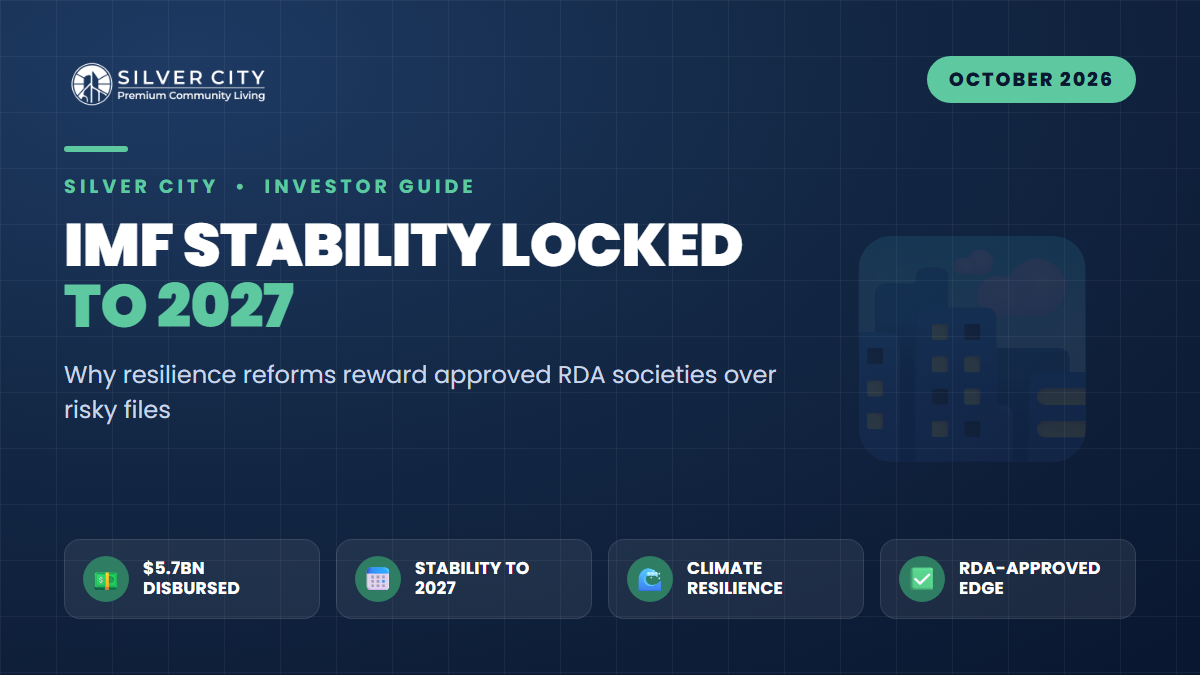
Once the IMF Executive Board signs off (approval is imminent), Pakistan unlocks about US$1.0 billion (SDR 760 million) under the EFF and roughly US$210 million (SDR 154 million) under the RSF — pushing cumulative disbursements under the two arrangements to about US$5.7 billion. With the EFF running on a 37-month clock from September 2024, the programme anchors external discipline well into 2027.
What the October 2026 Deal Actually Delivers
The headline is stability. The SLA confirms that Pakistan has stayed on its reform path: gross reserves climbed to about US$21.5 billion by end-September 2026, headline inflation sat around 10.3% in September, and FY26 growth is estimated near 3.6%. For a market that spent 2022–2023 bracing for default, a funded IMF programme stretching to 2027 removes the tail risk that has haunted every buy-or-wait decision.
| Item | Detail (per Oct 7, 2026 SLA) |
|---|---|
| EFF 4th review tranche | ~US$1.0bn (SDR 760m) |
| RSF 3rd review tranche | ~US$210m (SDR 154m) |
| Cumulative EFF + RSF disbursed | ~US$5.7bn |
| EFF arrangement | 37-month, approved Sep 2024 (anchors to ~2027) |
| RSF arrangement | 28-month, approved May 2025 |
| Board approval | Pending — imminent |
| Gross reserves (end-Sep 2026) | ~US$21.5bn |
The RSF Is the Part Investors Keep Missing
The EFF stabilises the currency and the budget. The RSF is different — it is a climate-and-disaster resilience facility. The reforms it supports, as described in the IMF’s own review, include integrating climate factors into public investment planning, strengthening disaster-risk financing, irrigation pricing, energy-efficiency standards, electricity-subsidy targeting, and transport decarbonisation.
Read that list as a property investor. “Climate factors in public investment planning” and “disaster-risk financing” translate, over time, into tighter scrutiny of where development is allowed, how it is built, and who carries the loss when a floodplain goes under. The direction of travel is unambiguous: the state is being nudged, through loan conditionality, toward penalising badly-sited, unregulated construction and rewarding properly-planned, approved development.
Why This Favours Approved Societies Over “Files”
Pakistan’s unapproved-file culture — buying a paper allotment in a scheme that has no layout approval, no NOC, and often no legal land title — is precisely what resilience-focused reform works against. Unapproved schemes are the ones most likely to sit on natural drainage paths, nullahs, and low-lying flood zones, because cheap land is cheap for a reason. When disaster-risk financing and climate-screened planning mature, these are the plots that become uninsurable, unmortgageable, and unsellable.
This is not hypothetical in Rawalpindi. In March 2025 the Rawalpindi Development Authority (RDA) declared 157 housing schemes illegal and sought a ban on plot transactions within them, acting under the Punjab Development of Cities Act 1976 and the Punjab Development Authorities (Private Housing Schemes) Rules 2021. Through 2025 the RDA continued sealing offices of non-compliant societies. An IMF programme that hard-wires resilience into planning gives regulators more cover, not less, to keep tightening.
Approved vs Unapproved: The Investor’s Risk Ledger
| Factor | RDA-approved society | Unapproved file / illegal scheme |
|---|---|---|
| Legal transferability | Clean title, RDA records | Transfer bans, disputed title |
| Flood/drainage siting | Approved layout, engineered drainage | Often on nullahs / low-lying land |
| Bank financing | Mortgageable | Rarely financeable |
| Future insurability | Favoured under disaster-risk reform | At risk of exclusion |
| Resale liquidity | Broad buyer pool | Shrinking, discount-only |
| Regulatory exposure | Low | Sealing, demolition risk |
How to Position for 2026–2027
- Verify approval first, price second. Confirm the society and your specific block appear in current RDA-approved records before any payment. A bargain price in an unapproved scheme is a liability, not an asset.
- Check the siting, not just the brochure. Ask where the nearest nullah and natural drainage run. Resilience reform will progressively reward dry, well-drained, engineered sites.
- Favour developed or fast-developing phases. With external stability secured to 2027, capital flows toward low-risk, possession-ready inventory with real infrastructure on the ground.
- Think like a lender and an insurer. If a bank would mortgage it and an insurer would cover it, it is on the right side of the reform curve.
Frequently Asked Questions
Does the IMF deal mean property prices will rise?
Not automatically. What it removes is downside risk — currency collapse and default fears that froze the market. A funded programme to 2027, cooling inflation, and ~US$21.5bn reserves create a calmer base for genuine, infrastructure-backed appreciation, which concentrates in legally secure, well-planned projects rather than speculative files.
How does a climate loan (RSF) affect my plot choice?
The RSF pushes disaster-risk financing and climate-screened public investment. Over the medium term that means flood-prone, unapproved plots face higher regulatory, insurance, and financing friction, while approved societies with engineered drainage become the default safe choice. It shifts relative value toward compliance.
Is an unapproved “file” ever worth the discount?
Rarely, and the risk is rising. With the RDA having declared 157 schemes illegal and seeking transaction bans, an unapproved file can become untransferable overnight. The discount reflects real, intensifying risk — not a hidden bargain.
How do I confirm a society is RDA-approved?
Check the RDA’s published approved-schemes and NOC status for the exact phase and block you are buying, and insist on seeing approval documentation in writing. Do not rely on marketing claims or verbal assurances from agents.
The Bottom Line
The October 2026 IMF agreement locks external stability into 2027 and, through the RSF, bakes climate and disaster resilience into how Pakistan plans and finances development. The clear winners are properly-planned, legally-secure, well-drained projects — not cheap files on vulnerable land. For investors wanting exposure to Rawalpindi’s growth while staying on the right side of this reform curve, an RDA-approved society such as Silver City is worth serious consideration: approved status, planned infrastructure, and clean transferability are exactly the attributes the next two years will reward. As always, verify current approval and documentation yourself before committing capital.