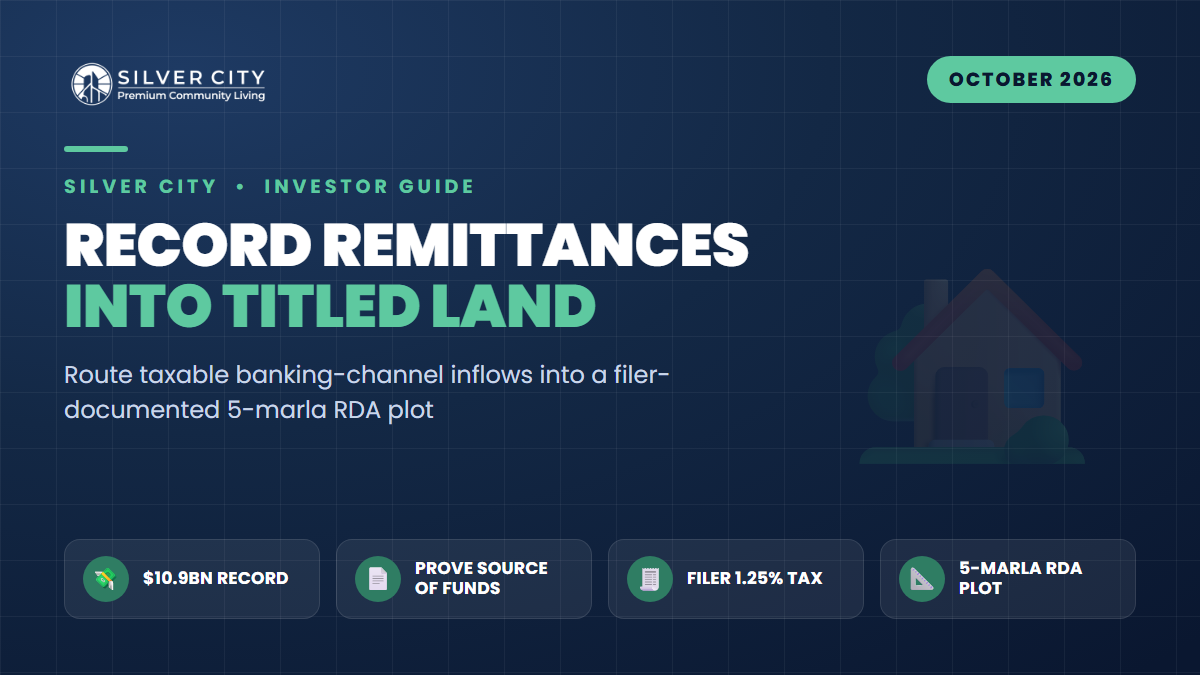
On 10 October 2026, the State Bank of Pakistan (SBP) reported that overseas Pakistanis sent home a record $10.9 billion in the first quarter of FY27 (July–September 2026) — up roughly 14% from $9.5 billion a year earlier. What makes the number striking is its timing: it arrived after the SBP scrapped its two headline remittance incentive schemes from 1 July 2026. The diaspora kept sending more even without a reward on the other end. For serious investors, that signals a durable inflow worth converting into something permanent: titled, documented land.
What Changed in the Remittance System
Under International Monetary Fund (IMF) pressure over ballooning costs, the SBP discontinued the Sohni Dharti Remittance Programme (SDRP) and the Telegraphic Transfer Charges Incentive Scheme (TTCIS) effective 1 July 2026. The TTCIS had reimbursed banks and exchange companies a flat SAR 20 rebate on each eligible $200 transaction — a subsidy estimated to cost Pakistan Rs100–120 billion a year.
Crucially, the SBP directed banks, microfinance banks and exchange companies to keep processing eligible home-remittance transfers free of charge for both sender and beneficiary. So the end-user experience is largely unchanged; only the backend subsidy is gone. The practical takeaway for a buyer: your inflow still lands clean and fee-free through the formal banking channel — and that formal channel is exactly what creates a paper trail you can use.
Why “Banking-Channel” Matters for Property
Money that enters Pakistan through the formal banking channel generates documentation at every step: a remittance advice, and for encashment into rupees, a Proceeds Realization Certificate (PRC) from the receiving bank. These are the cleanest possible evidence of where your purchase money came from. Pakistan has historically allowed foreign remittances brought in through normal banking channels and encashed into rupees to be treated favourably for source-of-funds purposes under Section 111(4) of the Income Tax Ordinance — though recent budgets have tightened the thresholds, so the documentation matters more than ever, not less.
Cash in a drawer buys you nothing you can prove. A banking-channel inflow that you then route into a registered, RDA-approved plot leaves you holding both a title deed and the trail that explains it.
The Filer Advantage Is Now the Whole Game
The Finance Act 2026 simplified property withholding tax and sharpened the filer/non-filer gap dramatically. Buyers pay advance tax under Section 236K; sellers under Section 236C. Being on the Active Taxpayers List (ATL) is no longer a nicety — it is the single biggest cost lever a diaspora buyer controls.
| Transaction | Filer (on ATL) | Non-Filer |
|---|---|---|
| Buying property – 236K | 1.25% (flat) | 10.5% – 18.5% (slabbed by value) |
| Selling property – 236C | 2.75% (flat) | 11.5% |
On an affordable plot the difference is enormous in percentage terms. Take a 5-marla plot priced at roughly Rs2.75 million:
- As a filer: 236K at 1.25% ≈ Rs34,375 advance tax.
- As a non-filer: 236K at 10.5% ≈ Rs288,750.
- You save roughly Rs254,000 on a single plot — more than the first year of instalments on many plans.
Overseas Pakistanis can file a return and appear on the ATL even without Pakistan-source salary income; many maintain filer status precisely to buy and sell property cheaply. The advance tax you pay is adjustable against your final liability, so for a genuine filer it is a cash-flow item, not a sunk cost.
Why a 5-Marla RDA Plot Fits the Inflow
A 5-marla plot is the sweet spot for diaspora capital: large enough to build a home or resell, small enough to fund from monthly remittances rather than one lump sum. Insist on an RDA-approved (Rawalpindi Development Authority) society — approval is what makes the title bankable, transferable and defensible. Unapproved files are where overseas buyers most often lose money to disputes and stalled development.
A Clean, Documented Buying Sequence
- Register as a filer and confirm you appear on the ATL before transfer.
- Remit through the banking channel into your own Pakistani account (a Roshan Digital Account works well for this).
- Collect the PRC / remittance advice for each inflow and keep them with the plot file.
- Pay the seller and 236K tax from that documented account — never cash — so the money trail is unbroken.
- Register the title and declare the asset in your wealth statement at filing time.
Indicative Costs and Timeline
| Item | Typical figure (2026) |
|---|---|
| 5-marla plot price (RDA society) | Rs2.55m – Rs2.75m |
| Booking | ~15% down |
| Confirmation | ~15% |
| Monthly instalment | ~Rs30,000 over ~48 months |
| 236K advance tax (filer, ~Rs2.75m) | ~Rs34,375 |
Funded from a steady remittance stream, a plan like this is realistically covered by setting aside a portion of what many diaspora households already send home each month.
Frequently Asked Questions
Does the end of SBP reward schemes make remittances more expensive for me?
No. The SBP removed the backend subsidy to banks and exchange companies, but directed them to keep offering eligible home-remittance transfers free of charge to both sender and receiver. Your transfer experience is largely unchanged — and the formal channel still generates the PRC you need for property.
I live abroad and earn no income in Pakistan. Can I still be a filer?
Yes. Non-resident Pakistanis can file an income tax return and appear on the Active Taxpayers List. Doing so cuts 236K buyer tax from double-digit slabs to a flat 1.25% and makes any future sale far cheaper under 236C — a saving that typically dwarfs the cost of filing.
What exactly proves my “source of funds” on a plot?
The strongest package is: a banking-channel inflow into your own account, the bank-issued PRC or remittance advice for that inflow, payment to the seller and tax authorities from the same documented account, a registered title in an RDA-approved society, and the asset declared in your wealth statement. Together these answer the source-of-funds question before it is ever asked.
Is a 5-marla plot better than a flat for overseas buyers?
For most diaspora investors, a plot in an approved society offers lower entry cost, instalment flexibility that matches monthly remittances, no maintenance while you are abroad, and the option to build later. The key is RDA approval and a clear, transferable title — not the structure type.
The Bottom Line
A record $10.9 billion quarter shows the diaspora inflow is strong and structural, even without incentives. The winning move is to convert that taxable, banking-channel money into a filer-documented, titled asset that proves its own origin. An RDA-approved society such as Silver City on Girja Road near the Thalian interchange — with affordable 5-marla plots on multi-year instalment plans — is a credible option worth shortlisting as you build a clean, documented property position in the Twin Cities. Always verify current pricing, approval status and tax figures with the society and a tax professional before you commit.
@@END@@
Sources: [Dawn – Remittances rise 14pc to $10.9bn](https://www.dawn.com/news/2036050/remittances-rise-14pc-to-109bn-in-july-sept), [Business Recorder – SBP discontinues TTCIS](https://www.brecorder.com/news/40428281), [Dawn – Remittance incentives abolished as IMF steps in](https://www.dawn.com/news/2012606), [aiksol360 – 236C & 236K filer vs non-filer rates](https://aiksol360.com/guide/property-tax-rates-pakistan-filer-vs-non-filer/), [Silver City – RDA 5-marla value entry](https://silvercity.pk/rawalpindi-rda-5-marla-value-entry-236c-236k-tax-cuts/).