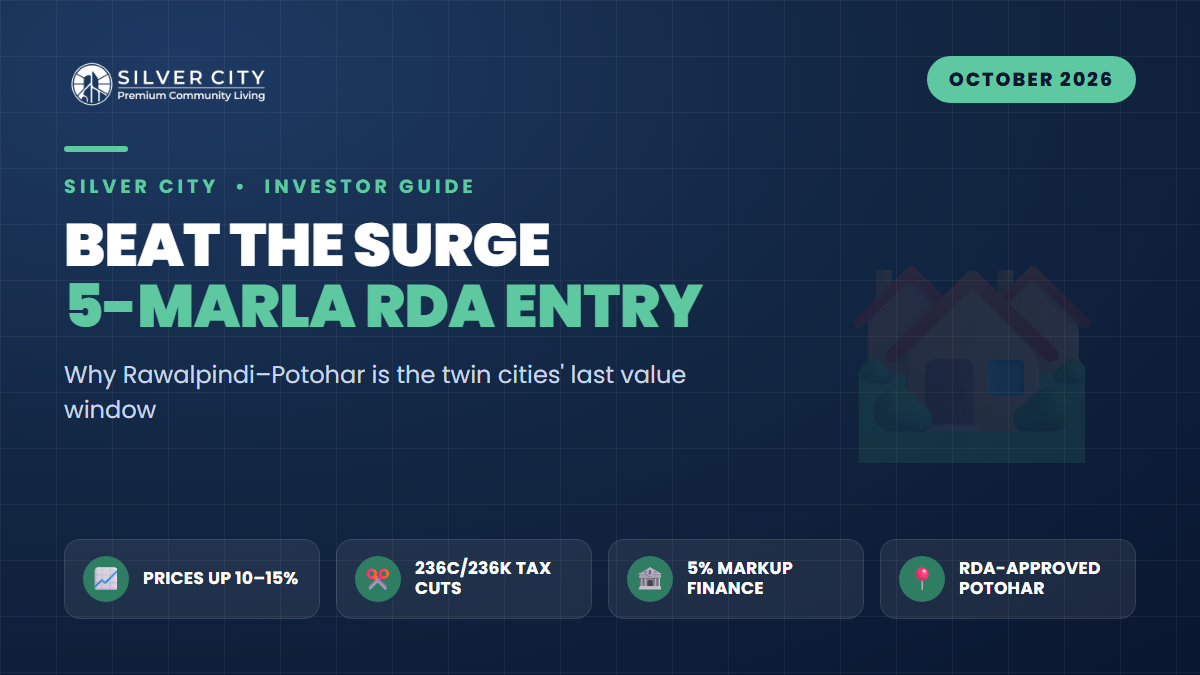
In October 2026, Business Recorder reported that residential property prices had climbed an estimated 10–15% in recent weeks across Karachi, Lahore and Islamabad, as buyers and investors returned to the market in force. The drivers are no longer speculative: lower transaction taxes under Sections 236C and 236K, a government-backed low-markup housing finance scheme, and a stretch of genuine macroeconomic stability have combined to pull capital back into bricks and mortar.
But here is the part most headlines miss. Property cycles in Pakistan do not arrive everywhere at once. The big three cities move first; the Rawalpindi–Potohar belt typically lags the cycle by a few quarters. For an investor, a lag is not a weakness—it is a window. This guide explains why that window is open now, and why a 5-marla RDA-approved plot is arguably the twin cities’ last affordable entry point before the surge catches up.
What the Data Actually Shows
The recovery is measurable, not anecdotal. According to market data cited through 2026, average house prices in February 2026 stood at roughly PKR 83.6 million in Islamabad, PKR 77.7 million in Karachi, and PKR 52.1 million in Lahore. Karachi alone recorded about 16.6% year-on-year house-price growth by mid-2026. Those are not plot prices—they are built-house averages—but they signal the direction of travel across the whole asset class.
When headline markets run this hard, the affordability gap pushes first-time buyers and yield-seeking investors outward toward cheaper, well-planned peripheries. Rawalpindi–Potohar, sitting right next to Islamabad but priced a fraction of it, is the natural overflow zone.
The three tailwinds, briefly
- Tax cuts (236C/236K): The Budget 2026–27 reduced withholding tax on property transactions. For active filers, buyer tax under Section 236K is now a flat 1.25% (down from 1.5%+), and seller tax under Section 236C is 2.75% (down from 4.5% on the top slab). Lower friction on both ends of a deal directly improves net returns.
- Low-markup finance: The Mera Ghar Mera Ashiana markup-subsidy scheme, launched with the State Bank in September 2025 and revised in 2026 to a uniform 5% end-user markup, offers up to 90% financing (10% equity) over a 20-year tenor, with the subsidy running for the first 10 years. It is channelled through commercial, Islamic and microfinance banks and HBFCL. Cheaper credit widens the buyer pool.
- Macro stability: Easing inflation and a lower policy-rate environment have cut the opportunity cost of holding real estate versus cash, nudging savers back into property.
One caveat worth stating plainly: tax measures only become binding once the Finance Bill is passed and FBR formally notifies the rates. Always confirm the current notified figures with a tax professional before transacting.
Why Rawalpindi–Potohar Lags—and Why That Helps You
Peripheral markets lag because transactions there are thinner, developer inventory releases are slower, and price discovery depends on the spillover from core-city demand. Capital chases Islamabad’s DHA and Bahria first; only once those become expensive does momentum roll down Girja Road, the Chakri belt and the wider Potohar plateau.
That rolling delay is exactly what an early entrant exploits. You are buying into the same macro cycle that has already lifted Islamabad 10–15%, but at a price that has not yet re-rated. Infrastructure is tightening the gap too: the Rawalpindi Ring Road and the Chakri–Thalian corridor are pulling western Potohar into the twin cities’ commuter map, which historically compresses the discount a periphery trades at.
The Numbers: 5-Marla RDA Plot vs. a Built House
The contrast in capital outlay is stark. A 5-marla plot in a well-planned, RDA-approved Rawalpindi society typically trades in the Rs 2.0–3.5 million band, with entry-level corridor plots around Rs 2.55–2.75 million—often on 36–48 month instalment plans. Compare that to the multi-crore built-house averages above.
| Asset | Market | Indicative price (2026) | Entry route |
|---|---|---|---|
| Average house | Islamabad | ~PKR 83.6 million | Mostly cash / large finance |
| Average house | Karachi | ~PKR 77.7 million | Mostly cash / large finance |
| Average house | Lahore | ~PKR 52.1 million | Mostly cash / large finance |
| 5-marla plot | RDA Rawalpindi | Rs 2.0–3.5 million | 36–48 month instalments |
| 5-marla plot (entry corridor) | Girja Road / Potohar | Rs 2.55–2.75 million | ~Rs 30,000/month |
A representative instalment structure looks like roughly 15% booking + 15% confirmation + ~48 monthly instalments of around Rs 30,000. That turns a plot into a disciplined savings vehicle rather than a lump-sum gamble—and keeps you liquid while the cycle does the work.
A Simple Entry Timeline
- Verify approval first. Confirm the society and your specific block/plot are RDA-approved. Rawalpindi has far more unapproved schemes than approved ones—verification is non-negotiable.
- Pick the payment plan that fits cash flow. A 48-month plan at ~Rs 30,000/month spreads risk; pay booking and confirmation only after document checks.
- Buy on paper early in the development phase, when entry prices and instalments are lowest, and infrastructure milestones (roads, grid, Ring Road links) are still ahead of you.
- Hold through the lag. The thesis is that twin-cities momentum rolls into Potohar over the coming quarters; your edge is time-in, not timing.
Risks to Weigh Honestly
No entry is risk-free. Peripheral plots can be less liquid than core-city property, so plan for a multi-year hold. Developer delivery and infrastructure timelines can slip. Tax rates remain subject to the Finance Bill and FBR notification. And the 10–15% figure describes recent weeks in the big cities—past momentum is not a guarantee of future gains. Size your position so that you are comfortable even if the catch-up is slower than hoped.
Frequently Asked Questions
Why buy in Rawalpindi instead of Islamabad right now?
Islamabad house prices already average well over PKR 80 million and have absorbed much of the recent 10–15% move. Rawalpindi–Potohar plots start around Rs 2.0–2.75 million and have not yet fully re-rated, so you capture the same cycle at a far lower entry price with instalment flexibility.
How do the 236C and 236K tax cuts help a plot investor?
Section 236K is the withholding tax a buyer pays; Section 236C is what a seller pays. Lower rates for active filers (currently around 1.25% buyer and 2.75% seller) reduce the cost of both entering and exiting a deal, which improves your net return. File your taxes to qualify for filer rates, and confirm the notified figures before you transact.
Can I use the low-markup housing scheme for a plot?
The Mera Ghar Mera Ashiana subsidy is designed primarily for buying or constructing a first home rather than raw land, with a uniform 5% markup, up to 90% financing and a 20-year tenor. It matters to plot investors indirectly: cheaper home finance expands the pool of eventual buyers and builders, supporting plot demand across approved societies.
How do I confirm a society is genuinely RDA-approved?
Ask the developer for the RDA approval and layout-plan references, then cross-check directly with the Rawalpindi Development Authority rather than relying on marketing claims. Verify that your exact block and plot number fall within the approved scheme, and keep every payment receipt in your own name.
The bottom line: the national recovery is real, but it reaches the periphery last. That lag is the opportunity. Among RDA-approved options on the western Potohar side, Silver City on Girja Road—positioned along the Chakri–Thalian Ring Road corridor, with 5-marla plots in the affordable entry band on multi-year instalments—is worth putting on your shortlist as you evaluate a disciplined, early entry before the surge reaches the twin cities. Do your own verification, confirm current tax rates, and buy only what your cash flow can comfortably carry.