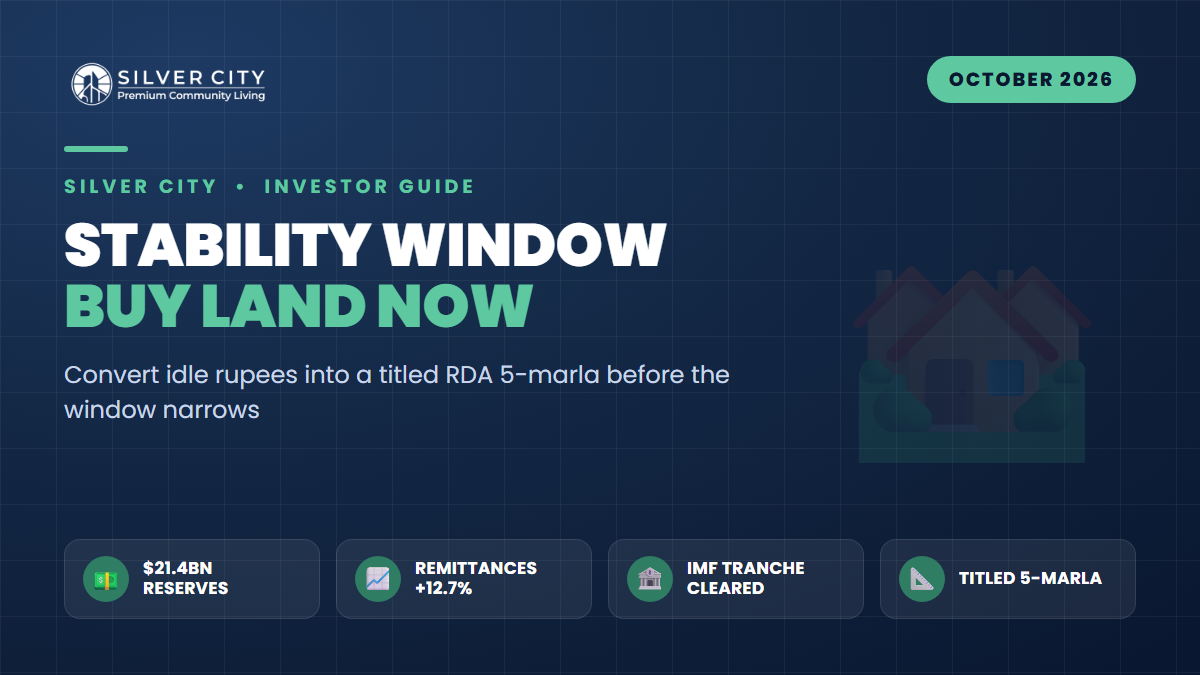
For the first time in years, Pakistan’s external numbers are lining up on the same page at the same time. The State Bank of Pakistan’s foreign exchange reserves have climbed to a record of roughly $21.4–21.5 billion, lifted substantially by proceeds from a recent Eurobond issuance. Overseas workers sent home $3.59 billion in September 2026, up 12.7% year-on-year, pushing the July–September FY27 tally to $10.9 billion (a 14.74% jump). And on 8 October 2026, Pakistan reached a staff-level agreement with the IMF unlocking about $1.2 billion, combining the fourth review of the $7 billion Extended Fund Facility with the third review of the Resilience and Sustainability Facility.
Three green lights rarely shine together in this economy. For an investor sitting on idle rupees—or a few thousand dollars—the question is no longer “is it safe to deploy?” but “where does disciplined capital go while the window is open?” This article makes the case that a titled, RDA-approved 5-marla plot is the most rational home for that money today, and why the two obvious alternatives—gold and equities—are late to their own party.
Why This Window Matters for Property Buyers
Macro stability is not an abstraction for real estate. When reserves cover more import months and the IMF program stays on track, the rupee’s downside is capped, inflation expectations cool, and—critically—the State Bank gains room to keep easing. A steadier policy-rate path lowers the opportunity cost of holding land and improves mortgage math for end-buyers. Remittance strength matters even more directly: a large slice of overseas earnings has always flowed into Pakistani plots, and a 12.7% YoY rise in September is fresh demand looking for titled, legally clean inventory in the twin cities.
The catch is that windows close. IMF tranches are disbursed review-by-review; the next Executive Board sign-off is weeks away, not guaranteed in perpetuity. Reserve peaks built partly on borrowed Eurobond money can soften. The rational move is to convert idle, yield-free cash into a hard, titled asset while confidence is high and before any correction in the macro mood reprices land upward.
Gold at Record Rs440k and an Off-Peak KSE-100
The instinct of many savers is bullion. But gold in Pakistan touched roughly Rs440,636 per tola on 17 October 2026—a record. Buying at an all-time high means paying top rupee for an asset that yields nothing, carries storage and purity risk, and whose local price already embeds both the global rally and rupee weakness. The easy money in this gold cycle has been made.
Equities tell a different but equally cautionary story. The KSE-100 has been volatile through October 2026, trading around 166,000 points after touching intraday levels near 168,580 and then sliding on days when banks led declines. The index is strong on a one-year view but choppy and off its recent peak—hardly a clean entry, and it demands a risk appetite and screen-time most property investors neither have nor want.
Land, by contrast, is a different animal: tangible, locally governed, and—when the title is clean—largely insulated from the daily sentiment swings that whipsaw the bourse.
| Asset (Oct 2026) | Entry level | Yield | Key risk | Timing read |
|---|---|---|---|---|
| Gold | ~Rs440k/tola (record) | None | Buying at all-time high; purity/storage | Late cycle |
| KSE-100 equities | ~166,000 pts (off peak) | Dividends, volatile | Daily volatility, sentiment-driven | Choppy, off-peak |
| RDA 5-marla plot | ~Rs2.55–2.75m | Capital appreciation + build/rent optionality | Non-approved schemes, title fraud | Early, stability-backed |
The Case for a Titled 5-Marla in Rawalpindi
The 5-marla format is the workhorse of Pakistani property investing for good reason: it is the entry size that matches the PM Apna Ghar mortgage band, appeals to the widest pool of end-buyers, and stays liquid in both up and down markets. In well-planned, RDA-approved Rawalpindi societies, standard 5-marla residential plots currently trade in roughly the Rs2.0–3.5 million range, with entry-level corridor plots around Rs2.55–2.75 million on 36–48 month instalment plans.
Two words carry the whole thesis: titled and approved. A plot in a society with a valid Rawalpindi Development Authority No Objection Certificate (NOC) is a plot you can register, transfer, mortgage, and build on without the legal cloud that hangs over unapproved schemes. The single most expensive mistake a first-time investor makes is paying a “cheap” price for land that can never be regularised.
Financing the entry: PM Apna Ghar
The macro easing cycle has a concrete retail counterpart. Under the PM Apna Ghar programme, financing of up to around Rs5.0 million is available for a 5-marla property, with an indicative monthly instalment near Rs32,997 over 20 years and roughly 10% equity (about Rs500,000). For a salaried buyer, that converts a down-payment plus a predictable monthly outflow into a titled, appreciating asset—exactly the kind of leverage a stability window makes safer to take on.
A Practical Timeline for Deploying Idle Capital
- Weeks 0–1: Verify the society’s current RDA NOC status directly and confirm the exact sector/block is within the approved layout.
- Weeks 1–2: Shortlist 5-marla plots in the Rs2.55–2.75m band; compare cash price against 36–48 month instalment totals.
- Weeks 2–3: Do physical due diligence—site visit, development status, road access, and dealer/society transfer process.
- Weeks 3–4: Execute transfer with proper documentation; retain stamped receipts and the transfer letter in your name.
- Ongoing: Hold for capital appreciation, or build to rent/sell as the corridor matures.
The logic of moving inside roughly a month is simple: it aligns your purchase with the current confidence peak rather than chasing prices after the next IMF disbursement and remittance print reprice twin-city land further.
Frequently Asked Questions
Is now really better than waiting for prices to dip?
With reserves at a record, remittances rising double-digits, and an IMF tranche cleared at staff level, the macro backdrop is pushing land demand up, not down. “Waiting for a dip” in a stability window usually means buying later at a higher base—while idle cash earns nothing and loses value to inflation.
Why a 5-marla rather than a larger plot?
Five marla is the most liquid residential size in Rawalpindi, maps onto the PM Apna Ghar mortgage band, and attracts the broadest buyer pool. That liquidity protects you on exit, which larger, pricier plots cannot always guarantee.
How do I confirm a society is genuinely RDA-approved?
Ask for the society’s NOC and layout approval, then verify it against RDA’s own records rather than relying on a brochure or a dealer’s word. Confirm that the specific block and plot number fall inside the approved area—partial approvals are common.
Should I convert dollars or hold them given strong reserves?
A record reserve position and a steadier rupee reduce the case for sitting on idle dollars for pure currency gain. Converting a portion into a titled, appreciating rupee asset lets you participate in the stability story rather than merely watching it.
The Bottom Line
Three macro signals—record $21.4bn reserves, 12.7% remittance growth, and a cleared $1.2bn IMF tranche—have opened a stability window that rewards action over hesitation. With gold at a record Rs440k/tola and the KSE-100 trading off its peak, a titled, RDA-approved 5-marla plot is the asset that best turns idle rupees or dollars into something tangible, financeable, and legally secure. Among the options on Rawalpindi’s growth corridor, Silver City—an RDA-approved, NOC-cleared society near the Thalian interchange and the emerging Ring Road—is well worth shortlisting as you move within this window. As always, verify current NOC status and pricing directly before committing capital.