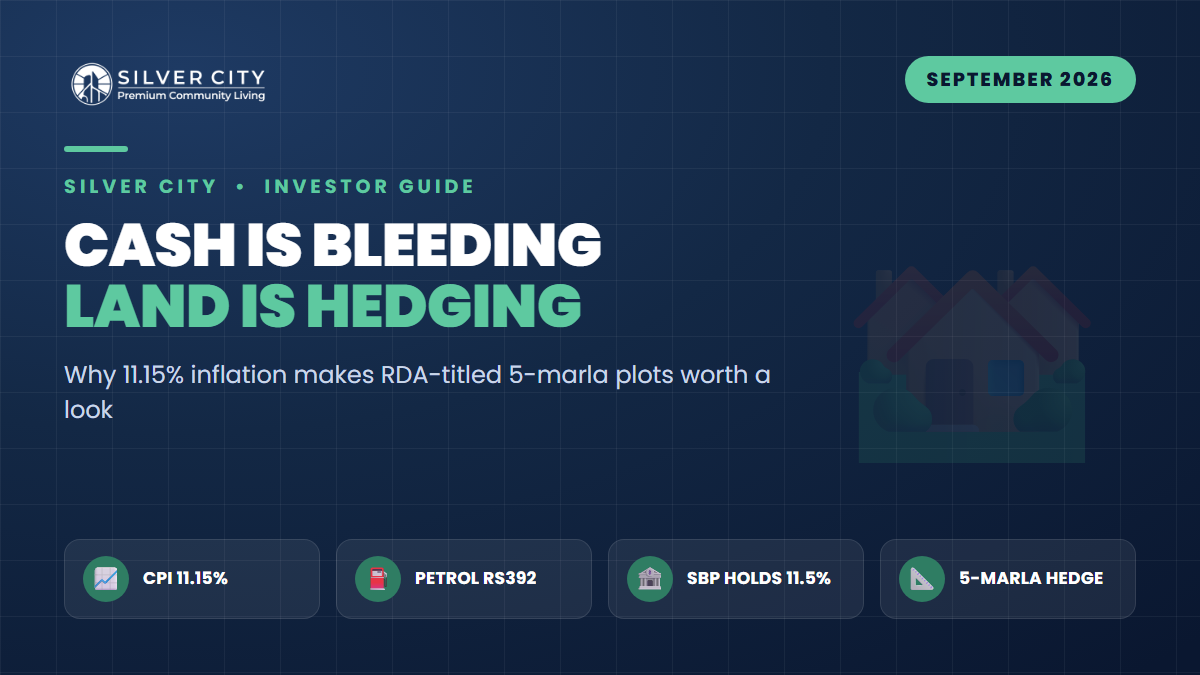
For eighteen months, holding rupees felt safe. Inflation had cooled to just 3.1% in August 2025, the State Bank was cutting, and cash in a savings account looked like a reasonable place to wait. That window has closed. In August 2026 headline CPI snapped back to 11.15% year-on-year — more than tripling from a year earlier — and a fresh energy shock has pushed pump prices to painful levels. For anyone sitting on idle cash, the maths has quietly turned negative. This article makes the case, with current numbers, for rotating some of that bleeding cash into a hard, title-backed real asset: an RDA-approved 5-marla plot.
What actually changed in August–September 2026
Three data points reset the picture for Pakistani savers this quarter:
- CPI back to 11.15%. The Pakistan Bureau of Statistics reported August inflation at 11.15% year-on-year, up from 9.2% in July and a mere 3.1% in August 2025. Food prices rose 13.89% and the housing-and-energy group climbed 8.87%. Rural inflation (12.2%) ran hotter than urban (10.4%).
- An energy supply shock. A prolonged Middle East conflict and disruption fears around the Strait of Hormuz — the chokepoint for a fifth of the world’s oil — spiked global crude and premiums. Petrol peaked well above Rs390 before a slight easing on improved Gulf supply news left it at Rs392.05 and high-speed diesel at Rs418.96 per litre as of 23 September 2026. Diesel feeds directly into transport, construction and food costs.
- SBP holding at 11.5%. On 14 September 2026 the Monetary Policy Committee kept the policy rate unchanged at 11.5% for a third consecutive meeting, citing rising global commodity prices and geopolitical risk. Inflation is now well above the SBP’s 5–7% medium-term target.
Why cash is “bleeding” right now
The headline policy rate of 11.5% looks like it barely beats 11.15% inflation. But savers do not earn the policy rate. A typical bank savings account or profit-rate deposit pays materially less, and then the taxman takes a cut — withholding tax on profit (higher for non-filers) plus the eroding effect of month-on-month price rises. Net of tax and inflation, most ordinary rupee savings are now delivering a negative real return. Put simply: your money is technically growing on paper while its purchasing power shrinks every month the CPI prints above your after-tax yield.
A quick illustration
| Where Rs2.75m sits for 12 months | Nominal return | After ~10% tax on profit | Real value vs 11.15% CPI |
|---|---|---|---|
| Cash under the mattress | 0% | 0% | ≈ −11.15% (loses ~Rs307,000 of purchasing power) |
| Savings account (~9% profit) | ~9% | ~8.1% | ≈ −3% real |
| Well-chosen appreciating land | Varies (illiquid) | Capital gains rules apply on sale | Tends to track/beat inflation over the cycle |
These figures are illustrative, not guaranteed. Land is not risk-free and it is not liquid — but it is the classic reason investors reach for a real asset when the currency is losing value.
Why land — and why 5 marla specifically
Real assets — land, developed plots, gold — historically hold value through inflationary cycles precisely because construction, energy and material costs are what push CPI higher in the first place. When diesel is Rs419 and cement, steel and labour follow, the replacement cost of developed land rises with them. That is the mechanism behind land acting as an inflation hedge.
The 5-marla plot is the sweet spot for the average investor because:
- Lower entry ticket. In RDA-approved Rawalpindi societies, standard 5-marla residential plots currently sit in roughly the Rs2.55–2.75 million band — a fraction of comparable CDA plots in Islamabad.
- Installments do the hedging for you. Many societies offer ~48-month plans. You lock today’s price and pay in future, cheaper rupees — inflation quietly works in the buyer’s favour on the outstanding balance.
- Deepest resale demand. The 5-marla category is the most liquid end-user segment in the twin cities, which matters when you eventually want to exit.
The one rule that separates a hedge from a trap: RDA title
None of the above works if the plot is not on approved, transferable land. The hedge thesis depends entirely on buying inside an RDA-approved (NOC-cleared) society. Approval means the Rawalpindi Development Authority has sanctioned the layout, land use and development plan — the difference between a title you can transfer, mortgage and build on, and a “file” that a bulldozer or a court can invalidate. An unapproved plot is not an inflation hedge; it is a speculation on approval that may never come.
Verify before you pay: confirm the society’s NOC and approval status directly with RDA, match plot and block numbers to the sanctioned layout, and check that instalments are documented against a specific, titled plot — not a pooled “membership.”
A practical rotation checklist
- Keep 6–12 months of expenses and any near-term commitments in cash/liquid savings. Do not put emergency money into illiquid land.
- Rotate only surplus, idle cash that is currently losing real value.
- Prefer approved corridors with real infrastructure momentum — e.g. Girja Road near the Thalian interchange and the emerging Rawalpindi Ring Road.
- Get the transfer done in your name (or a registered file) and keep every receipt; budget for transfer fees and applicable taxes.
- Think in 3–5 year horizons. Land rewards patience, not panic.
Frequently Asked Questions
Is 5-marla land really a better inflation hedge than a bank deposit right now?
With CPI at 11.15% and typical after-tax deposit yields below that, cash-based savings are delivering negative real returns. A well-located, approved plot tends to track construction and land-replacement costs, which rise with inflation. The trade-off is liquidity: a deposit can be withdrawn instantly, land cannot. Land suits surplus capital with a multi-year horizon, not money you may need soon.
If the SBP is holding at 11.5%, won’t property prices stay flat?
A steady policy rate keeps borrowing expensive, which can cap speculative frenzy — but end-user demand for affordable 5-marla plots in approved societies has stayed resilient. Meanwhile, the same commodity and energy pressures keeping rates high are also raising the future cost of developed land, supporting values over the cycle.
How does buying on installments help against inflation?
You fix the purchase price today and repay the balance over ~48 months. As the rupee loses value, those future payments cost you less in real terms, while the asset’s price is locked at today’s rate. This is one of the clearest ways ordinary investors can put inflation to work for them rather than against them.
What is the single biggest risk to avoid?
Buying an unapproved or disputed plot. Without a clear RDA NOC and a title that matches the sanctioned layout, you hold a liability, not a hedge. Always verify approval directly with the Rawalpindi Development Authority before transferring any money.
The takeaway
With inflation back in double digits, diesel near Rs419 and the State Bank holding rates steady, idle rupees are losing purchasing power month after month. Rotating a portion of that surplus into a hard, title-backed real asset is a time-tested response — provided the title is genuine. For investors focused on the affordable 5-marla segment along the Girja Road–Thalian corridor, Silver City is one RDA-approved option worth evaluating, on flexible instalment plans and near the developing Rawalpindi Ring Road. As always, verify current prices and NOC status directly before committing, and size any position to money you can leave working for several years.