The story just changed from “bypass” to “corridor”
For three years, the investment case for plots along the Rawalpindi Ring Road (RRR) has rested on one word: access. Once the Chakri interchange opened, land off Chakri Road and Girja Road stopped being remote farmland and became a five-minute drive from a controlled-access ring. That story is now largely priced in. As of September 2026, the RRR’s 38.3-km main carriageway is roughly 99% complete and fully carpeted, per Rawalpindi Division Commissioner Salman Ghani, with four of five interchanges — Banth, Chak Beli Khan, Adiala and Chakri — finished and functional.
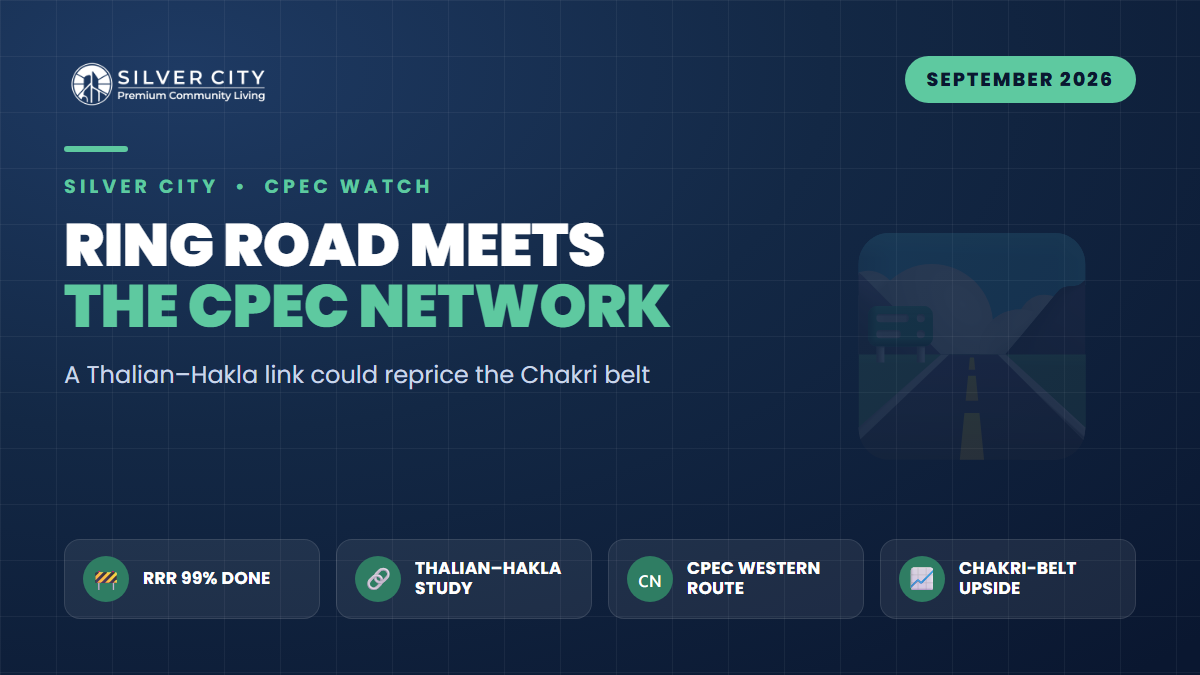
But a second, larger catalyst is now on the table, and most retail buyers have not repriced for it yet. NESPAK has completed the preliminary feasibility for Ring Road Phase-II (RR-II) — a proposed direct link between the Thalian interchange and the Hakla interchange, tying the RRR into the China–Pakistan Economic Corridor (CPEC) western network. This is not the same as the interchanges already open. It is the difference between a road that helps you reach the airport and a road that plugs your neighbourhood into a national freight artery.
What exactly is being studied — and why it’s different
The interchanges that opened in 2026 are local access points. They connect the ring to existing arteries — GT Road, Adiala Road, Chak Beli Khan Road and Chakri Road. Useful, but domestic.
The Phase-II study is about network integration. Hakla, on the M-1, is the head of the M-14 motorway (Hakla–Dera Ismail Khan, ~285 km), which forms the Western Alignment of CPEC. Linking Thalian (already the RRR’s western tie-in to the M-2) onward to Hakla would let traffic and freight move from the Ring Road into the CPEC western corridor toward KP and, ultimately, the southern trade routes — without threading through Islamabad’s saturated core.
NESPAK has reportedly prepared three alignment options for submission to the Punjab cabinet:
| Option | Description | Length | Est. Cost | Status |
|---|---|---|---|---|
| M-2 widening (preferred) | Widen existing M-2 from 3 to 5 lanes each side | ~15.3 km | ~Rs 9 billion | Most cost-effective |
| Eastern route | New highway east of the motorway | ~19.5 km | ~Rs 18 billion | Under review |
| Western route | New corridor west of the motorway | ~26.5 km | ~Rs 24 billion | Under review |
Important honesty check: this is a feasibility stage, not a funded or ground-broken project. No alignment has been approved, financed or dated. Treat it as a probable medium-term catalyst, not a guaranteed 2027 event.
Why the Chakri belt captures the upside
Geography does the work here. Plots in the Chakri–Girja corridor sit on the western arc of the Ring Road, the same side that feeds Thalian and, prospectively, the Hakla link. If the RR-II study converts into a built corridor, the belt gains a third structural anchor on top of the two it already has:
- Anchor 1 (built): the completed Chakri interchange and the New Islamabad International Airport corridor.
- Anchor 2 (built): the M-2 motorway tie-in at Thalian, connecting to Lahore and the national network.
- Anchor 3 (studied): a Thalian–Hakla CPEC link converting the belt from a commuter suburb into a logistics-adjacent location.
Logistics adjacency matters because it draws demand the residential story alone cannot: warehousing, fuel and service commercial, and end-users tied to freight movement. That broadens the buyer pool and, historically in Pakistan, is what turns a slow-appreciating file into a step-change.
How to think about entry timing and price
The disciplined approach is to separate what is built from what is studied, and price accordingly. Pay for verifiable asphalt; treat the CPEC link as optionality you are not overpaying for today.
| Catalyst | Status (Sep 2026) | What it prices in | Horizon |
|---|---|---|---|
| Chakri interchange + carriageway | ~99% built, carpeted | Local access, airport corridor | Now |
| Thalian M-2 tie-in | Temporary link live (~18,000 vehicles/day) | National motorway access | Now / near-term |
| Formal RRR inauguration | Awaiting toll booths, Thalian resolution | Sentiment, tolling activation | Near-term |
| Thalian–Hakla CPEC link (RR-II) | Preliminary feasibility done | Freight/logistics repricing | Medium-term |
For context on entry cost, RDA-approved plots on the Girja/Thalian corridor have been quoted from roughly Rs 2.75 million for 5 marla and around Rs 10.35 million for 1 kanal, frequently on 48-month payment plans — meaning you can lock a position before the CPEC-link narrative is confirmed, using instalments rather than a single lump sum.
Also keep the delay history in view: the RRR has slipped past six completion deadlines, and its budget has climbed from about Rs 33 billion to roughly Rs 47 billion. Government timelines here run late and over-budget. Underwrite conservatively — buy for the built infrastructure, and let the CPEC link be upside rather than your base case.
Frequently Asked Questions
Is the Rawalpindi Ring Road already connected to CPEC?
Indirectly. The RRR ties into the M-2 at Thalian, which is part of the national motorway grid. What’s newly under study is a direct Thalian–Hakla link that would feed the RRR into the M-14 / CPEC western alignment. That specific link is at feasibility stage, not built.
How is this different from the interchanges that already opened?
The open interchanges (Chakri, Banth, Adiala, Chak Beli Khan) provide local access to existing roads. The proposed CPEC link is about network integration — routing freight and long-distance traffic from the Ring Road into the CPEC western corridor. It targets a different, larger demand base.
Which RR-II route is most likely to be chosen?
NESPAK’s preferred option is widening the existing M-2 from three to five lanes per side (~15.3 km, ~Rs 9 billion), as the cheapest and least disruptive. The eastern (~Rs 18 billion) and western (~Rs 24 billion) new-corridor options are also on the table pending Punjab cabinet review. No decision is final.
Should I buy now or wait for the CPEC link to be approved?
Prices tend to move on confirmation, not construction. Buying now on the strength of the already-built interchanges — ideally on an instalment plan — lets you hold the position at pre-confirmation pricing. Just size the purchase so the CPEC link is a bonus, not a bet you need to win.
The bottom line
The Ring Road’s interchange story is maturing; the CPEC network story is just beginning. A confirmed Thalian–Hakla link would reprice the western Chakri arc from “airport suburb” to “logistics-adjacent corridor” — a structurally different, more durable catalyst than the access story already in the price. For investors who want a foothold on that arc while the study is still on paper, an RDA-approved scheme such as Silver City on the Girja/Thalian corridor is worth genuine consideration: approved title, flexible 48-month plans, and a location sitting exactly where the next catalyst would land. Verify current pricing and NOC status directly before committing, and buy for what’s built — with CPEC as your upside.