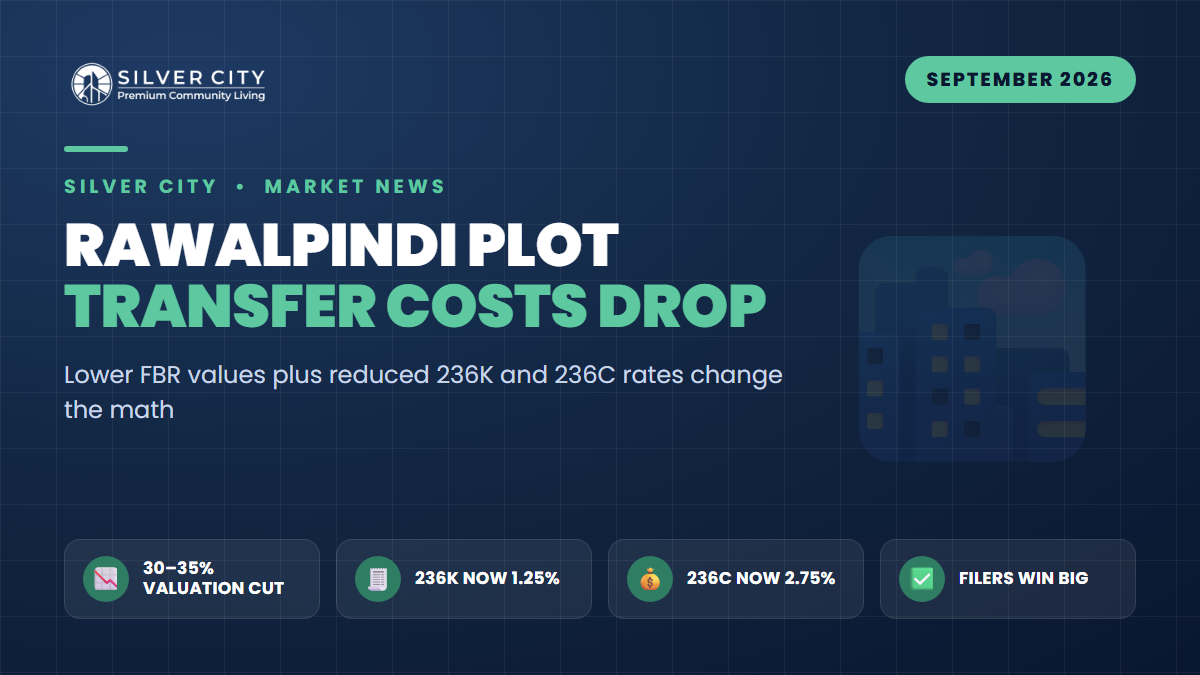
For the first time in several years, the formal cost of transferring a plot in Rawalpindi has fallen on two fronts at once. The Federal Board of Revenue (FBR) has cut its official valuation rates for Rawalpindi properties by roughly 30–35% in the top brackets, and the advance tax rates that sit on top of those values — Section 236K for buyers and Section 236C for sellers — have been simplified down to a flat 1.25% and 2.75% for tax filers. Because these two taxes are calculated on the FBR value, a lower value multiplied by a lower rate compounds into a genuinely large saving. This article breaks down exactly what changed and shows you the numbers so you can decide whether now is the moment to move.
What Actually Changed in 2026
Two separate policy levers moved in the same direction, and it is the combination that matters:
- Lower FBR valuation tables. FBR notified revised valuation rates for Rawalpindi through S.R.O. 877(I)/2026, part of a wider round of revisions covering roughly eight cities (Islamabad’s companion notification was S.R.O. 644(I)/2026, dated 16 April 2026). These updated the tables first set in October 2024, and several high-value residential brackets — including DHA phases — saw reductions in the 10–35% range.
- Lower, flatter advance-tax rates for filers. The earlier value-based slabs (which pushed some buyers toward 3–4%) were simplified. For active tax filers, Section 236K (buyer’s advance tax) is now 1.25% and Section 236C (seller’s advance tax) is 2.75%. Non-filers continue to pay dramatically more — roughly 10.5% and 11.5% respectively — which is the single biggest reason to be on the Active Taxpayers List (ATL) before you transact.
Both 236K and 236C are advance, adjustable income taxes — not final costs. They are credited against your annual tax liability when you file your return, so a filer can recover them, while a non-filer effectively burns the higher amount.
The Buy-Now Math: A Worked Example
Assume a Rawalpindi plot whose FBR value was around PKR 20,000,000 under the old table and falls about 32% to roughly PKR 13,600,000 under the revised table. The figures below are illustrative to show the mechanism — always confirm the current FBR value for your specific area and plot size.
| Item | Old regime (approx.) | New regime (approx.) | Change |
|---|---|---|---|
| FBR value used for tax | PKR 20,000,000 | PKR 13,600,000 | −32% |
| Buyer — 236K (filer) | 3% = PKR 600,000 | 1.25% = PKR 170,000 | −PKR 430,000 |
| Seller — 236C (filer) | 3% = PKR 600,000 | 2.75% = PKR 374,000 | −PKR 226,000 |
| Combined federal advance tax | PKR 1,200,000 | PKR 544,000 | −PKR 656,000 |
The buyer’s 236K bill in this example drops by around 72%, and the seller’s 236C bill by roughly 38%. That is the headline: two reductions stacking on the same base. For an investor buying and later selling within a portfolio, both legs of the round-trip are now cheaper.
The Non-Filer Gap Is the Real Story
The low headline rates only apply if you are on the ATL. Using the same PKR 13,600,000 value, a non-filer buyer would face 236K at around 10.5% — roughly PKR 1,428,000, versus PKR 170,000 for a filer. That is a gap of over PKR 1.25 million on a single purchase. If you are considering property, getting your name on the Active Taxpayers List before the transfer date is the highest-return paperwork you will ever do.
| Status | 236K buyer (approx.) | 236C seller (approx.) |
|---|---|---|
| Filer (on ATL) | 1.25% | 2.75% |
| Non-filer | ~10.5% | ~11.5% |
Costs This Article Does Not Cover
The valuation cut and 236K/236C are the federal piece. To budget accurately for a Rawalpindi transfer, also account for:
- Punjab provincial charges — stamp duty and related town/registration fees, which are levied under provincial rules (Rawalpindi sits in Punjab). These are often calculated on DC or provincial valuation tables, not the FBR table.
- Section 7E — the deemed-income provision and its certificate requirement, which can apply on the seller’s side.
- Capital Gains Tax (CGT) — payable by the seller depending on holding period and acquisition date.
- Society transfer fees — the housing scheme’s own charges for changing ownership records.
None of these are eliminated by the FBR valuation cut, but the cut still lowers the base for the federal advance taxes, which are usually the largest single line item on a formal transfer.
Why This Window May Not Last
FBR valuation tables are revised periodically — the current Rawalpindi values replaced an October 2024 set, and the direction of travel over recent years has generally been upward as FBR works to close the gap between official values and open-market prices. A downward revision is unusual and is widely read as a deliberate move to revive transaction volumes. That makes the present alignment — lower values and lower filer rates together — a favourable but not permanent window. Investors who were waiting on the sidelines for transfer costs to ease now have their reason.
Practical Checklist Before You Transfer
- Confirm you are on the current ATL (file your latest return if not).
- Pull the exact FBR value for your area, phase, and plot size — do not rely on generic figures.
- Get a written cost sheet covering 236K/236C, provincial stamp duty, 7E, CGT, and society transfer fees.
- Verify the society is RDA-approved and the file/plot is transferable and free of dues.
- Time the transfer while both your filer status and the current valuation table are in effect.
Frequently Asked Questions
Does the valuation cut reduce the price I pay the seller?
No. The FBR value is a tax-calculation benchmark, not the market price. The seller still negotiates the actual sale price with you. What the cut lowers is the base used to compute your 236K, the seller’s 236C, and certain other levies — reducing your tax bill, not the purchase amount.
Are 236K and 236C refundable?
They are advance, adjustable taxes. When you file your annual income tax return, the amounts you paid are credited against your total tax liability, so filers can effectively recover or offset them. Non-filers cannot claim the same benefit and pay far higher rates up front, making the case for filing overwhelming.
Do overseas Pakistanis get the filer rate?
Non-resident Pakistanis can access filer-equivalent rates by being on the ATL or by using FBR’s designated process for overseas Pakistanis to be treated as filers for a transaction. Confirm your status and documentation with a tax practitioner before the transfer date, as procedures are updated from time to time.
Is this a good time to buy a plot in Rawalpindi?
For a filer, the combination of a lower valuation table and reduced 236K/236C rates makes the formal cost of acquiring — and later selling — a plot among the lowest it has been in years. If the underlying plot, location, and society approvals are sound, the reduced transaction friction strengthens the case rather than weakening it.
The Bottom Line
A 30–35% valuation cut layered on top of flat 1.25% and 2.75% filer rates has quietly delivered the cheapest formal plot-transfer environment Rawalpindi has seen in years. The saving is real, it is largest for filers, and it may narrow at the next valuation revision. If you are choosing where to deploy that advantage, an RDA-approved scheme with clean approvals and transferable files — such as Silver City on the Rawalpindi–Chakri corridor — is worth shortlisting, precisely because these tax efficiencies only pay off when the underlying society and title are secure. Do your due diligence, confirm the current FBR value for your plot, and make sure your filer status is active before you sign.