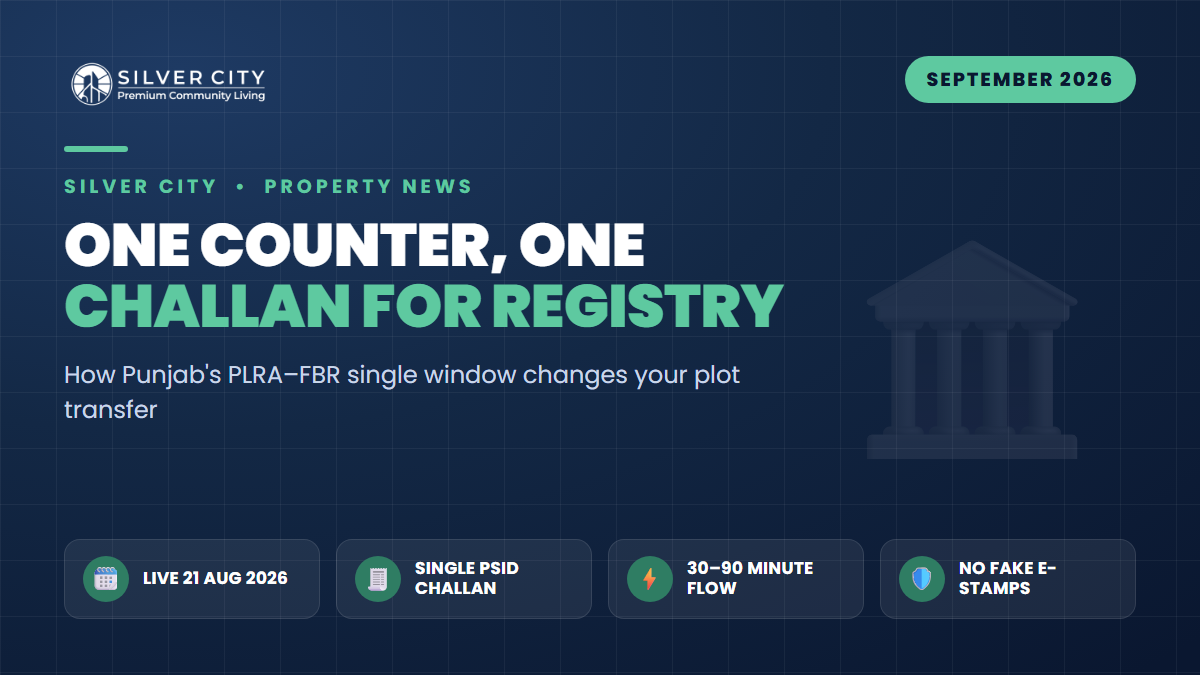
If you are buying a plot in Rawalpindi right now, the paperwork you were dreading has quietly changed. Since 21 August 2026, every property registration in Punjab — Rawalpindi included — runs through an integrated PLRA–FBR one-counter system. The Punjab Land Records Authority and the Federal Board of Revenue have connected their portals end to end, so the two-portal, three-visit ritual that defined property transfers for years is being replaced by a single, auto-generated challan and one payment.
This is not a cosmetic update. It changes which challans you generate, who calculates your tax, and how fraud gets caught before your money moves. Here is exactly what a Rawalpindi/Silver City buyer needs to know.
What Actually Changed on 21 August 2026
Previously, the FBR e-payment portal and the PLRA e-stamping/registration system did not talk to each other. A buyer generated an FBR PSID for withholding tax, separately arranged an e-stamp paper for stamp duty and CVT, and then took everything to the sub-registrar — hoping the numbers matched. Because the systems were disconnected, fake and duplicate e-stamp challans became a recurring problem, particularly in high-value DHA and Bahria Town deals, feeding a stream of registry-fraud cases.
Under the integrated flow, PLRA and FBR share data live. The system now:
- Auto-retrieves the seller’s ownership record, transfer history and property certificate;
- Auto-calculates stamp duty, Capital Value Tax (CVT) and FBR withholding tax from the declared value and each party’s Active Taxpayer List (ATL) status;
- Generates one combined challan covering all of these in a single PSID;
- Accepts a single payment through any bank’s mobile app; and
- Auto-routes the confirmed case to the sub-registrar for signing.
Because the challan is generated inside the linked system and verified in real time, a fabricated or reused e-stamp simply will not clear — the counter blocks it.
The New Transfer Process, Step by Step
| Step | What happens | Who does it |
|---|---|---|
| 1 | Both parties attend the sub-registrar’s office with original CNICs | Buyer & seller |
| 2 | Operator opens the integrated portal; system pulls fard, inteqal history and property certificate | Data entry operator |
| 3 | Sale price, shares and party details are entered | Operator |
| 4 | System auto-computes stamp duty, CVT and WHT by value and ATL status | Integrated system |
| 5 | One combined challan (single PSID) is issued for review | System |
| 6 | Payment via bank mobile app; reflects within minutes | Buyer |
| 7 | Case auto-routes to sub-registrar; parties give biometrics and sign the register | Sub-registrar |
| 8 | Mutation (inteqal) proceeds under standard PLRA timeline | PLRA / patwari |
For a clean transaction with clear title and both parties on the ATL, the counter portion now typically takes 30 to 90 minutes instead of several visits spread over days. Note that Punjab has also, from 2026, stopped recognising land mutation without a registered deed — the old practice of oral or “open” transfers is over, which makes the registry itself non-negotiable.
The Challans and Paperwork You Now Deal With
The headline change: you no longer generate a separate FBR challan yourself. The single window produces it. Practically, your checklist shrinks to:
- Original CNICs of buyer and seller (and attorney documents if acting through a power of attorney);
- Confirmed sale price / declared value — this drives every tax figure, so agree it before you arrive;
- ATL / filer status for both parties — filing before the transaction is the single biggest cost lever (see below);
- The property certificate, which the system checks automatically — if it is missing, the registry halts.
Physical copies of fard and inteqal are largely redundant now, since the operator retrieves them digitally.
What It Costs: Taxes Bundled Into One Payment
The rates themselves did not change on 21 August — only the way they are calculated and collected. Provincial charges in Punjab broadly run as follows, with federal withholding stacked on top:
| Charge | Applies to | Typical rate |
|---|---|---|
| Stamp duty | Provincial (buyer) | ~1–2% of value (urban higher) |
| Capital Value Tax (CVT) | Provincial (buyer) | ~2% in notified urban areas |
| Registration / PLRA fee | Provincial (buyer) | Fixed slab or ~0.1–1% of value |
| Section 236K – advance tax | Federal (buyer) | Filer ~3%; non-filer sharply higher |
| Section 236C – advance tax | Federal (seller) | Filer ~3%; non-filer sharply higher |
Both 236K and 236C rise in slabs with property value (higher bands above Rs 50m and Rs 100m), and jump steeply for late filers and non-filers — a non-filer can pay several times the filer rate, adding lakhs to a mid-sized Rawalpindi plot. Because the system reads ATL status automatically, there is no room to fudge it at the counter. The practical takeaway is unchanged but now enforced harder: get on the Active Taxpayer List before you transact. Always treat the challan the system shows you as the authoritative figure and confirm it before paying, since exact percentages depend on your value slab and filer status.
What This Means for a Silver City Buyer Specifically
Rawalpindi falls squarely under Punjab and PLRA, so any plot transfer in and around the city now flows through this single window. For societies where the developer maintains clean, RDA-recognised records and clear title, the integration is a net positive: faster completion, one payment, and far less exposure to the fake-challan fraud that has burned buyers elsewhere. The lesson is to buy where the paper trail is genuinely clean to begin with, because the system will surface every gap.
Frequently Asked Questions
Do I still need to generate an FBR challan myself before the registry?
No. That was the old two-portal process. Since 21 August 2026 the integrated PLRA–FBR system auto-generates a single combined challan (one PSID) covering stamp duty, CVT and withholding tax. You pay it through your bank’s mobile app.
How long does a transfer take now?
For a clean deal with clear title and both parties on the ATL, the counter process typically takes 30 to 90 minutes. The subsequent mutation (inteqal) still follows the standard PLRA timeline, generally a few weeks.
Does the new system change how much tax I pay?
No — the rates are unchanged. It changes how they are calculated and collected: automatically, in one challan, based on your declared value and filer status. Filers pay dramatically less than non-filers, so registering on the ATL beforehand is the key saving.
Is this only in Punjab?
Yes, for now. The one-counter integration went live in Punjab (including Rawalpindi) on 21 August 2026, with similar rollouts reported for Sindh and KP later in the year.
The Bottom Line
Punjab’s PLRA–FBR single window makes property transfers faster, cleaner and much harder to defraud — provided the property you are buying already has honest records. That makes the choice of society more important than ever. Silver City, an RDA-approved development in Rawalpindi, is worth considering for exactly that reason: buying into a project with transparent, approved documentation lets you enjoy the speed of the new one-counter system without inheriting title problems the system will otherwise expose at the worst possible moment.
@@END@@