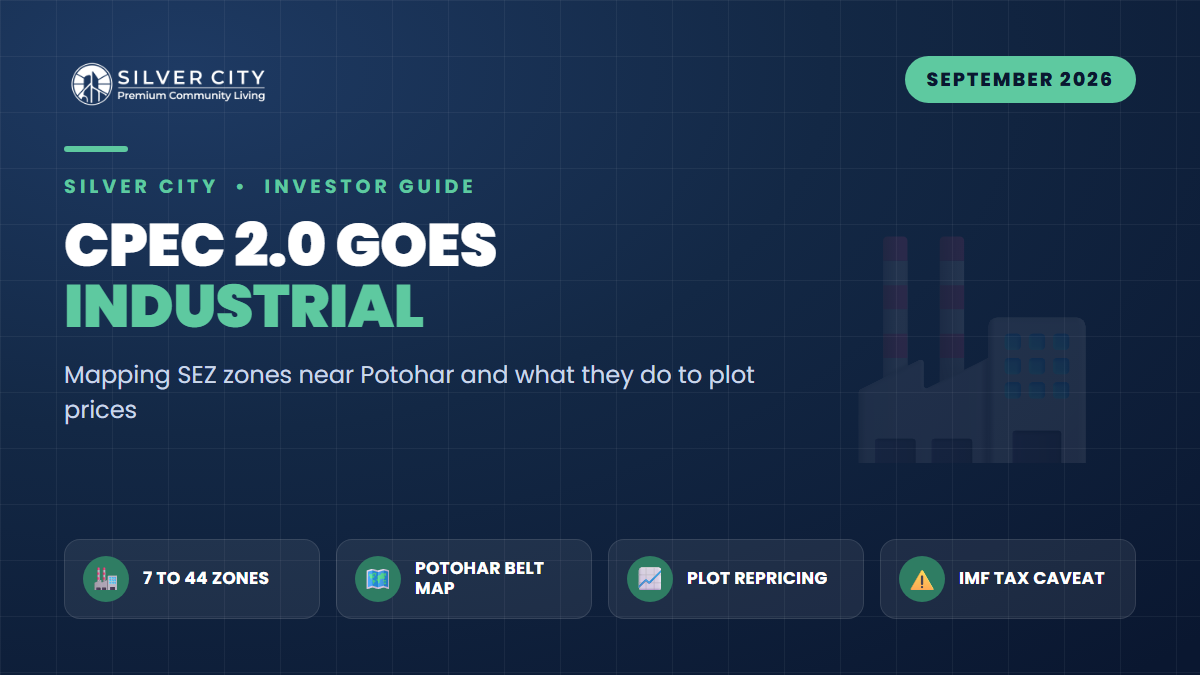
Pakistan’s Special Economic Zone (SEZ) map just changed dramatically. In a January 17, 2026 briefing at the Project Management Unit of the CPEC Industrial Cooperation Development Project (PMU CPEC-ICDP), the government confirmed that approved SEZs have risen from 7 to 44 since 2019 — with 37 newly notified zones pushed through by the Board of Investment (BoI). This is the clearest signal yet that CPEC 2.0 has pivoted from roads-and-power infrastructure to industry-led, export-oriented growth, with SEZs acting as the anchor platforms.
For property investors in Rawalpindi and the wider Potohar plateau, the question is not the national headline — it’s local: which of these zones actually sit within your catchment, and what does confirmed industrial activity do to the value of nearby residential and commercial plots? This guide maps the belt and lays out the repricing mechanics honestly, including the caveats most sales pitches skip.
From Corridor to Factories: What Changed in CPEC 2.0
Phase 1 of CPEC (roughly 2015–2020) was about energy plants and motorways. Phase 2 — “CPEC 2.0” — reorients toward manufacturing, agro-processing, engineering goods, chemicals, and technology transfer. The SEZ framework is the delivery mechanism. Under the original plan, nine priority zones were envisaged; the three flagships were Rashakai (Nowshera, KP), Dhabeji (Sindh), and Allama Iqbal Industrial City (Faisalabad). The BoI has now widened that list to 44 notified zones nationwide, spanning every province and territory.
Which Zones Sit Near the Rawalpindi–Potohar Belt
Rawalpindi’s underrated advantage is geography: it sits at the junction of GT Road, the M-1 (to Peshawar), and the M-2 (to Lahore). Several notified or operational zones fall within a practical driving radius of the twin-city and Potohar market. The most relevant:
| Zone | Location / Access | Approx. distance from Rawalpindi–Islamabad | Status |
|---|---|---|---|
| Islamabad Model SEZ (IMSEC) | Near Rawat, junction of N-5 & Islamabad Expressway | Within ICT / Rawat belt | Inaugurated Jul 2023; ~1,000+ acres; targets ~$2.5bn investment, low-carbon industry |
| Rashakai SEZ | M-1 Motorway, Nowshera (KP) | ~90 km via M-1 | Phase 1 (247 acres) operational; 60%+ leased to Pak & Chinese firms |
| Hattar Economic Zone | Haripur (KP), off the Taxila corridor | ~40–50 km | Established priority zone; multiple operational units |
| Rawalpindi Ring Road Industrial Estate | Corridor along the new Ring Road | Within district | PIEDMC-approved concept (2026); awaiting Punjab Assembly legislation & land acquisition |
Two things stand out. First, IMSEC near Rawat is the single most consequential zone for twin-city land, because it puts a federally backed industrial cluster directly on the Islamabad Expressway–N-5 spine. Second, the Ring Road industrial corridor — a 500-metre development band on both sides of the Ring Road planned to include industrial plots, transport terminals, a wholesale market, an IT zone, and an expo centre — is the one most directly wired into the Potohar plotting market where societies like Silver City operate.
The Honest Caveat: SEZ vs. Industrial Estate Under the IMF
Investors should understand a policy nuance that materially affects timelines. The Rawalpindi Ring Road project was originally floated as a full SEZ but was reclassified as an industrial estate, because the broad tax exemptions that define an SEZ conflict with Pakistan’s current IMF programme conditions. An industrial estate still drives jobs, roads, and demand — but without the blanket duty holidays, the investor pull is more gradual. Treat “SEZ notified” as a starting gun, not a finish line: notification precedes land acquisition, master-planning, and phased construction, each of which can take years.
How SEZ Proximity Actually Reprices Adjacent Plot Land
SEZs don’t lift every nearby plot equally. Repricing follows identifiable channels, and the strongest gains cluster where several channels overlap:
- Employment catchment & rental demand: A working zone creates thousands of workers and managers who need housing within a 20–30 minute commute. Residential societies inside that ring see rental yields and end-user demand firm up first.
- Interchange & road access: Value concentrates around motorway interchanges, the Ring Road, and Expressway access points — not evenly across a district. A plot 5 minutes from an interchange outperforms one 25 minutes away, even in the same society.
- Commercial spillover: Zones pull warehousing, transport terminals, and services. Commercial and mixed-use plots on connecting arteries often reprice faster than pure residential.
- Phasing risk discount: Land near a notified but unbuilt zone trades at a discount to land near an operational one. As phases complete and firms move in, that discount narrows — which is exactly where patient capital earns its return.
The table below sketches an illustrative repricing pathway. These are directional ranges for how belt-adjacent plot values tend to behave as a zone matures — not a forecast for any specific society or a promise of returns.
| Zone maturity stage | Typical market behaviour for adjacent plots | Investor posture |
|---|---|---|
| Notification / announcement | Speculative bump, then consolidation; high uncertainty | Entry point for risk-tolerant, long-hold buyers |
| Land acquisition & groundbreaking | Renewed interest as project becomes tangible | Verify RDA/RUDA approval, road access, phase location |
| First units operational | Rental demand appears; end-user buying begins | Yield-focused buyers enter; discount narrows |
| Zone at scale | Sustained demand; premium for interchange-close plots | Exit window for early entrants; hold for cashflow |
Practical Checklist Before You Buy on the Belt
- Confirm the plot is inside an RDA/RUDA-approved scheme — approval status governs resale, transfer, and financing.
- Measure real drive time to the nearest zone and interchange, not map distance.
- Ask whether the nearby zone is an SEZ or an industrial estate, and which phase is actually funded.
- Prefer plots with confirmed road frontage or Ring Road/Expressway access over cheaper interior files.
- Match your horizon to the zone’s stage: notified zones suit 3–5 year holds, not quick flips.
Frequently Asked Questions
How many SEZs are near Rawalpindi under CPEC 2.0?
Within a practical radius, the most relevant are the Islamabad Model SEZ near Rawat, Rashakai (~90 km up the M-1), and Hattar in Haripur, plus the planned Rawalpindi Ring Road industrial corridor. These sit inside or adjacent to the Potohar market that Rawalpindi societies serve.
Does an SEZ nearby guarantee my plot price will rise?
No. Repricing depends on the zone actually being built and staffed, and on your plot’s access to interchanges and arteries. Land near a notified-but-unbuilt zone carries phasing risk and can sit flat until construction and hiring begin.
Why was the Rawalpindi Ring Road SEZ downgraded to an industrial estate?
Full SEZ status requires tax exemptions that clash with Pakistan’s IMF programme conditions. Reclassifying it as an industrial estate keeps it compliant, so it still drives jobs and demand but without blanket duty holidays — meaning a more gradual investor pull.
Is now a good time to enter the Potohar belt?
For patient, RDA-approved, access-verified plots, the notification wave is an early window. Just size your holding period to the nearest zone’s maturity stage rather than expecting immediate flips.
Wrap-Up
CPEC 2.0’s jump from 7 to 44 SEZs is a genuine structural shift toward industry — and Rawalpindi’s motorway-junction geography places several zones within its economic catchment. The winners will be plots that combine confirmed approval, strong interchange access, and a realistic horizon. On that scoring, an RDA-approved option positioned in the Potohar corridor with Ring Road access — such as Silver City — is worth shortlisting as you map your own SEZ-adjacent strategy. Verify the paperwork, measure the drive time, and match your hold period to the belt’s build-out.