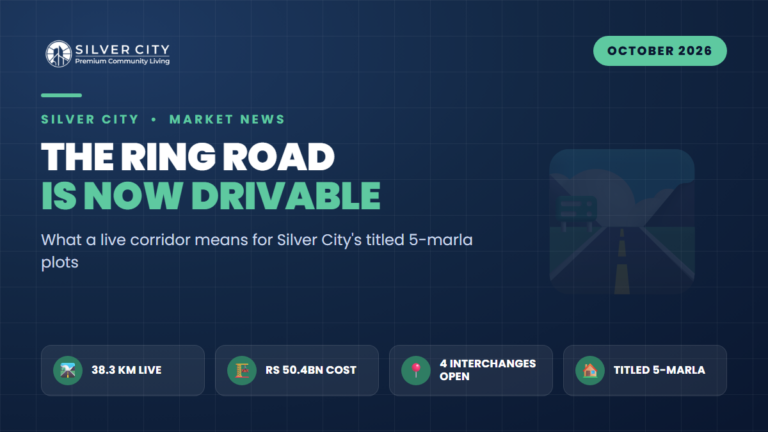
The Rawalpindi Ring Road (RRR) is finally moving from map to macadam. Phase 1 is roughly 90% asphalted, carpeting has been laid across most of the ~38.3 km six-lane corridor, and interchanges at Baanth, Chak Beli Khan, Adiala and Chakri are largely complete, with Thalian folded into the later phase. Just as importantly, on 11 June 2026 the Rawalpindi Chamber of Commerce and Industry (RCCI) formally pressed the Rawalpindi Development Authority (RDA) to allocate suitable commercial and industrial land along the corridor, a meeting that referenced earlier land-use decisions from 15 May 2026.
That combination (near-finished roadworks plus an open lobbying fight over who gets commercial zoning) is exactly the moment when a dangerous price gap opens up between interchange-facing commercial plots and interior residential plots. This guide gives Pakistani investors a practical framework for reading that premium, and for avoiding the classic mistake: paying a “commercial” price for a plot that is only ever going to be residential.
Why the Premium Is Widening Right Now
Two forces are pulling the numbers apart. First, physical access: once traffic actually flows, plots within sight of an interchange become genuine candidates for filling stations, showrooms, marquees, food outlets, logistics yards and roadside retail. Second, scarcity of approvals: developers and traders alike now know that only a fraction of frontage will ever be zoned commercial. RDA has stated that adequate commercial and industrial areas are already built into the plan, meaning the supply of true commercial NOCs is being rationed, not expanded on demand.
When access improves and approvals stay scarce, verified commercial land re-rates upward while ordinary residential land rises more gently. The problem is that marketing does not wait for approvals. Interior plots get sold on the promise of “commercial potential” long before any zoning exists.
The Four Tiers of “Commercial” You Will Be Sold
- Approved commercial (zoned + NOC): The plot is designated commercial on the sanctioned layout and carries society/RDA approval. This is the only tier that deserves a full commercial premium.
- Interchange-adjacent, main-boulevard residential: High footfall and visibility, but still residential on paper. Real convertibility upside. But you are buying a possibility, not a right.
- “Future commercial” / corridor-facing: Marketed on proximity to the Ring Road belt. Zoning is speculative and depends on decisions like the RCCI-RDA allocation still being negotiated.
- Interior residential dressed up as “investment commercial”: No frontage, no access advantage, no plausible zoning path. The premium here is pure narrative.
Indicative Price Bands on the Ring Road Belt
The figures below are illustrative market ranges for the Girja Road / Thalian belt (where RDA-approved schemes such as Silver City sit), not fixed quotes. Always confirm live rates and the sanctioned layout before paying.
| Plot type | Typical size | Indicative price range (PKR) | Premium vs interior residential |
|---|---|---|---|
| Interior residential | 5 Marla | 15-20 lakh | Baseline |
| Main-boulevard residential | 5-10 Marla | 25-45 lakh | ~1.5-2x |
| Approved standard commercial | 4-8 Marla | 1.2-3 crore+ | ~4-8x |
| Interchange-facing commercial | Varies | Highest in scheme | Scheme-topping |
Note the gap: a genuine commercial plot can cost four to eight times an interior residential plot. That is precisely why “commercial potential” is such an attractive thing for a seller to imply, and such an expensive thing for a buyer to assume.
A Simple Valuation Framework
Before you pay any premium above the residential baseline, score the plot on these five checks. Treat any “no” as a reason to pay a residential price, not a commercial one.
- Zoning proof: Is the plot marked commercial on the currently sanctioned layout, not a glossy brochure map? Get it in writing from the society and cross-check with RDA.
- Approval status: Is the scheme itself RDA-approved, and is the commercial category NOC-covered? Speculative frontage in an unapproved pocket is the highest-risk tier.
- Access reality: Can vehicles actually enter and exit near the plot? An interchange 3 km away with no service-road access is not “interchange-adjacent.”
- Conversion pathway: If it is residential today, what is the documented process, fee and probability of commercialisation? “The dealer says it will convert” is not a pathway.
- Exit demand: Who is the next buyer, an end-user business, or only another speculator hoping for the same rezoning? Genuine commercial has user demand; narrative commercial only has resale hope.
A quick rule of thumb: commercial premium you should pay ≈ (probability zoning is real) × (full commercial value − residential value). If you honestly rate the zoning probability at 30%, you should not be paying 100% of the commercial premium.
How to Avoid Overpaying for Zoning That Never Comes
- Buy the paper, not the pitch. Insist on the approved master plan, the plot’s category on the allotment file, and the society’s NOC status. Photograph and date everything.
- Separate “corridor benefit” from “commercial rights.” Nearly every plot on the belt benefits from the Ring Road. Very few carry commercial rights. Only the second justifies a crore-plus premium.
- Watch the policy, not the poster. The RCCI-RDA allocation is still being decided. Until specific commercial/industrial pockets are gazetted, “future commercial” remains a bet.
- Prefer approved residential with real upside over unapproved “commercial” with imagined upside. On a finished, populated boulevard, residential appreciation is often more bankable than speculative conversion.
- Price your downside. Ask: if this never becomes commercial, what is it worth as residential, and am I comfortable at that price today?
Frequently Asked Questions
Does proximity to a Ring Road interchange guarantee commercial value?
No. Proximity improves access and visibility, which raises the ceiling for commercial use, but value is only realised when a plot is actually zoned commercial and NOC-covered. Many interchange-adjacent plots remain residential on the sanctioned layout, so their commercial value stays theoretical until approvals change.
How much more do genuine commercial plots cost than residential ones?
On the Ring Road belt, approved commercial plots commonly trade at roughly four to eight times the price of a comparable interior residential plot, with interchange-facing commercial commanding the scheme’s highest rates. That multiple is the whole reason to verify zoning before paying, the gap you overpay is large.
What happened in the June 2026 traders’ meeting, and why does it matter?
On 11 June 2026, RCCI representatives urged RDA to allocate suitable commercial and industrial zones along the corridor; RDA responded that adequate areas were already incorporated into the plan. For investors this signals that commercial land is being rationed by policy, so “future commercial” plots depend on decisions that are still open, not a done deal.
Is it safer to buy residential and hope for conversion later?
Buying approved residential on a main boulevard is generally lower-risk than buying speculative “commercial.” You pay a residential price, capture Ring Road appreciation, and keep conversion as optional upside rather than the reason the price is inflated. Just confirm the scheme is RDA-approved so your baseline value is secure.
The Bottom Line
The Ring Road is real, the asphalt is nearly down, and the commercial land fight is live. Which is exactly why discipline matters now. Pay for verified zoning and genuine access; refuse to pay for narrative. For investors who want Ring Road exposure without the zoning gamble, an RDA-approved scheme on the Girja Road / Thalian belt such as Silver City (silvercity.pk) (with clearly categorised residential and commercial plots and documented approvals) is worth shortlisting and diligencing against the checklist above. Buy the paper, price the downside, and let the interchange premium work for you instead of against you.