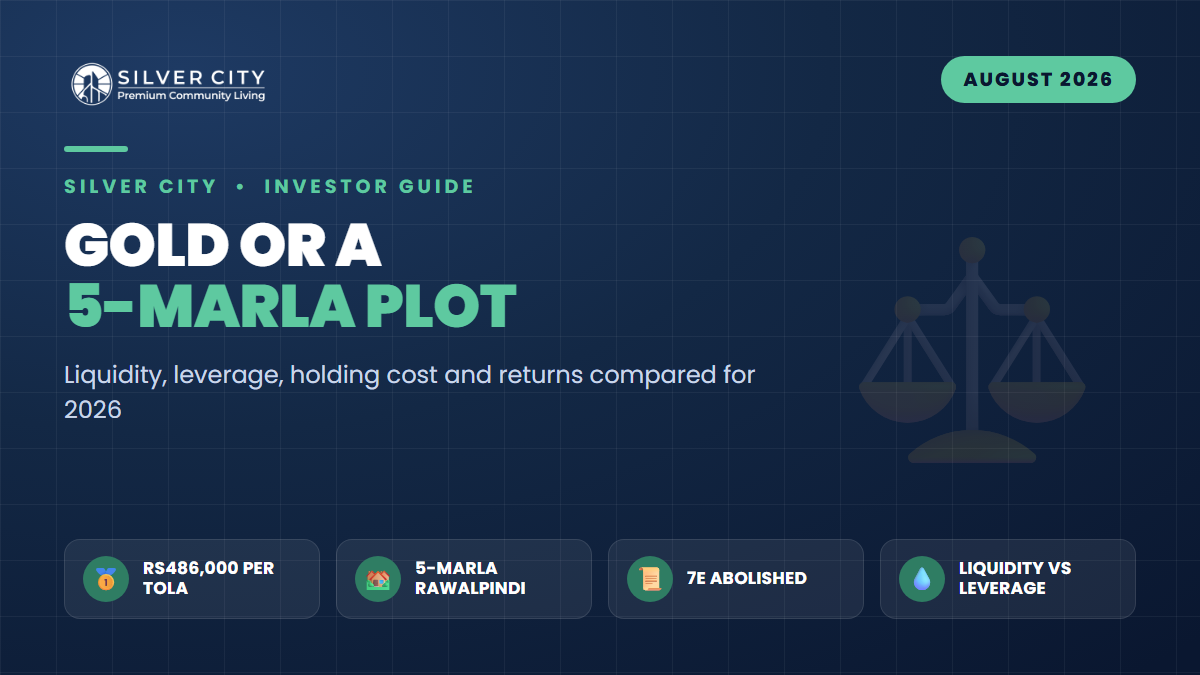
Late August 2026 delivered a headline no Pakistani saver could ignore. On 24 August, 24-karat gold climbed Rs4,200 in a single session to Rs487,136 per tola, and by 26 August it was hovering near Rs486,500 — within touching distance of the psychological Rs500,000 mark. For the mid-size investor sitting on Rs40–50 lakh, the question is sharper than ever: park it in the yellow metal, or buy a 5-marla plot in a Rawalpindi housing society?
This is not a “gold is always better” or “property never fails” article. It is an honest, four-way head-to-head across the levers that actually decide your return: liquidity, leverage, holding cost, and appreciation — updated for a tax landscape that changed materially in July 2026.
The two assets, priced in today’s rupees
A mid-size budget buys meaningfully different things in each market. At roughly Rs486,000 a tola, Rs45 lakh converts to about 9.25 tolas of gold. The same Rs45 lakh sits comfortably in the entry-to-mid band for a 5-marla residential plot in an RDA-approved Rawalpindi society — with prices ranging from around Rs35 lakh in developing blocks (for example, cheaper blocks in Faisal Hills) up to Rs1 crore or more in prime, fully developed locations such as parts of Mumtaz City.
| Factor | Gold (~Rs486,000/tola) | 5-Marla RDA Plot |
|---|---|---|
| Entry ticket | One tola (~Rs486k); fully divisible | Rs35 lakh–Rs1 crore+ by society/block |
| Liquidity | Same-day sale at any jeweller | Weeks to months to find a buyer |
| Divisibility | Sell one tola at a time | All-or-nothing; no partial exit |
| Leverage | None (cash purchase) | Installment plans stretch capital |
| Annual holding cost | Locker/insurance; no wealth levy | Nominal after 7E abolition |
| Income | None | None until built/rented |
Liquidity: gold wins, decisively
Gold is the most liquid asset an ordinary Pakistani household can hold. You can walk into any Saraafa bazaar and convert one tola to cash the same afternoon — and you can sell exactly as much as you need, keeping the rest. That divisibility is invaluable when an emergency needs Rs2 lakh, not Rs45 lakh.
A plot is the opposite. Selling a 5-marla file means listing it, negotiating with dealers, and waiting — often weeks in a hot market and many months in a slow one. In a downturn you may have to accept a discount to exit at all. You cannot sell “half a plot” to cover a short-term cash need. For any investor who might need money in a hurry, this is the single biggest mark against real estate.
Leverage: the plot’s quiet advantage
Here property strikes back. Gold is almost always a cash purchase — what you pay is what you own. Plots in RDA-approved societies, by contrast, are routinely sold on installment plans of two to four years. A booking of Rs8–10 lakh can secure an asset worth several times that, letting your capital control more property than an outright gold purchase of the same rupees would control in metal.
If prices rise while you are still paying installments, your return is calculated on the full plot value, not just the cash you have deployed — the essence of leverage. The flip side is real: if you miss installments you can face penalties or cancellation, and if prices stall you are still committed to the full schedule. Leverage magnifies both directions.
Holding cost: the 7E story changes the maths
This is where 2026 rewired the comparison. Section 7E — the “deemed income” tax introduced in the Finance Act 2022 that levied an effective ~1% annual charge on the fair-market value of certain properties over Rs25 million — was struck down by the Federal Constitutional Court in May 2026 and then formally deleted from the Income Tax Ordinance by the Finance Act 2026, effective 1 July 2026. There is now no deemed-income tax on holding immovable property.
For a plot investor that is a genuine tailwind: the annual friction cost of simply owning land has fallen to little more than nominal society maintenance dues. Gold, for its part, carries no wealth levy either, but you do bear the quiet cost of secure storage — a bank locker or insurance — and the buy-sell spread the jeweller takes on each transaction. On pure holding cost, the two are now closer than they were a year ago, with the 7E repeal doing the heavy lifting on the property side.
Transaction taxes still matter, though, and they favour gold’s simplicity. Buying a plot triggers advance tax under Section 236K (1.25% for filers, 2.5% for non-filers on the FBR value); selling triggers 236C (2.75% for filers, 11% for non-filers). Capital gains on property acquired on or after 1 July 2024 are taxed at a flat 15% for filers, with no holding-period relief. Filing your return is no longer optional if you want to avoid the punishing non-filer rates.
Appreciation: different engines
Gold’s 2026 surge is driven by global forces — a weaker dollar, central-bank buying, and geopolitical risk — amplified locally by rupee depreciation. That makes it a superb hedge, but its price can also correct sharply when those forces reverse. It protects your purchasing power; it rarely compounds wealth by itself.
A well-chosen plot behaves differently. Its upside comes from development — roads, gas, a completed grid, and rising demand as a society matures. A file bought early in an approved society at a developing-block price can re-rate substantially once possession and infrastructure arrive, and it can later be built on to generate rent. That is genuine value creation rather than pure price hedging — but only if the society is legitimate and actually develops. A file in an unapproved or stalled scheme can stay frozen for years.
So which one, for the mid-size investor?
- Choose gold if you value liquidity, may need cash at short notice, want a clean inflation hedge, and prefer no dealer, no development risk, and no tax filing headaches.
- Choose a 5-marla plot if you have a 3–5 year horizon, can use installment leverage, want an asset you can eventually build on, and are disciplined about buying only RDA-approved land.
- The pragmatic answer is usually a blend: keep a liquid gold cushion for emergencies, and channel your longer-horizon capital into a verified plot for the appreciation and leverage gold cannot offer.
Frequently Asked Questions
Is gold at Rs486,000 too high to enter now?
No one can reliably time the top. Gold is near record levels and could keep climbing toward Rs500,000 or correct. If you are buying gold as a hedge rather than a trade, cost-averaging in tranches — buying a little each month — reduces the risk of committing everything at a single peak.
Does the 7E repeal really lower the cost of holding a plot?
Yes. With Section 7E deleted from 1 July 2026, there is no deemed-income tax on holding immovable property. Your ongoing cost is now essentially society maintenance charges, which makes long-term plot holding cheaper than it was under the old regime. Transaction taxes (236K, 236C) and capital gains tax still apply when you buy or sell.
How do I verify a Rawalpindi society is genuinely RDA-approved?
Check the society and its specific block against the Rawalpindi Development Authority’s official records or NOC list, and insist the seller produce a matching approval reference. Never rely on a brochure or a dealer’s word alone — approval status, block by block, is what separates a safe file from a frozen one.
Which gives better returns over five years?
Historically both have rewarded patient holders, but through different engines: gold protects purchasing power against rupee depreciation, while a developing approved plot can re-rate as infrastructure is completed and can later generate rental income. For most mid-size investors, holding both spreads the risk more sensibly than betting everything on one.
The bottom line
Gold near Rs486,000 is a reminder of how well the metal shields wealth from a falling rupee — but liquidity and hedging are not the same as compounding growth. A 5-marla plot in a genuinely approved Rawalpindi society offers leverage, a now-lighter holding cost after the 7E repeal, and real development-driven upside — provided you verify the NOC before you pay a rupee. If you are weighing that property allocation, an RDA-approved option such as Silver City in Rawalpindi is worth shortlisting and doing your own due diligence on. Confirm approvals, compare block prices, and match the asset to your own timeline before you commit.