If you follow Pakistan’s property market, you have probably seen the headlines: the Federal Board of Revenue (FBR) has switched on a new “Certificate of Eligibility” button inside its IRIS portal. It sounds ominous for buyers — a fresh clearance gate before you can register a property. For most small and mid-tier investors, though, the reality is far calmer. If you are an active filer buying an ordinary residential plot — say a 5-marla plot in an RDA-approved society like Silver City — the eligibility block simply does not apply to you.
This guide breaks down what Section 114C actually does, who it targets, and why a sub-Rs100 million plot sits comfortably below the threshold that triggers the certificate requirement.
What Section 114C Actually Is
Section 114C was inserted into the Income Tax Ordinance, 2001 through the Finance Act, 2025, and took effect for the 2025-26 tax year. Its purpose is to stop ineligible persons — broadly, people who have not filed returns or cannot justify the money — from making certain high-value purchases: expensive cars and expensive property, among other economic transactions.
To make the rule operational, FBR integrated a Certificate of Eligibility feature into the IRIS portal on 18 June 2025. An eligible taxpayer generates this certificate online, and it is then presented to the registering authority (the sub-registrar, housing authority, or development authority) so the transfer can be recorded.
Who counts as an “eligible person”?
Under Section 114C, you are an eligible person if you meet two conditions:
- You filed your income tax return for the tax year immediately preceding the year of the transaction.
- You have declared enough resources in your wealth statement or financial statements to reasonably justify the value of the purchase.
The certificate is essentially FBR confirming that your declared wealth covers the deal. Commentary on the law has widely cited a benchmark of declared resources equal to roughly 130% of the transaction value — i.e. the price plus a comfortable buffer for taxes and incidental costs. Anyone failing these tests is an ineligible person and faces restrictions.
The Threshold Is the Whole Story
Here is the crucial detail that headlines often skip: the eligibility block only bites above a value threshold that the government notifies. The law empowers FBR to set (and revise) the aggregate value above which registering authorities must refuse an ineligible person’s transaction. The figures discussed in the Finance Act framework are:
| Transaction type | Threshold discussed under 114C | Applies to a 5-marla Silver City plot? |
|---|---|---|
| Residential immovable property | Value exceeding ~Rs 50 million | No — far below |
| Commercial immovable property | Value exceeding ~Rs 100 million | No — far below |
| High-value transactions needing an FBR certificate | Above Rs 100 million (advance certificate) | No — not triggered |
Note: exact threshold values are set and updated by FBR through notification (SRO), so confirm the current figure with your lawyer or dealer before a large deal.
Where a 5-Marla Silver City Plot Sits
Silver City is an RDA-approved housing society on Girja Road / Adiala Road in Rawalpindi, close to the Thalian interchange on the M-2 motorway and the new Islamabad International Airport corridor. A 5-marla residential plot there currently sits in the Rs 2.5–2.8 million range on a cash basis, with easy installment plans spreading payment over roughly 3–4 years.
| Item | Approximate figure |
|---|---|
| 5-marla plot (cash / discounted) | ~Rs 2.55 million |
| 5-marla plot (list / installment) | ~Rs 2.75 million |
| Residential 114C threshold (discussed) | ~Rs 50 million |
| Gap below the threshold | Over 18x under |
The maths is decisive. A plot priced under Rs 3 million is roughly one-eighteenth of the residential threshold and a tiny fraction of the Rs 100 million high-value certificate trigger. There is no aggregate-value scenario in which a single ordinary 5-marla purchase pulls you into the eligibility-certificate net. An active filer transfers the plot the normal way — no IRIS eligibility certificate required.
What You Still Need to Do (Regardless of 114C)
Section 114C not applying does not mean “no taxes.” The usual property-transaction duties remain in force, and staying a filer keeps them at the lower rates:
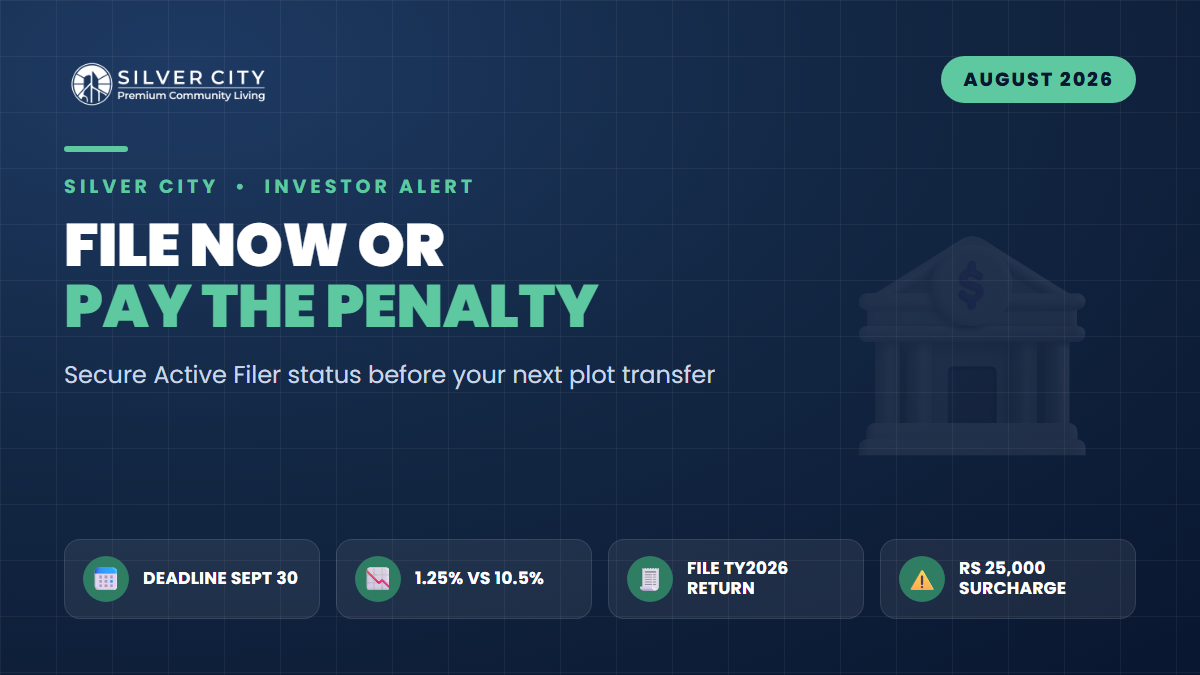
- Advance tax under Section 236K — the purchaser’s advance tax on registration/transfer. Filers pay materially lower rates than non-filers, so keeping your name on the Active Taxpayers List (ATL) directly saves money.
- Provincial stamp duty and registration/CVT charges — payable at the Rawalpindi sub-registrar / RDA level.
- Society transfer fee — Silver City’s own transfer charge for updating ownership records.
- Declare the asset — record the plot in your wealth statement so your books stay consistent. This is exactly what makes you “eligible” if you later scale up to a bigger purchase.
Why This Is Good News for Small Investors
The design of Section 114C actually rewards the disciplined, mid-tier investor. Buying an affordable, sub-threshold plot in a documented, RDA-approved society and declaring it properly builds a clean paper trail. Over time that same trail is what lets you generate an eligibility certificate effortlessly when you graduate to a 1-kanal plot, a commercial unit, or a multi-plot portfolio that does cross the notified value. In short: start under the threshold, file every year, and you are always on the eligible side of the ledger.
Frequently Asked Questions
Do I need an FBR Certificate of Eligibility to buy a 5-marla plot in Silver City?
No. The certificate requirement is triggered by high-value transactions above the notified threshold (discussed at roughly Rs 50 million for residential property and Rs 100 million for the advance certificate). A 5-marla plot at around Rs 2.5–2.8 million is far below that, so an active filer transfers it normally.
What makes me an “eligible person” under Section 114C?
Two things: you filed your income tax return for the tax year immediately before the purchase, and you have declared enough resources in your wealth or financial statements to justify the transaction value. Meeting both keeps you eligible and, for larger deals, lets you generate the certificate on IRIS.
I am a non-filer buying a small plot — am I blocked?
For a sub-threshold purchase the 114C eligibility block is not the operative restriction. However, non-filers pay much higher advance tax under Section 236K and lose other filer benefits. Becoming a filer before you transact is almost always worth it — and it future-proofs you for bigger purchases that would trigger 114C.
Where do I generate the certificate if I ever need it?
Through the FBR IRIS portal, where the “Certificate of Eligibility” feature went live on 18 June 2025. You generate it online and present it to the registering authority to complete a high-value transfer.
The Bottom Line
Section 114C and its IRIS Certificate of Eligibility are aimed squarely at high-value, hard-to-explain transactions — not at the everyday plot buyer. For an active filer, a sub-Rs100 million purchase like a 5-marla plot simply transfers without the eligibility block. That makes an affordable, well-documented, RDA-approved society such as Silver City a sensible entry point: you stay clear of the threshold today while building exactly the clean, declared record that keeps you “eligible” as your portfolio grows. As always, confirm the latest notified thresholds and 236K rates with your tax advisor before you sign.