The macro picture just shifted in the investor’s favour
For three years, the biggest enemy of every Pakistani saver was not the property market — it was their own bank balance. A rupee that slid from the low 200s toward 300 quietly erased purchasing power while cash sat “safe” in an account. That dynamic is now easing, and the change matters for anyone deciding whether to keep holding cash or convert it into a hard, appreciating asset like a Rawalpindi plot.
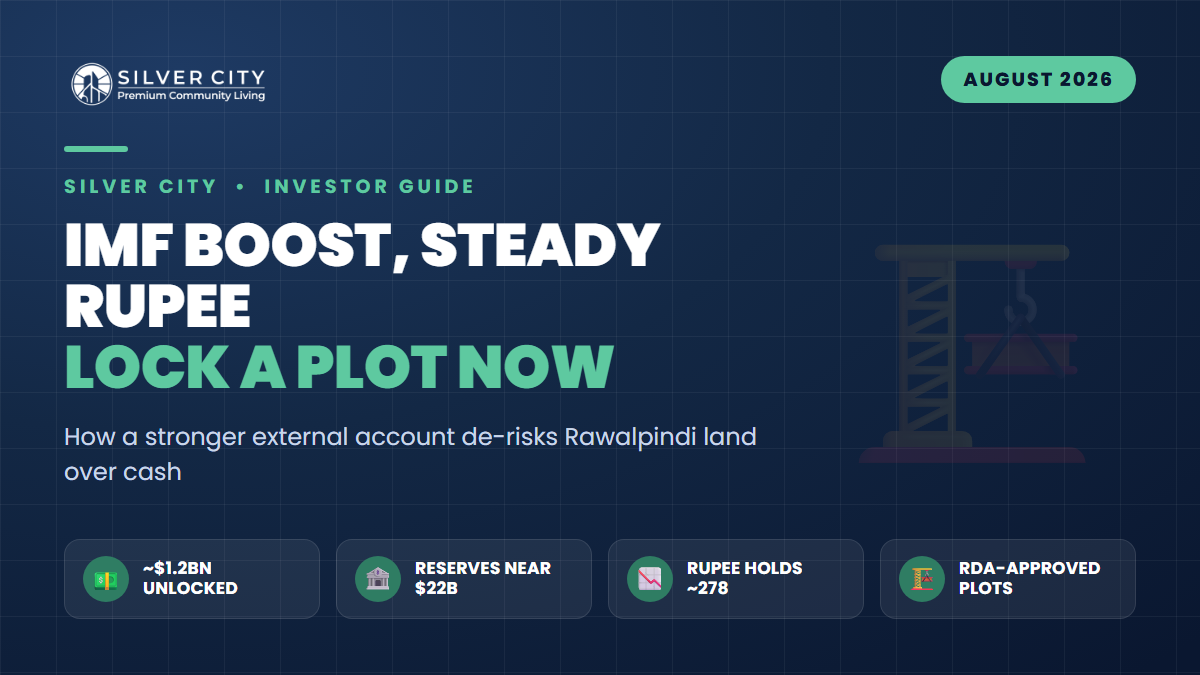
The International Monetary Fund’s latest review of Pakistan’s US$7 billion Extended Fund Facility (EFF) cleared an immediate disbursement of roughly US$1.2 billion — about US$1 billion under the EFF plus around US$200 million under the linked Resilience and Sustainability Facility (RSF). That brought cumulative disbursements under the two arrangements to about US$3.3 billion, with further tranches expected as remaining reviews are completed on schedule. The Fund explicitly cited easing inflation, rebuilding reserves and improving investor confidence.
Those are not abstractions. They are the exact conditions that historically precede a stable — or appreciating — property market in Rawalpindi and Islamabad.
What the numbers actually say
Two indicators tell the story better than any forecast:
- Reserves are materially higher. State Bank of Pakistan (SBP) reserves have recovered from crisis-era lows to around US$17 billion, with total liquid reserves (including commercial banks) near US$22 billion — supported by record remittances, IMF inflows and tighter reserve management.
- The rupee is holding. The interbank rate has stabilised in the 277–278 band for an extended stretch, a sharp contrast to the double-digit annual depreciation of 2022–2023.
When reserves rise and the currency stops falling, the “cost of waiting” for a real asset collapses. You are no longer racing a depreciating rupee; you can plan an instalment purchase with reasonable confidence that your future payments won’t be devalued mid-plan.
Cash vs. a plot: the de-risking logic
Holding cash carries two silent costs in Pakistan: currency depreciation and inflation. Even with headline inflation cooling, real deposit returns after tax have often been thin. A well-located, approved plot addresses both — it is priced in rupees but tends to track (and frequently outpace) inflation over multi-year horizons, and land near active infrastructure corridors captures development-driven gains that cash never will.
The external-account improvement de-risks this move in three concrete ways:
- Instalment predictability. A stable rupee means a 3-year payment plan is easier to budget in real terms.
- Lower devaluation drag. Reduced pressure on the currency lowers the odds of a sudden shock eroding your entry.
- Confidence-led demand. IMF-anchored stability tends to revive buyer sentiment, supporting resale liquidity.
A worked comparison
The table below illustrates the intuition with representative figures. It is directional, not a guarantee — always verify live prices and plans directly with the developer.
| Scenario (3-year horizon) | Cash in bank | Approved Rawalpindi plot |
|---|---|---|
| Primary risk | Depreciation + inflation erosion | Market timing / project delivery |
| Purchasing-power trend | Flat to negative in real terms | Historically inflation-tracking or better |
| Entry method | Lump sum, idle | Small down payment + monthly instalments |
| Upside driver | Deposit rate (taxable) | Development, demand, location premium |
| Best suited to | Very short-term liquidity needs | 2–5 year wealth preservation & growth |
Why Rawalpindi, and why now
Rawalpindi’s western growth corridor — around Girja Road, the Thalian Interchange and the M-2 motorway access — has become one of the most watched belts for mid-ticket plot investment. New RDA-approved societies here offer instalment-friendly entry points that let investors deploy capital gradually rather than in one lump sum. Representative pricing in this belt currently looks like the following:
| Plot size | Indicative price | Typical down payment | Instalment structure |
|---|---|---|---|
| 5 Marla | ~Rs 1.5 million | ~Rs 375,000 (25%) | 36 monthly instalments (~Rs 22,900) |
| 10 Marla | ~Rs 3.0 million | ~Rs 750,000 (25%) | 36 monthly instalments (~Rs 45,800) |
| 1 Kanal | On request | ~25% | 3–4 year easy plans |
Figures are indicative and change with phase, location within the scheme and promotions — confirm the current schedule before committing.
Sensible cautions before you commit
A friendlier macro backdrop is a tailwind, not a green light to skip diligence. Keep these in mind:
- Verify the approval. Only buy where the society holds a valid RDA (or relevant authority) status, and confirm the specific block/phase is approved — not just the parent scheme.
- Match the horizon. Plots reward patience; treat this as a 2–5 year hold, not a quick flip, and keep emergency liquidity separate.
- Watch execution risk. Development pace, possession timelines and dealer credibility matter more than headline prices.
- Stay tax-clean. Use documented channels, keep your filer status active and factor in FBR duties on purchase and transfer.
Frequently Asked Questions
Does the IMF disbursement directly raise property prices?
Not directly or overnight. The ~$1.2bn tranche strengthens reserves and confidence, which supports currency stability and buyer sentiment. Those conditions historically underpin steadier — and often rising — plot demand, but prices still depend on location, approvals and development activity.
Is the rupee really stable enough to plan a 3-year instalment plan?
The rupee has held in the 277–278 range for a sustained period with reserves near multi-year highs, which is far more predictable than the 2022–2023 slide. No currency is risk-free, but the environment is now more supportive of budgeting fixed rupee instalments than it has been in years.
Why choose land over gold or a savings account?
Gold hedges currency risk but generates no development-led upside; savings accounts often deliver thin real returns after tax and inflation. An approved plot in a growth corridor can preserve purchasing power and capture infrastructure-driven appreciation, while instalments lower the entry barrier.
What’s the single most important check before buying?
Confirm the legal approval status of the exact plot and phase you intend to buy, then verify the current price and payment schedule in writing with the developer. Approval and documentation protect your capital more than any market forecast.
The takeaway
The strengthening external account — an IMF review unlocking roughly $1.2 billion, reserves climbing toward $22 billion and a rupee holding near 278 — meaningfully lowers the risk of converting idle, depreciating cash into a hard asset. For investors with a multi-year horizon, an approved, instalment-friendly Rawalpindi plot is a rational way to preserve and grow purchasing power in this window. Among the RDA-approved options along the Girja Road–Thalian corridor, Silver City is worth shortlisting and evaluating on its merits — verify its approvals, current pricing and delivery record, then decide with your own numbers in hand.