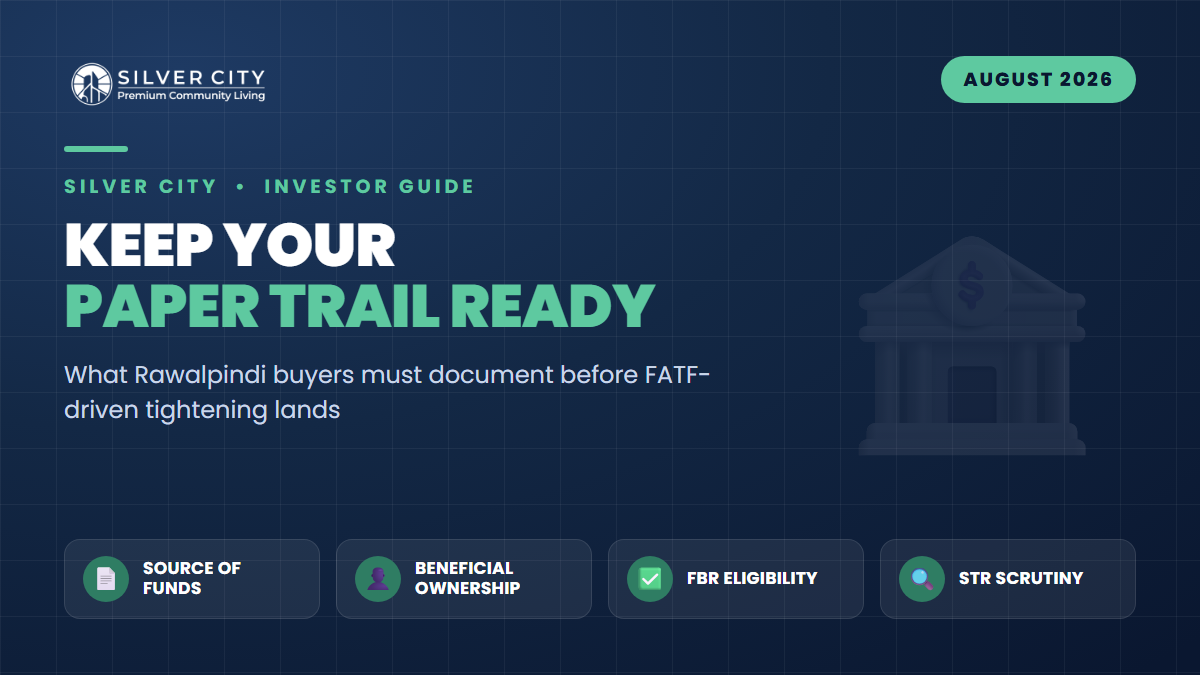
In May 2026, ahead of the FY2026-27 budget talks, the International Monetary Fund did something Rawalpindi property investors should pay close attention to: it publicly flagged Pakistan’s near-zero suspicious-transaction reporting (STR) from the real estate sector and called the country’s oversight of designated non-financial businesses and professions (DNFBPs) “unsatisfactory.” Translation for buyers on the ground — the era of walking into a society office with a bag of undocumented cash and walking out with a plot file is ending. The documentation you keep before a transfer is about to matter as much as the price you negotiate.
What the IMF Actually Said — And Why It Hits Property
The IMF’s concern is simple. Real estate has long been perceived as the parking lot for untaxed and “dirty” money in Pakistan. Yet the number of STRs generated by real estate agents, builders and developers — the DNFBPs legally required to flag suspicious deals to the Financial Monitoring Unit (FMU) — has been strikingly low relative to the volume and value of transactions. When banks file thousands of STRs and the entire property sector files a handful, the mismatch tells regulators the reporting framework is being bypassed.
In response, Pakistan committed to the IMF that the Directorate General of DNFBPs, the FBR and the FMU would tighten the reporting framework, force real estate entities to register with the system, and refresh the National Risk Assessment through the National AML/CFT Authority. This is FATF-driven pressure with a domestic enforcement engine behind it — and it flows downhill to the individual buyer at the society transfer counter.
The Compliance Layers Already in Force
Much of the tightening is not theoretical — it has already been legislated. Buyers in Rawalpindi should understand three stacked requirements:
- Active Taxpayer List (ATL) filing: Individuals not on the ATL (and outside narrow exemptions) face restrictions and punitive tax on property transactions. Being a filer is now the baseline entry ticket.
- Section 114C “eligible person” test (Finance Act 2025, effective 1 July 2025): For higher-value deals, you must be an “eligible person” — someone whose declared wealth or financial statement for the immediately preceding tax year shows sufficient resources, defined as at least 130% of the cash and cash-equivalent assets used for the purchase.
- FBR Certificate of Eligibility (IRIS portal): The FBR has rolled out a “Certificate of Eligibility” feature on its IRIS portal to enforce these rules digitally at the point of transaction.
When the Eligibility Certificate Kicks In
| Transaction Type | Threshold | What’s Required |
|---|---|---|
| Residential property | Up to Rs 50 million | ATL/filer status; source of funds prudent to retain |
| Commercial plot | Up to Rs 100 million | ATL/filer status; documentation prudent |
| Any property | Above Rs 100 million | Advance FBR Eligibility Certificate confirming declared wealth ≥ 130% of transaction value |
Note the direction of travel: thresholds and the “declared money” principle almost always tighten over time, not loosen. Buying at Rs 45 million today does not exempt you from keeping a clean file — the next budget can lower the bar.
The Beneficial-Ownership Question
One of Pakistan’s core FATF commitments is transparency of beneficial ownership — identifying the real human being who ultimately owns or controls an asset, not just the name printed on the allotment file. This is the death knell for the classic benami arrangement, where property is held in a relative’s, employee’s or nominee’s name.
If you are buying through a company, a family arrangement, or in someone else’s name for convenience, expect to be asked — now or at resale — who the ultimate beneficial owner is and how the funds trace back to that person. Structuring a purchase to obscure the true owner is exactly the pattern STR reforms are designed to catch. The safest posture is straightforward: buy in the name of the person whose declared, taxed wealth funds the purchase.
The Document Trail Rawalpindi Buyers Should Build — Before the Transfer
Do not wait for a challan or notice. Assemble and retain the following for every purchase, regardless of value:
- Source-of-funds evidence: Bank statements showing the money’s origin — salary, business income, a documented sale of another declared asset, an inheritance, or a remittance through formal banking channels.
- Wealth statement linkage: Ensure the funds and the resulting property appear consistently in your tax return and wealth statement for the relevant year.
- Banking-channel payment proof: Pay via cheque, pay order or bank transfer, not cash. Retain deposit slips and transaction IDs — a bank trail is your strongest defence.
- CNIC and beneficial-owner declaration: Clear identity records for the actual owner; avoid nominee holdings.
- Society-side paperwork: Allotment letter, transfer receipt, dealer’s commission invoice, and the society’s own KYC form — increasingly, RDA-approved societies are formalising buyer KYC.
- FBR certificates where applicable: Eligibility Certificate for deals above threshold, plus proof of ATL status on the transfer date.
Indicative Compliance Timeline
| Milestone | Status |
|---|---|
| ATL/filer restrictions on property deals | In force |
| Section 114C “eligible person” rule | Effective 1 July 2025 |
| FBR Certificate of Eligibility on IRIS | Live |
| IMF flags near-zero real-estate STRs | May 2026 |
| DNFBP reporting framework tightening & mandatory registration | Ongoing / rolling out |
Why This Can Be Good News for Genuine Investors
Documentation discipline is not just a burden. As undocumented cash gets squeezed out, artificial price inflation cools, and properties held cleanly become far more liquid at resale — a buyer with a spotless paper trail sells faster and to a wider pool. Notably, the government has also removed the Federal Excise Duty on property transfers, easing the legitimate cost of buying. The message is coherent: reduce friction for documented buyers, raise it for undocumented money.
Frequently Asked Questions
Do I need an FBR Eligibility Certificate to buy a plot in Rawalpindi?
Only if the transaction crosses the threshold — broadly, residential property above Rs 50 million or any property above Rs 100 million requires an advance Eligibility Certificate confirming your declared wealth is at least 130% of the transaction value. Below that, you still need to be a filer on the ATL, and keeping source-of-funds records is strongly advisable because thresholds tend to tighten.
What exactly counts as “source of funds”?
Documented, taxed money whose origin you can trace: salary, business income, proceeds from selling another declared asset, inheritance, or a formal-channel remittance. The key is that it appears in your bank statements and reconciles with your tax return and wealth statement. Undocumented cash has no place in the trail.
Can I still buy property in a relative’s name?
You can, but it is risky under the beneficial-ownership push. Regulators want to identify the real owner behind an asset, and nominee (benami) holdings are precisely what the reforms target. If the funds are yours, holding the property in your own name — matched to your declared wealth — is the cleaner, safer route.
Will an STR automatically get me in trouble?
No. An STR filed by a dealer or society is a report of a pattern that looks suspicious, not a finding of guilt. If your funds are documented and your file is complete, scrutiny is easily satisfied. The buyers at risk are those who cannot explain where the money came from.
The Bottom Line
FATF-driven tightening is not a distant threat — the legislative pieces are already live, and the IMF’s May 2026 pressure guarantees enforcement will only sharpen. The winning strategy for Rawalpindi investors is boringly simple: buy in your own name, pay through the bank, keep every receipt, and reconcile the purchase with your tax filings. When you’re choosing where to put documented money, an RDA-approved society matters because approved projects are the ones aligning with formal KYC and transfer standards. Silver City, located on Girja Road near the Thalian Interchange with RDA/NOC approval and plots from 5 to 10 marla and 1 Kanal, is one such option worth considering for buyers who want to invest cleanly and hold an asset that stays liquid as the documentation net tightens.
@@END@@