The headline looks like relief. The math says otherwise.
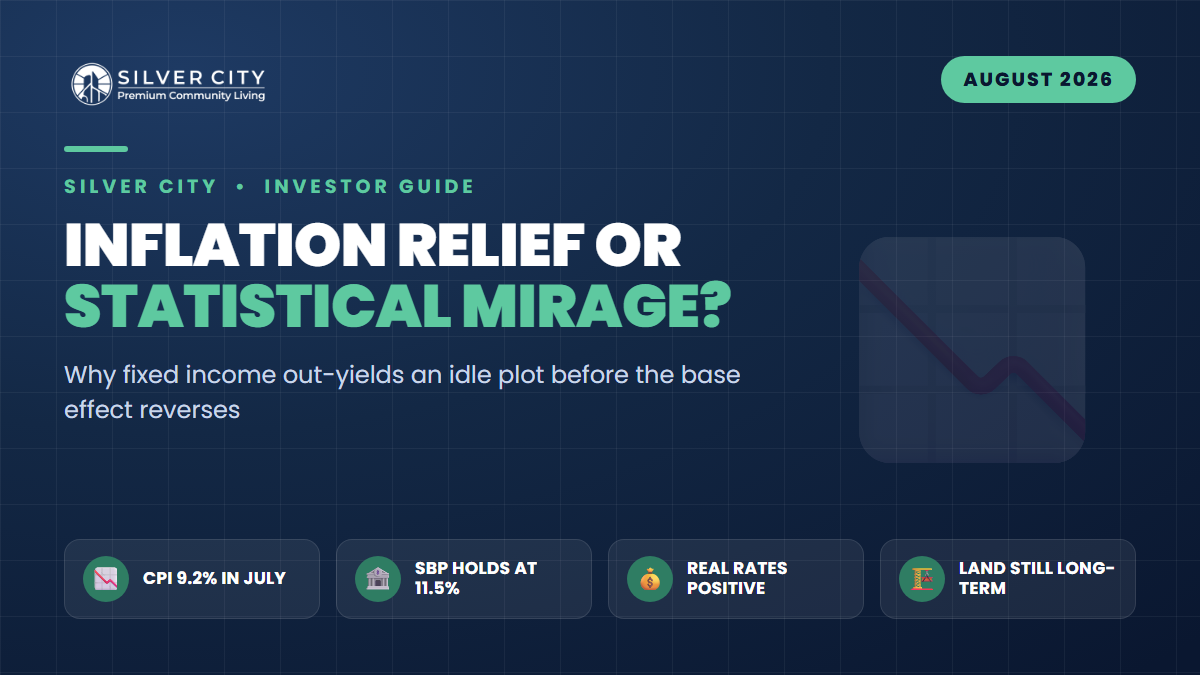
On 1 August 2026, the Pakistan Bureau of Statistics reported that national CPI inflation cooled to 9.2% year-on-year in July 2026, down sharply from 11.1% in June. Property WhatsApp groups lit up instantly: “Inflation is beaten, rates will crash, buy plots before prices run.” That reflex is understandable — and, for the next few quarters, probably wrong.
The drop from 11.1% to 9.2% is largely a base effect, not fresh disinflation. Year-on-year inflation compares this July’s price level to last July’s. Because prices spiked hard in mid-2025, the comparison “base” is elevated, which mechanically drags the YoY figure down even when current prices are still climbing. The proof is in the monthly number: prices actually rose 1.2% month-on-month in July 2026, after a 0.3% dip in June. Rural inflation (9.9%) is running hotter than urban (8.7%). In other words, your cost of living did not fall in July — the statistical mirror just made the annual change look smaller.
Why the State Bank isn’t buying the “relief” either
The clearest tell is what the professionals did with real money. On 27 July 2026, the State Bank of Pakistan’s Monetary Policy Committee held the policy rate at 11.5% for the third consecutive meeting, after a 100 basis-point hike back on 27 April. If the SBP believed 9.2% was durable, it would be cutting to support a fragile recovery. Instead it is sitting still — citing sticky month-on-month momentum, uncertain oil prices, and regional (Middle East) risk to the import bill.
That posture creates the single most important fact for investors this year: real interest rates are now strongly positive. With the nominal rate at 11.5% and headline inflation at 9.2%, the “real” return on rupee savings is roughly +2.3% on a backward-looking basis — and the SBP looks at forward inflation, where its own real-rate cushion is wider still. Positive real rates are the textbook signal that holding cash-like assets is being rewarded, and that speculative, non-yielding assets are being penalised.
Recent SBP policy timeline
| Meeting | Action | Policy Rate |
|---|---|---|
| 27 April 2026 | Hike +100 bps | 11.5% |
| May 2026 | Hold | 11.5% |
| June 2026 | Hold | 11.5% |
| 27 July 2026 | Hold (3rd straight) | 11.5% |
The uncomfortable comparison: an idle plot yields nothing
Here is what many first-time investors overlook. A vacant plot in a developing society produces zero cash yield. It pays no rent, no profit, no coupon. Its only return is capital appreciation — and appreciation is slowest exactly when interest rates are high, because buyers can earn 11–12% risk-free instead of chasing land. Meanwhile the plot quietly costs you: development charges, membership dues, and the opportunity cost of capital that could have been compounding elsewhere.
Compare that to the fixed-income menu available to any Pakistani saver in mid-2026:
| Instrument | Indicative Annual Return | Cash Yield? |
|---|---|---|
| 12-month T-bill | ~11.5–11.75% | Yes (at maturity) |
| 6-month T-bill | ~11.4–11.65% | Yes |
| Special Savings Certificate (NSS) | 11.6% (final payout 12.4%) | Yes (6-monthly) |
| 3–5 year PIB | ~11.3–11.65% | Yes (coupon) |
| Idle residential plot | 0% cash + uncertain appreciation | No |
Run the arithmetic on a PKR 5,000,000 stake. Parked in a one-year T-bill or Special Savings Certificate near 11.5%, that capital throws off roughly PKR 575,000 of near-risk-free income in twelve months. For the same idle plot to merely match that, it must appreciate 11.5% and stay perfectly liquid — a tall order in a high-rate window when transaction volumes thin out and files can take months to sell. Short-term, on a pure yield basis, fixed income wins.
How buyers should read the “relief” before it reverses
None of this means land is a bad asset. It means timing and cash flow matter. Base effects are temporary by definition: as the high 2025 base rolls off later in FY2027, YoY inflation is likely to drift back up toward double digits, keeping the SBP cautious. The rate-cut cycle that genuinely re-prices land upward will probably arrive after that reversal is digested, not because of one flattering July print. A disciplined investor should therefore:
- Treat 9.2% as a data point, not a trend. Watch month-on-month CPI and the SBP tone, not the headline YoY number.
- Earn the positive real rate while you wait. Keep dry powder in T-bills or National Savings so your capital compounds instead of idling.
- Buy land on installments, not lump sums. Developer payment plans let you secure today’s plot price while your reserve keeps earning 11–12% — capturing the location without locking up dead capital.
- Prioritise RDA/CDA-approved, high-demand societies. When the cycle turns, approved and well-located inventory re-rates first and holds value; unapproved files stay illiquid.
Frequently Asked Questions
What exactly is a “base effect” and why does it make 9.2% misleading?
A base effect happens because year-on-year inflation compares today’s prices to the same month a year ago. Prices surged in mid-2025, so the comparison base is high, which pulls the annual percentage down even while prices keep rising month to month. July 2026 actually saw a 1.2% monthly increase — so the “relief” is arithmetic, not a real fall in your grocery or fuel bill.
If inflation is 9.2%, why is the SBP still at 11.5%?
Because the SBP targets forward-looking, sustainable inflation, not one soft print. It held the rate for the third straight meeting on 27 July 2026, citing sticky monthly momentum, oil-price and regional risks, and the likelihood that the base effect reverses. A positive real rate (about +2.3%) is deliberate — it keeps the rupee attractive and inflation anchored.
So should I never buy property in a high-rate environment?
No. High rates are the best time to negotiate and to lock plots on installment plans, because speculative demand is thin and sellers are motivated. The key is not to sink lump-sum cash into a non-yielding idle plot when the same rupees can earn 11–12% risk-free. Buy the location on terms; keep the reserve working.
When does an idle plot start beating fixed income?
Typically once the rate-cut cycle is clearly underway and real rates compress. Falling rates lower the risk-free yield and pull buyers back into land, driving appreciation that can outpace the (now lower) fixed-income return. That inflection tends to follow — not precede — a confirmed, durable drop in inflation, which a single base-effect month does not deliver.
The takeaway
July’s 9.2% is a flattering snapshot, not a green light. With the SBP anchored at 11.5% and real rates positive, the disciplined move is to let fixed income out-yield idle capital in the short term while positioning for the eventual turn in the land cycle. When you are ready to commit to real assets, favour approved, well-located inventory: Silver City, an RDA-approved housing society in Rawalpindi with flexible installment plans, is exactly the kind of secure, well-connected option worth shortlisting — so you own the location on sensible terms today and let it re-rate when the cycle, not the base effect, finally turns.