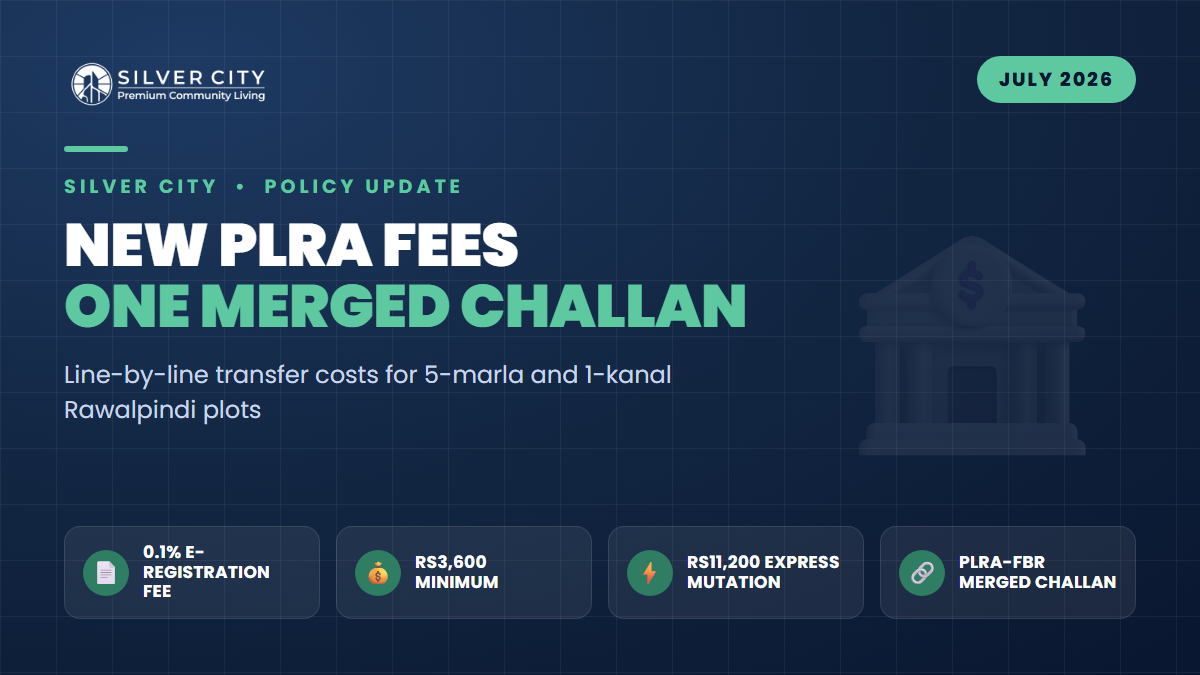
Two changes landed within weeks of each other this year, and together they reshape what a plot transfer in Rawalpindi costs and how long it takes. In July 2026 the Punjab Land Records Authority (PLRA) notified a revised schedule of service charges for FY2026-27, effective immediately. And since mid-2026, PLRA’s e-registration workflow has been wired directly into FBR’s systems, so the separate trip to the FBR portal to generate a 236C/236K challan is no longer part of the process.
Most coverage has treated these as two headlines. For anyone actually closing a deal, they are one question: what do I now write on the cheque, and how many working days does this take? Below is the arithmetic, on a 5-marla and a 1-kanal Rawalpindi plot, with every line identified.
What PLRA Actually Notified
The headline item is the e-registration service fee: 0.1% of the land value, subject to a minimum charge of Rs3,600. That floor matters more than it looks. Because 0.1% of Rs3.6 million is exactly Rs3,600, the minimum binds on any transaction valued below roughly Rs36 lakh — a small commercial shop, a share transfer, an inheritance-driven partition. On a Rs20 lakh transaction the effective rate is 0.18%, not 0.1%.
Key lines from the revised schedule:
| Service | Revised charge (FY2026-27) |
|---|---|
| E-registration service fee | 0.1% of land value (minimum Rs3,600) |
| Express mutation | Rs11,200 |
| Ordinary mutation | Rs1,200 |
| Mutation through banks | Rs2,100 |
| Express fard / mutation / girdawari | Rs4,000 |
| Ordinary copy | Rs900 |
| Certified copy of registered deed | Rs1,400 |
| Local commission via e-registration | Rs6,700 |
| Housing / development authority transactions | Rs3,000 |
| Bank verification (successful / unsuccessful) | Rs1,000 / Rs700 |
| Overseas service charge (foreign missions) | USD 50 per transaction |
The Federal Side Moved in the Opposite Direction
Here is the context most PLRA fee stories missed. The Finance Act 2026-27, gazetted ahead of the 1 July 2026 rollout, cut advance tax on property for active filers to a flat rate regardless of slab: 2.75% for the seller under section 236C and 1.25% of fair market value for the buyer under 236K. The old three-tier filer slabs — which ran to 4.5% on the seller side — are gone.
Separately, the Punjab Stamp (Amendment) Ordinance 2026, assented to on 10 April 2026, standardised stamp duty on immovable property at 1% across urban and rural Punjab, removing the 3% rural rate.
So the PLRA increase of a few thousand rupees arrives in the same year that the tax load on a Rs2 crore deal fell by lakhs. Judge the schedule in that frame, not on its own.
Line by Line: 5 Marla vs 1 Kanal
The two columns below assume an active-filer buyer and an active-filer seller, a declared value of Rs50 lakh on the 5-marla and Rs2 crore on the 1-kanal, and an urban rated area where the 1% corporation/TMA fee applies. Substitute your own valuation-table figure — the structure holds, only the multiplicands change.
| Cost line | Rate | 5 marla (Rs50 lakh) | 1 kanal (Rs2 crore) |
|---|---|---|---|
| Stamp duty | 1% | Rs50,000 | Rs200,000 |
| Corporation / TMA fee | 1% | Rs50,000 | Rs200,000 |
| Registration fee | Fixed | Rs1,000 | Rs1,000 |
| PLRA e-registration service fee | 0.1% | Rs5,000 | Rs20,000 |
| Mutation (ordinary) | Fixed | Rs1,200 | Rs1,200 |
| FBR 236K (buyer, filer) | 1.25% | Rs62,500 | Rs250,000 |
| Buyer subtotal | — | Rs169,700 (3.39%) | Rs672,200 (3.36%) |
| FBR 236C (seller, filer) | 2.75% | Rs137,500 | Rs550,000 |
| Both sides combined | — | Rs307,200 (6.14%) | Rs1,222,200 (6.11%) |
| If express mutation used (+Rs10,000) | — | Rs317,200 (6.34%) | Rs1,232,200 (6.16%) |
Three things fall out of this table. First, the entire PLRA block — e-registration fee plus mutation — is Rs6,200 on the 5-marla and Rs21,200 on the kanal. That is 2% and 1.7% of total transfer cost respectively. The fee revision is real, but it is not what makes transfers expensive; the 236C/236K pair and the two 1% provincial levies are.
Second, the express-mutation premium is a flat Rs10,000 over the ordinary rate. On a Rs2 crore kanal deal, that is 0.05% of value to compress a queue. If express attestation pulls your possession date forward even a week, it pays for itself in almost any Rawalpindi scenario. On a Rs20 lakh file it is a genuine decision.
Third, these are filer numbers. Late-filer and non-filer schedules remain substantially higher — into double digits on the non-filer side — and were not cut alongside the filer rates. Confirm your Active Taxpayer List status before you book a transfer date, not after.
How the Merged Challan Changes Transfer Day
Under the old sequence, the buyer and seller generated tax challans on the FBR portal first, then moved to the PLRA side for the e-stamp challan, with manual verification at several points. Under the integrated system, the challan is generated within PLRA’s workflow: property details are pulled from the land record, CNIC, ownership share and value are transmitted to FBR electronically, FBR determines filer status and the applicable rate, and both the 236C and 236K challans come back automatically. PSIDs are payable through Bank of Punjab, JazzCash, Easypaisa, internet banking or a bank counter.
| Stage | Old workflow | Integrated workflow |
|---|---|---|
| Tax challan | Separate FBR portal visit; manual value entry | Auto-generated inside PLRA; value pulled from record |
| Filer status check | Verified manually, often disputed at counter | Determined electronically by FBR |
| Stamp / e-stamp | Second portal, second challan | Same session as the tax challans |
| Payment | Bank counter, per challan | PSID via app, wallet or counter |
| Deed + biometrics | Arazi Record Centre appointment | Unchanged — still in person |
| Mutation | Ordinary or express request after registration | Ordinary Rs1,200 / express Rs11,200 |
What this removes is not the appointment — biometrics and deed execution still happen in person at the Arazi Record Centre. What it removes is the pre-appointment scramble: the rejected challan because a value was keyed in differently on two portals, the re-issued PSID, the second bank trip. In practice that is where multi-day slippage used to come from. Budget your calendar around the appointment slot and the mutation mode you choose, not around challan generation.
Practical Notes Before You Sign
- Verify the value your challan uses. DC valuation-table figures and FBR fair-market values are not always the same number for the same plot. The tax lines above use one assumed value for clarity.
- Housing-society plots behave differently. Where the transfer happens on society records first and the registry follows, the corporation-fee and registration-fee treatment differs from a directly registered urban plot. PLRA’s Rs3,000 housing/development authority transaction line is separate again.
- The stamp duty relief came via ordinance. An ordinance has a limited life unless re-enacted. Confirm the live rate on the Punjab e-stamp portal on the day you generate the challan.
- Keep every PSID receipt. 236C and 236K are adjustable against your annual return. Paid and undocumented is money donated.
Frequently Asked Questions
Is the Rs3,600 e-registration charge on top of the 0.1% fee?
No. Rs3,600 is the floor, not an addition. You pay 0.1% of the land value or Rs3,600, whichever is higher. Since 0.1% of Rs3.6 million equals Rs3,600, the flat minimum applies to anything valued below roughly Rs36 lakh, and the percentage takes over above that.
Do I still need to generate an FBR challan separately?
Not under the integrated PLRA-FBR registry. The 236C and 236K challans are produced within the PLRA e-registration workflow, with filer status resolved electronically. You still have to pay them, and you still attend in person for biometrics and deed execution.
Is Rs11,200 for express mutation worth paying?
It is a flat Rs10,000 premium over ordinary mutation regardless of plot size. On a kanal-sized transaction it is a rounding error against the tax lines and usually worth it. On a small file where nothing is time-critical, ordinary mutation at Rs1,200 is the sensible default.
Did total transfer costs go up or down this year?
Down, materially, for active filers. PLRA’s service charges rose by a few thousand rupees, but the filer 236C rate fell to a flat 2.75% and 236K to 1.25%, and Punjab standardised stamp duty at 1%. On the Rs2 crore example above, the PLRA increase is a fraction of the federal saving.
The Investor Takeaway
Total round-trip transfer cost on a filer-to-filer Rawalpindi plot now sits near 6.1-6.3% of declared value, with roughly 3.4% falling on the buyer. The PLRA schedule is a small, visible line in that stack; the merged challan mostly buys back time rather than money. Both changes push in the same direction — cleaner paperwork, fewer counters, better-documented ownership.
That environment rewards buying into schemes where the approval trail is already clean. Silver City, an RDA-approved society on the Rawalpindi side, is one option worth putting on the shortlist when you are comparing plots whose paperwork will have to survive this new, far more connected registry.