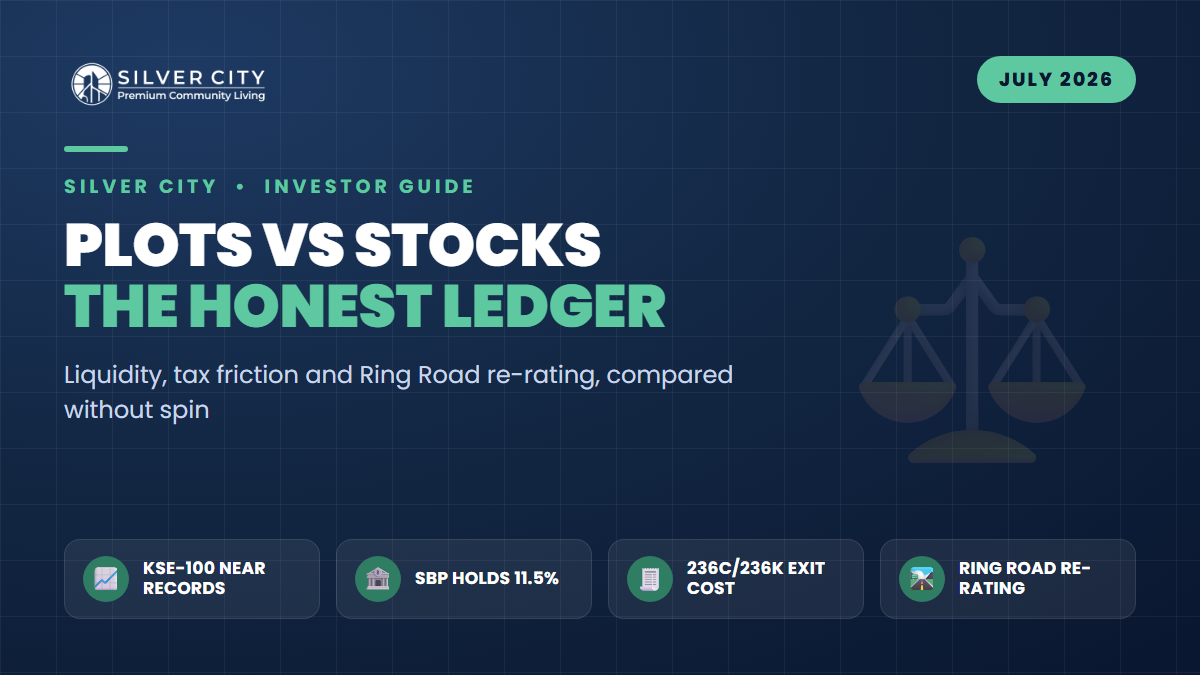
On Monday 27 July 2026, the State Bank of Pakistan’s Monetary Policy Committee held the policy rate at 11.5% — a second consecutive pause. The MPC pointed to headline inflation easing to 11.1% in June from 11.7% in May, projected FY2027 GDP growth of 3.5%–4.5%, and flagged Middle East developments as a live risk to the outlook. Inflation is expected to drift toward the upper end of the 5%–7% target band by June 2027.
Meanwhile the Pakistan Stock Exchange has had a loud month. The KSE-100 pushed above 186,000 in early July, with 2026 peaks in the 189,000–191,000 region. And then it gave much of that back. The index closed 27 July around 178,262 — after a single-session gain of more than 4%. Month-on-month, the index was roughly flat (about −0.1%). Year-on-year, it was up roughly 28%.
Read that paragraph again, because it is the whole argument. The same index that triggered the question “should I sell my plot and buy shares?” moved 4% in one day and roughly nothing in a month. That is not a criticism of equities. It is a description of them.
Where equities genuinely win: liquidity
There is no honest way to argue this one for plots. If you own PSX-listed blue chips and you need Rs 30 lakh on Tuesday, you sell on Tuesday and settle in T+2. You can sell 30% of the position and keep 70%. Brokerage plus CDC and PSX charges on a round trip typically land well under 1%.
A 10 Marla plot cannot do any of that. You cannot sell one-third of it. In a soft market a genuine sale in Rawalpindi’s outer societies can take 45 to 120 days from listing to registry — longer if the file has a transfer complication or the society’s dues are outstanding. Plots are not a liquidity instrument, and anyone selling them to you as one is doing you a disservice.
The practical consequence: your emergency fund, your children’s near-term fee liability and any money you might need inside 24 months should never sit in land. That is not a plots-versus-stocks argument. That is basic sequencing.
The exit friction nobody prices in
Here is where the rotation-into-equities pitch quietly breaks. Selling a plot is not free, and the Finance Act 2026-27 changed the numbers materially — mostly in the investor’s favour, but only if you are on the Active Taxpayer List.
Advance tax under section 236C (collected from the seller) was simplified to a flat 2.75% of gross consideration for ATL persons, down from the earlier 4.5%–5.5% slabs. Advance tax under section 236K (collected from the buyer) came down to 1.25% of fair market value, from the earlier 1.5%–2.5% range. Section 7E — the deemed-income tax on certain immovable property — was withdrawn following the constitutional ruling against taxing notional income. Non-filer rates remain multiples of these; confirm the current non-ATL figure with your tax adviser before you sign anything, because the gap is now the single most expensive line item in a Pakistani property transaction.
| Cost line (ATL / filer) | Plot exit — Rs 1 crore | Equity exit — Rs 1 crore |
|---|---|---|
| Advance tax on sale (236C) | 2.75% = Rs 275,000 | Not applicable |
| Advance tax on purchase (236K, borne by buyer) | 1.25% = Rs 125,000 | Not applicable |
| Stamp duty + registration (Punjab, indicative) | ~2%–3%, verify current schedule | Nil / negligible |
| Brokerage / agent commission | ~1% per side, customary | Typically under 0.3% round trip |
| Capital gains tax | 15% flat for ATL on property acquired on/after 1 July 2024 | 15% flat for ATL on securities acquired on/after 1 July 2024 |
| Realistic time to cash | 45–120 days | T+2 |
Add it up. A full round trip out of a plot and into shares costs you somewhere in the region of 5%–8% in transaction friction before a single rupee of capital gain is taxed. On a Rs 1 crore holding that is Rs 500,000 to Rs 800,000 of value destroyed at the moment of rotation. The KSE-100 has moved that much in two sessions this month. You are paying a permanent cost to chase a variable one.
Volatility exists in plots too — it just isn’t quoted
Be fair to equities here. Land is not less volatile than shares; land is less frequently priced. Nobody prints a daily mark on your file. A plot in a stalled, unapproved society can lose half its real value over three years and the owner will not know until they try to sell — at which point the discount arrives all at once, as an illiquidity haircut rather than a red candle.
The difference is behavioural, and it cuts both ways. The absence of a ticker stops panic selling, which helps most retail investors. It also lets a bad holding hide. If you own a file in a society with no RDA approval, no development on the ground and no exit demand, “it hasn’t dropped” is a story you are telling yourself, not a fact.
The Ring Road re-rating equities cannot replicate
This is the asymmetry the rotation argument ignores. The KSE-100 is a leveraged bet on rates, corporate earnings and sentiment — all of which are being repriced continuously by thousands of participants. There is no informational edge available to a retail investor in Rawalpindi buying OGDC.
Land near an infrastructure corridor is different: the re-rating is event-driven and locally observable. The Rawalpindi Ring Road reached roughly 85% physical progress by May 2026, with the main carriageway largely carpeted and a June 2026 completion target. Banth, Chak Beli Khan, Adiala and Chakri interchanges are reported complete or near-complete. The Rs 5 billion Thalian interchange has been deferred to a later phase, with the corridor made operational via a temporary two-way connection to the motorway — a genuine caveat, not a fatal one. Chakri interchange sits roughly 13–15 minutes from New Islamabad International Airport.
That sequence — announcement, construction milestone, operational opening, then sustained commuter and commercial use — has historically produced a step re-rating in adjacent land that arrives in discrete jumps, not a smooth curve. Compensation to affectees in earlier phases ran between roughly Rs 69,000 and Rs 350,000 per kanal depending on location; developed plot values in approved societies along the corridor sit at multiples of that. You can drive the site and verify the tarmac yourself. No equity investor gets that.
A framework, not a rotation
- Do not sell an approved, well-located plot to buy an index at record levels. The 5%–8% friction plus 15% CGT is a certain loss against an uncertain gain.
- Do sell a file in an unapproved or stalled society. That is not diversification, it is a stranded asset — and at 2.75% seller tax, this is the cheapest exit window filers have had in years.
- Deploy new money, not rotated money. Fresh savings can go to equities; existing land positions should be judged on their own approval status and corridor exposure.
- Get on the ATL before you transact. The filer/non-filer spread on 236C and 236K now dwarfs any commission you might negotiate.
- Match the asset to the horizon. Money needed inside 24 months: liquid instruments. Money with a 4–7 year horizon and no call on it: land near infrastructure is doing something equities structurally cannot.
Frequently Asked Questions
Is the KSE-100 above 186,000 right now?
It traded above 186,000 in early July 2026 and reached 2026 peaks in the 189,000–191,000 area, but closed around 178,262 on 27 July after a volatile month that was roughly flat overall. Always check the live level on the PSX data portal before acting on any figure quoted in an article — including this one.
Does the SBP holding at 11.5% favour plots or stocks?
Marginally both, but neither decisively. A pause rather than a cut means the discount rate supporting equity valuations is not improving further, and mortgage-driven property demand stays constrained. The more relevant signal is the MPC’s guidance that inflation should ease toward 5%–7% by June 2027 — a disinflation path that historically supports real assets and eventually allows rate cuts.
How much tax will I actually pay selling a plot as a filer?
As an ATL taxpayer: 2.75% advance tax under 236C at transfer, plus provincial stamp duty and registration, plus capital gains tax at 15% for property acquired on or after 1 July 2024. Section 7E deemed-income tax no longer applies. Non-filers pay substantially more at every step — confirm current rates with a tax practitioner, as the schedule changes each Finance Act.
Can I hold both without over-concentrating?
Yes, and most disciplined Pakistani investors should. A workable split is liquid instruments for near-term needs, listed equities for medium-term growth you can stomach marking daily, and approved land for the 5-year infrastructure thesis. The mistake is not owning both — it is funding one by liquidating the other at a 6% frictional cost.
If your conclusion is that the corridor thesis is worth keeping exposure to, the qualifying test is straightforward: approval status, verifiable on-ground development, and real proximity to an operating interchange. Silver City, an RDA-approved scheme on Girja Road near the Thalian interchange with direct M-2 and Ring Road access and the Silver Avenue Flyover under construction, is one option worth putting on that shortlist — alongside whatever else you can drive to and inspect yourself. Verify the approval letter, the payment plan and current rates directly with the developer before committing.