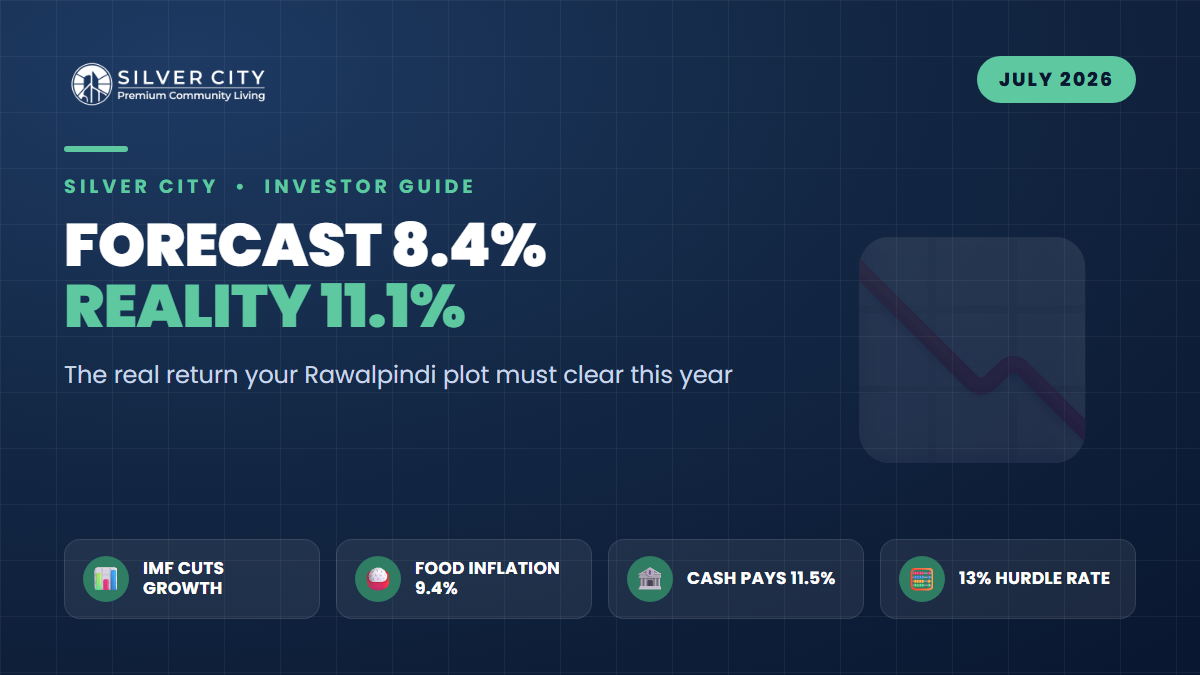
In April 2026 the IMF cut Pakistan’s FY2026-27 growth forecast to 3.5% (down from 4.1%) and raised its inflation projection to 8.4% — a sharp jump from the 7% it had penciled in at the second programme review. The Fund also more than doubled its current account deficit estimate for the year to about 0.9% of GDP (roughly $5 billion), citing Middle East conflict risk and the fact that Pakistan imports close to 90% of its energy from that region.
Then the data arrived. The Pakistan Bureau of Statistics reported June 2026 CPI at 11.1% year-on-year — easing from May’s 11.7%, but still 2.7 percentage points above the IMF’s full-year forecast. Rural food inflation ran at 9.4%, urban food at 8.2%. Average CPI for FY2025-26 closed at 7.05%, versus 4.49% the year before.
For a plot buyer in Rawalpindi, this gap is not an academic argument between economists. It changes the number your investment has to beat.
Why the Gap Between Forecast and Lived Inflation Matters
The IMF’s 8.4% is a fiscal-year average projection. June’s 11.1% is a point-in-time reading — the level Pakistan is entering FY2026-27 at. For the annual average to land at 8.4%, monthly prints have to fall meaningfully through the year. That is possible: headline inflation is already decelerating month-on-month (national CPI fell 0.3% in June), and the wholesale price index cooled to 10.7% from 12.7%.
But you don’t spend an average. If you sell a plot in November 2026, what matters is the price level on that date, not the smoothed fiscal-year figure. And the composition matters too. Food at 9.4% in rural areas hits household cash flow directly, which is exactly what determines whether a family in Rawalpindi can service a plot instalment plan while also buying atta and ghee.
The Real Story: Cash Is Finally Paying You
Here is what most plot pitches ignore. The State Bank held its policy rate at 11.5% on 15 June 2026, well above its 5–7% medium-term target, precisely because inflation refused to behave. That rate cascades into the risk-free instruments an ordinary saver can actually access.
As of the 18 July 2026 revision, National Savings offers:
| Instrument | Gross rate | Approx. net for a filer (after 15% WHT) |
|---|---|---|
| Behbood Savings Certificate | 12.96% | Tax-favoured (eligibility restricted) |
| Regular Income Certificate | 11.52% | ~9.8% |
| Special Savings Certificate | 11.2% / 12.6% (6th profit) | ~9.5–10.7% |
| Short Term Savings Cert. (1 yr) | 11.17% | ~9.5% |
| Defence Savings Certificate | 10.24% | ~8.7% |
| Savings Account | 10.00% | ~8.5% |
A filer parking money in an RIC nets roughly 9.8% with zero transaction cost, zero illiquidity, and zero development risk. If the IMF is right and inflation averages 8.4%, that is a positive real return of about 1.4% — genuinely unusual in Pakistan. If June’s 11.1% persists, cash loses about 1.2% a year in real terms.
Either way, cash is now a serious competitor. Your plot has to beat it after friction — and property friction is heavy.
The Friction Nobody Prices In
The Finance Act 2026 improved things considerably. From 1 July 2026, advance tax on sale (Section 236C) is a flat 2.75% for ATL filers, down from 4.5–5.5%; advance tax on purchase (Section 236K) is a flat 1.25%. Section 7E — the deemed-income tax on immovable property — was omitted entirely after the Federal Constitutional Court struck it down in May 2026. Punjab moved to a uniform 1% stamp duty on urban and rural property from 10 April 2026 (rural was previously 3%), and the CDA cut its transfer fee from 3% to 1% on the same date.
Critically, 236C and 236K are adjustable advance taxes for filers — creditable against your annual liability, not sunk costs. Non-filers face 11% under 236C with no such relief, which is a decisive argument for getting on the ATL before you transact.
What remains as genuine cost for a filer: stamp duty (1%), registration fee (~1%), society transfer fee, agent commission (~1% per side), and capital gains tax at 15% on the gain for ATL individuals and AOPs.
The Hurdle Rate: What Your Plot Must Actually Return
Assume a three-year hold, ~3% entry friction, ~1% exit commission, and 15% CGT on the gain. Working backwards from the required net outcome, here is the gross nominal CAGR a Rawalpindi plot must deliver:
| Your goal | Required net annual return | Required plot price CAGR (gross) |
|---|---|---|
| Just beat IMF’s 8.4% inflation | 8.4% | ~11.4% |
| Match National Savings (RIC, net) | 9.8% | ~13.0% |
| Beat June’s lived 11.1% inflation | 11.1% | ~14.6% |
| Earn a 4% premium over cash for illiquidity | 13.8% | ~17.6% |
Read the third row carefully. A Rawalpindi plot appreciating 12% a year sounds healthy. After friction and CGT, it does not even preserve purchasing power at June’s inflation rate — and it underperforms a savings certificate you could have bought at a post office. The illiquidity, the possession delays, the risk of an unapproved layout: all of that is being taken on for a negative real return.
How to Use This Before You Buy
- Get on the ATL first. The filer/non-filer gap on 236C alone (2.75% vs 11%) exceeds a full year of real return.
- Demand the 14.6% number from any agent quoting appreciation. If the projection is below it, the pitch is a nominal-return story, not a real-return story.
- Lengthen the hold to dilute friction. Fixed round-trip costs spread over seven years hurt far less than over two. Flipping in this cost structure rarely works.
- Weight development risk heavily. A plot in an unapproved scheme trades at a permanent liquidity discount, and that discount is not in any CAGR calculation.
- Watch the July MPC and the next two CPI prints. If inflation keeps decelerating toward the IMF’s path, the hurdle drops toward 11.4% and property looks materially better. If it stalls near 11%, cash keeps winning.
Frequently Asked Questions
Why is the required plot return so much higher than the inflation rate?
Because inflation is a gross number and your plot return is taxed and cost-laden. A 15% CGT charge on the gain plus roughly 4% in round-trip stamp duty, registration and commission means a large slice of every rupee of appreciation never reaches you. Roughly 3 percentage points of annual CAGR are consumed by friction on a three-year hold.
Is the IMF’s 8.4% forecast wrong, then?
Not necessarily — it is a fiscal-year average, and inflation was already decelerating in June (11.1% from 11.7%, with a 0.3% month-on-month decline). Getting to an 8.4% average requires that trend to continue. Treat 8.4% as the optimistic case and 11% as the pessimistic one, then check whether the investment works in both.
Does the abolition of Section 7E change the maths?
Yes, favourably. Section 7E levied tax on deemed rental income from certain immovable properties and was a genuine annual carrying cost on idle plots. Its omission from 1 July 2026 removes that drag, which is one reason plot holding is more attractive in FY2026-27 than it was two years ago.
Should I just keep the money in National Savings instead?
If your horizon is under three years, quite possibly. Certificates are liquid, cost-free to enter, and currently pay 10–13% gross. Property earns its premium over longer horizons and in locations where development genuinely advances — which is why approval status and infrastructure delivery, not the sales brochure’s appreciation chart, should drive the decision.
The Bottom Line
The forecast-versus-reality gap has done Pakistani investors a favour: it has made the hurdle rate visible. In FY2026-27, a Rawalpindi plot needs roughly 13% nominal appreciation just to match a savings certificate, and closer to 14.6% to beat the inflation people are actually living. That is achievable — but only in schemes where development is real, title is clean, and resale liquidity exists.
That is precisely where approval status earns its keep. Silver City, an RDA-approved housing society in Rawalpindi, is worth evaluating on exactly these terms: run the hurdle-rate maths above against its current rates and delivery timeline, and let the numbers — not the forecast — decide.