In June 2026, the Punjab Cabinet Standing Committee on Legislative Business cleared a package of amendments to the Punjab Private Housing Schemes Rules, 2022 — the rulebook that governs how every private society in the province, including those under RDA in Rawalpindi, gets approved and built. The amendments take legal effect on publication in the official Punjab Gazette.
Most coverage has framed this as a consumer-protection story. It is. But for anyone holding or buying property, the more consequential read is economic: these rules materially raise the capital, time and compliance cost of launching a new scheme, while leaving societies that are already approved and already developed largely untouched. That asymmetry is where the investment logic sits.
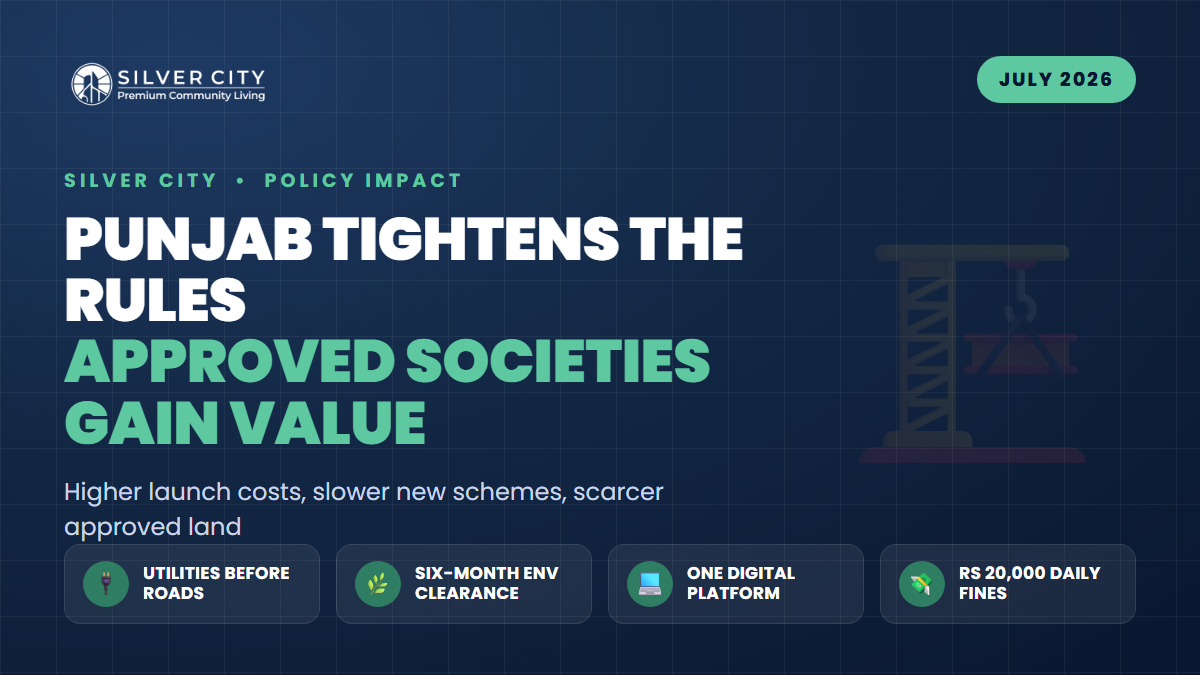
What actually changed
Five provisions do most of the work. Here is what each one requires and what it costs a developer in practice.
| Provision | What it requires | Practical effect on a new launch |
|---|---|---|
| Underground utilities first | Water, sewerage, gas, electricity, telecom and internet must be laid underground before roads are constructed | Front-loads heavy capex; developer cannot show a “carpeted road” to sell files while services lag years behind |
| Environmental clearance | Clearance must be obtained within six months | Hard deadline for EIA/IEE studies and EPA processing; slippage exposes the sponsor to penalty |
| Single digital platform | All new scheme applications and revisions processed through one centralised online system | Removes discretionary, relationship-driven approvals; every file is timestamped and auditable |
| Corporate structure | Projects with more than five landowners must register as a company or cooperative society; joint ventures capped at five entities | Ends the informal “twenty-partner pooled land” model; forces SECP-registered accounts and audited books |
| Daily penalties | Fines of Rs 5,000 to Rs 20,000 per day for illegal development or delay | Non-compliance becomes a running meter, not a one-time settlement |
Two further provisions matter for end-users. Developers must set aside land for parks, playgrounds, graveyards, public buildings, roads and waste management facilities — the amenities that were routinely promised on brochures and quietly deleted from revised layouts. And on completion, a scheme is handed to a seven-member management committee drawn from both the sponsor and the residents, which takes over maintenance and financial oversight.
Why this raises the cost of launching a new scheme
Utilities-before-roads is a working-capital problem
The traditional Pakistani development sequence is cheap on purpose: level the land, cut roads, plant a gate, start selling. Revenue from early bookings then funds the actual services. Reversing that order means the sponsor must finance the most expensive, least visible layer of infrastructure — trenching, ducting, sewerage mains, HT/LT cabling — before the site looks sellable enough to generate cash. That is a fundamental change to the cash-flow curve, and it disproportionately screens out thinly capitalised entrants. Well-funded sponsors can absorb it; the marginal ones cannot.
The six-month environmental clock
A six-month clearance window sounds generous until you account for baseline surveys, public hearings and EPA queries on sites that often sit near rain-fed nullahs or agricultural land. Combined with per-day fines, the clock converts a soft delay into a quantifiable liability. A scheme that drifts twelve months past a deadline at the upper fine band is looking at a seven-figure exposure before a single plot is transferred.
Five landowners, one company
The corporate-registration threshold quietly kills a very common launch structure: a syndicate of ten or fifteen local landholders pooling khasras under a verbal profit-share, with one marketing firm fronting the project. Under the amendment, that group must incorporate. Incorporation brings SECP filings, statutory audit and a paper trail — welcome for buyers, but a real barrier for informal sponsors who have historically relied on opacity.
The digital platform cuts both ways
Routing every application and revision through one platform is genuinely pro-developer in one respect: it should shorten honest approvals and make the queue visible. But it also ends the practice of launching on a “NOC applied for” basis and hoping approval catches up with sales. When status is a database field the public can query, pre-approval marketing gets much harder to sustain — and the gap between an approved society and an aspirational one becomes visible rather than debatable.
Where the scarcity premium comes from
Nothing in these amendments retroactively penalises a society that is already approved and already carrying underground services, laid roads and delivered possession. Those societies simply keep operating. What changes is the supply behind them.
Rawalpindi district has roughly 82 approved private housing schemes on RDA’s rolls. If the pipeline of new approvals slows — because launches now need more equity up front, a corporate wrapper, an environmental clearance on a deadline and a compliance-clean digital file — then the stock of genuinely developed, RDA-approved, possession-ready land stops growing at the rate demand does. That is the textbook setup for a premium on existing approved inventory, and it tends to show up first in transfer velocity and then in price.
Regional infrastructure sharpens the effect. The Rawalpindi Ring Road, at a revised cost of about Rs 46.64 billion, crossed 90 percent completion and was targeted to open in mid-2026, though the Thalian Interchange has been deferred to Phase II with a temporary carriageway connection to the motorway in the interim. Value accrues to plots with practical access to an interchange — Banth, Chak Beli Khan, Adyala Road, Chakri Road and Thalian — not to the corridor generally. Approved societies sitting on those access points are the ones where scarcity and connectivity compound.
This stacks on top of the file-system reform
The housing-rules amendment is not arriving alone. Punjab is also dismantling the open-file trading system: from 1 July 2026, file-based buying and selling is being abolished in Lahore schemes, with transactions moving to Punjab Land Records Authority property certificates linked to the Housing Schemes Management System (HSMS), and societies required to migrate records into HSMS. Read together, the direction of travel is unambiguous — Punjab is squeezing out speculative paper and pushing the market toward verified, located, registered plots in compliant schemes.
What to verify before you pay anything
- Check the society and the specific phase or extension on RDA’s official approved-schemes list — approval is not always society-wide.
- Ask for the sanctioned layout plan number and confirm your plot number appears on it.
- Confirm whether underground services are laid in your block, not just planned in the master plan.
- Ask the sponsor’s legal status: is it a registered company or cooperative, and who are the recorded directors?
- Insist on a records position under HSMS/PLRA as that system rolls out, rather than accepting an unregistered file.
- Visit the block. Possession, boundary pillars and working streetlights tell you more than any brochure.
Frequently Asked Questions
Do these amendments apply to societies that are already approved?
The amendments principally govern approval, launch and development of schemes going forward, plus handover and enforcement. A society that is already approved and developed is not re-approved under the new bar. Ongoing obligations — amenity land, handover to a seven-member management committee, and penalties for illegal development — still apply, which is why compliance history matters when you choose a society.
Will plot prices in approved societies rise immediately?
Not mechanically, and anyone promising a specific percentage is guessing. Supply-side constraints work with a lag and interact with interest rates, remittance flows and construction costs. The reasonable expectation is that the gap between developed, approved societies and unapproved or half-developed ones widens over the next several launch cycles — a relative premium, not an overnight jump.
How much are the fines, and who pays them?
Rs 5,000 to Rs 20,000 per day for illegal development or delay, levied on the scheme sponsor. Buyers do not pay them directly, but a penalised sponsor is a sponsor with less capital for your block’s development — so treat enforcement notices against a society as a material red flag.
Are the amended rules in force right now?
They were approved by the Cabinet Standing Committee on Legislative Business and take effect upon publication in the official Punjab Gazette. Before relying on any specific clause for a transaction, confirm the notified text and its commencement date with RDA or a property lawyer — committee approval and gazette notification are distinct steps.
The bottom line
Punjab has not banned new housing schemes. It has made them expensive, slow and transparent to launch — which is a different and, for existing holders, more favourable outcome. Capital will rotate toward land that has already cleared the bar: approved, serviced, connected and deliverable today.
That is the frame worth applying to any Rawalpindi purchase this year. Silver City, developed by Laraib Associate & Developers (Pvt) Ltd and SAREMCO Group on Girja Road near the Thalian Interchange, is one RDA-approved option in that category — approved status, developed infrastructure and motorway-side positioning, with 5 marla, 10 marla and 1 kanal residential plots alongside commercial and high-rise options on instalment plans. As always, verify the approval and payment plan directly with the developer and against RDA’s own records before you commit funds.