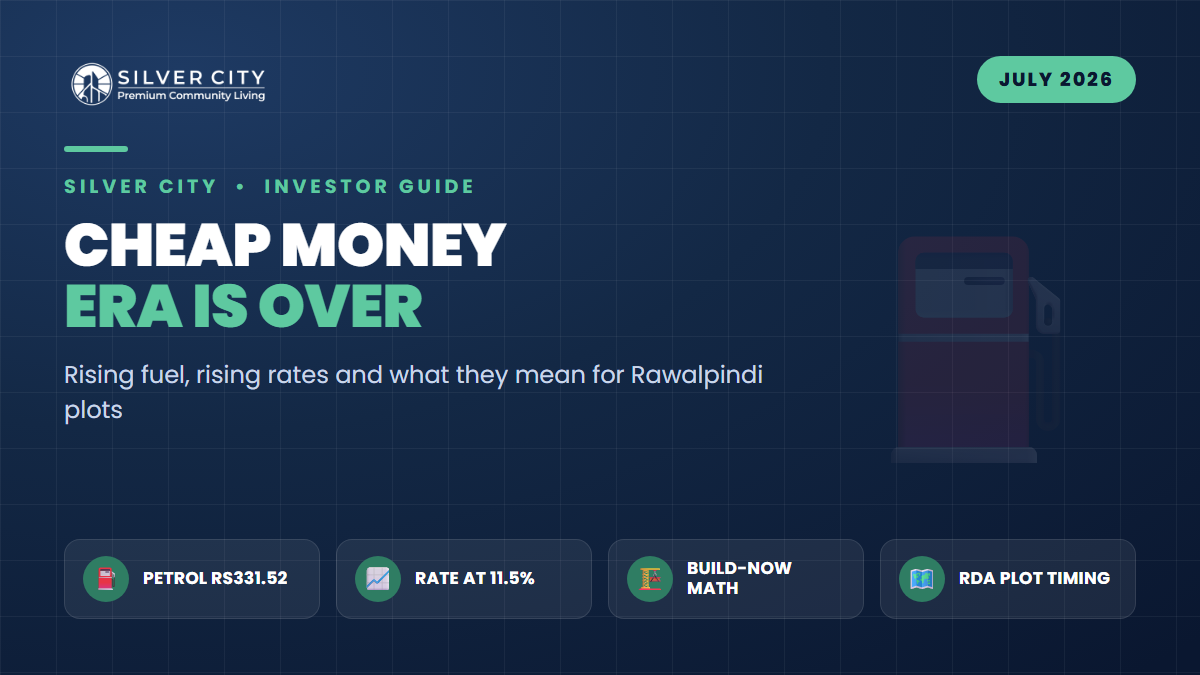
For three years, Pakistani property buyers grew used to a simple tailwind: inflation was cooling, the State Bank was cutting, and developer installment plans quietly got cheaper in real terms every month. That era just ended. With petrol reaching Rs331.52 per litre on 24 July 2026 under OGRA’s daily pricing regime, and the State Bank of Pakistan (SBP) having delivered its first policy-rate hike since 2023, the arithmetic behind Rawalpindi plot buying has shifted. This guide breaks down what a rising-rate, rising-fuel environment actually does to your installment plan, your plot holding costs, and the build-now-versus-hold-cash decision.
What Actually Changed in Mid-2026
Three data points frame the new reality for investors around Rawalpindi and Islamabad:
- Fuel: Petrol crossed to Rs331.52/litre on 24 July 2026 (up Rs4.40), while high-speed diesel reached Rs378.66/litre. Petrol has climbed roughly Rs32 — about 10.7% — from Rs299.50 at the end of June, driven by a global oil surge feeding directly into OGRA’s daily pump-price mechanism (a rolling average of international prices, freight and the rupee).
- Inflation: Headline CPI printed 11.7% year-on-year in May 2026 before easing slightly to 11.1% in June — but with diesel now the primary mover of transport and construction-input costs, the disinflation trend is under threat.
- Interest rates: The SBP raised the policy rate by 100 basis points to 11.5% — its first hike since June 2023 — and held there at its June review. The market is no longer pricing the steady cuts that defined 2024–2025.
The important shift is directional. When the policy rate is falling and inflation is dropping, a fixed-rupee installment plan gets easier to service every quarter. When the rate turns up and fuel re-ignites input costs, that free tailwind disappears — and the cost of the cash you’re not putting into property changes too.
Why Diesel at Rs378 Is a Construction Story, Not Just a Commute Story
Investors often read fuel headlines as a personal-budget issue. For property, diesel matters more than petrol. Diesel powers the trucks that haul sand, crush, steel and cement, the generators on site, and the machinery that lays roads and services in a new society. When diesel jumps 10%+ in a month, it flows into:
- Construction material delivered cost — cement, steel bars (sariya), bricks and aggregate all carry freight.
- Developer development charges — societies laying infrastructure face higher costs, which eventually reprice plot rates and development dues.
- Build labour and grey-structure quotes — contractors index their rates to input inflation.
This is why “build now vs hold cash” is no longer a neutral question. Construction costs tend to lead, and a rising-fuel regime argues for locking build quotes sooner rather than watching them drift up.
The Installment-Plan Math Has Flipped
Developer installment plans are effectively an interest-free loan from the seller — you pay a down payment and fixed monthly instalments over 3–4 years while (hopefully) the plot appreciates. Their attractiveness depends on two things: the fixed-rupee schedule, and the opportunity cost of your cash.
| Factor | Cheap-money era (2024–25) | Rising-rate era (mid-2026) |
|---|---|---|
| SBP policy rate direction | Falling | Rising (11.5%) |
| Cash left in bank / savings | Low return, easy to deploy in plots | Higher deposit & T-bill yields — cash has a cost |
| Fixed-rupee instalment in real terms | Gets cheaper as inflation falls | Less relief if inflation re-accelerates |
| Construction cost trajectory | Moderating | Pressured by diesel at Rs378+ |
| Best-suited strategy | Lump-sum buying | Long instalment plans + early build |
The nuance: higher rates make an interest-free instalment plan more valuable, not less. If a bank now pays you a double-digit return on parked cash, then a developer letting you pay Rs20,000–Rs23,000 a month with no markup is effectively subsidising you. The catch is discipline — you only capture that benefit if you keep the balance of your money earning, rather than spending it.
Plot Holding Costs in a Rising-Rate World
Holding a plot is not free, and the cost of holding rises when rates rise. Consider the components an investor should now count explicitly:
- Opportunity cost of the down payment and instalments paid so far — with deposit rates higher, that trapped capital could otherwise be earning ~11%.
- Annual maintenance / membership dues charged by the society.
- Plot value stagnation risk — if transaction volumes slow because financing is dearer economy-wide, appreciation can pause even as your capital is committed.
None of this argues against plots — Pakistani property has historically been a strong inflation hedge, and land near new road infrastructure has outperformed. It argues for buying plots that have a real catalyst (approved status, road connectivity, active development) rather than speculative files whose only story was cheap, easy money.
Build Now vs Hold Cash: A Practical Framework
- If you already own a plot and intend to build within 12–18 months: the rising-fuel trend leans toward locking grey-structure and material quotes sooner. Waiting rarely makes construction cheaper in a diesel-led cost cycle.
- If you are buying to hold land: favour long installment plans on approved societies. Keep your surplus cash earning in the meantime and let the developer’s interest-free schedule work for you.
- If you are cash-heavy and undecided: higher deposit yields mean you are no longer “losing” by waiting a quarter. Use that breathing room to buy quality — location and approvals — rather than rushing into any file.
Frequently Asked Questions
Does a higher SBP policy rate make property a bad investment?
Not inherently. Higher rates cool demand at the margin, but property remains a core inflation hedge in Pakistan, and most plot buying is cash- or installment-financed rather than bank-mortgaged. The bigger effect is on timing and selectivity — quality, approved, well-located plots hold up far better than speculative files when money gets tighter.
Are developer installment plans still worth it at 11.5% rates?
Yes — arguably more so. An interest-free developer schedule becomes more valuable precisely when banks are paying you double-digit returns on the cash you haven’t committed. The key is to actually keep that surplus earning, and to choose a developer with a credible delivery and approval record so the plan carries low execution risk.
Will rising fuel prices push plot prices up or down?
Fuel primarily raises construction and development costs via diesel freight, which over time supports higher plot and built-property prices. In the short run, tighter overall financing can slow transaction volumes. The net effect favours plots in societies actively spending on development, where infrastructure is being laid at today’s costs.
Should I lock a build quote now or wait for prices to fall?
In a diesel-led cost cycle, waiting for construction to get cheaper is usually a losing bet. If you have a firm build plan within 12–18 months, getting fixed quotes on grey structure and key materials protects you from the next round of fuel-driven increases.
Where Silver City Fits In
In a rising-rate, rising-fuel regime, the winning move is quality over hype: an RDA-approved society with real road connectivity and active development, offering flexible multi-year installment plans that let your surplus cash keep earning. Silver City on Girja Road, near the Thalian Interchange and Rawalpindi Ring Road corridor, checks those boxes — RDA approval, a connected location tied to new infrastructure, and 3.5, 5 and 10 Marla plus 1 Kanal plots on 3–4 year installment plans. In an era where cheap money is gone and selectivity matters more than ever, an approved, infrastructure-linked option like Silver City is worth shortlisting — but always verify the latest payment plan, plot availability and approval documents directly before committing.
@@END@@