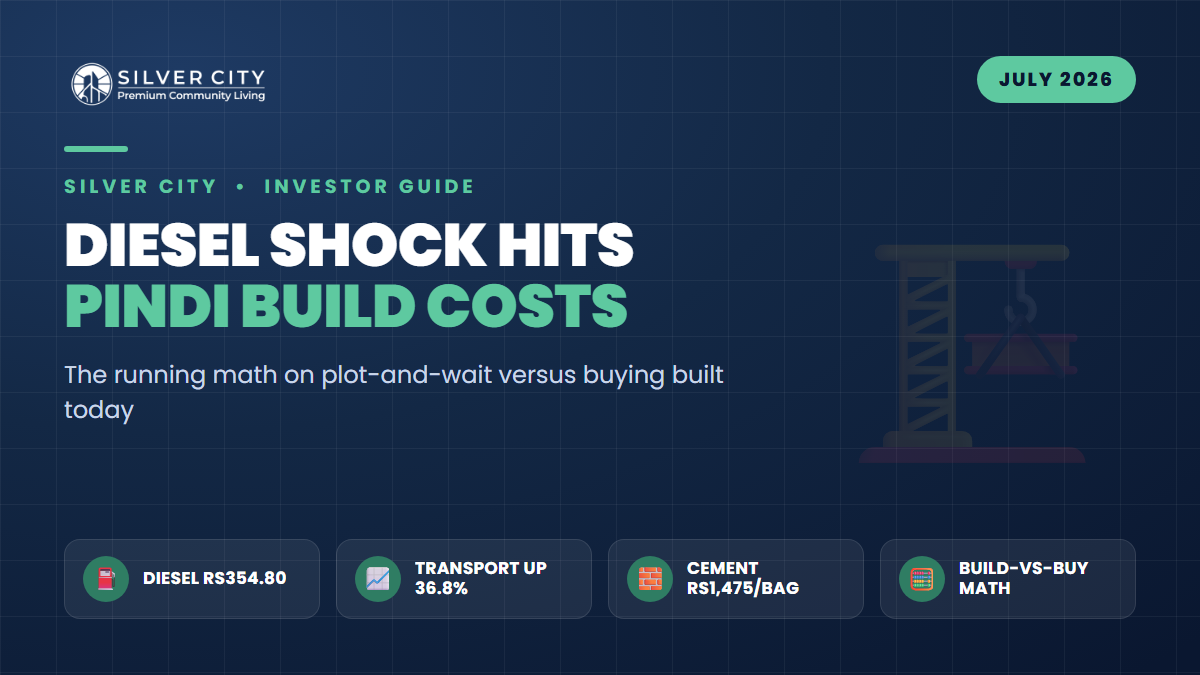
On 18 July 2026 the federal government did two things at once. It raised high-speed diesel by roughly Rs31 per litre to Rs354.80, and it scrapped the fortnightly pricing cycle in favour of daily price revision by OGRA, effective 12:00am each night against a seven-day rolling international average. Petrol moved to Rs316.15. Both changes land directly on the cost of building a house in Rawalpindi — and they change the calculation for anyone sitting on cash deciding between a plot and a finished unit.
This article runs the actual arithmetic rather than the usual “invest now” noise.
Why Diesel Is a Construction Input, Not Just a Transport Cost
Almost nothing on a Rawalpindi construction site arrives without diesel. Cement travels 100–250km from plants in the Attock, Hattar and Kohat belt. Grade 60 steel comes up from mills in Lahore and Karachi. Sand, crush and bricks move by tractor-trolley and tipper. Concrete mixers, dewatering pumps and generators all run on diesel — and with load-shedding still a factor, generator hours are not trivial.
The Pakistan Bureau of Statistics data confirms the pass-through. In May 2026, the transport index rose 36.78% year-on-year and 5.13% month-on-month, making transport the single largest contributor to headline CPI of 11.7%. Housing, water, electricity, gas and fuels added another 16.8%. Headline inflation eased slightly to 11.07% in June, but the transport component has not.
Where Material Rates Sit Today
| Input | July 2026 rate | Notes |
|---|---|---|
| Cement (50kg bag) | Rs1,415 – Rs1,475 | Brand-dependent; Askari at the top end near Rs1,505 |
| Grade 60 steel (rebar) | Rs270 – Rs320 per kg | Roughly Rs2.7–3.2 lakh per tonne |
| Grey structure, Rawalpindi | Rs2,600 – Rs4,200 per sq ft | Islamabad runs 15–25% higher |
| Turnkey, mid-range finish | Rs4,800 – Rs7,500 per sq ft | Premium finishing pushes past Rs9,000 |
Beware of quoted steel figures online — several sites currently publish “Rs15,000–18,000 per ton,” which contradicts their own per-kg numbers by a factor of nearly twenty. Always cross-check per-kg against per-tonne before signing anything.
The Core Trade-Off, With Numbers
Take a realistic case: a 10 marla plot in a developed Rawalpindi society and a double-storey home of roughly 3,000 sq ft covered area, built to mid-range turnkey standard at Rs6,500 per sq ft.
| Route | Cost today |
|---|---|
| 10 marla plot | Rs1.10 crore |
| Turnkey build, 3,000 sq ft @ Rs6,500 | Rs1.95 crore |
| Total: buy plot + build now | Rs3.05 crore |
| Comparable ready-built 10 marla house | Rs3.60 crore |
| Built-unit premium | Rs55 lakh (≈18%) |
That Rs55 lakh premium is what most buyers refuse to pay. The question is whether waiting actually saves it. Here is the same Rs1.95 crore build budget escalated forward at three plausible construction-inflation rates:
| Build inflation | Delay 12 months | Delay 24 months | Delay 36 months |
|---|---|---|---|
| 10% p.a. | Rs2.15cr (+19.5 lakh) | Rs2.36cr (+41 lakh) | Rs2.60cr (+64.5 lakh) |
| 14% p.a. | Rs2.22cr (+27.3 lakh) | Rs2.53cr (+58.4 lakh) | Rs2.89cr (+93.9 lakh) |
| 18% p.a. | Rs2.30cr (+35.1 lakh) | Rs2.72cr (+76.5 lakh) | Rs3.20cr (+125.4 lakh) |
The punchline: at 14% annual build-cost inflation, a 24-month delay costs Rs58.4 lakh in escalation — slightly more than the entire Rs55 lakh premium you refused to pay for the finished house. And that is before counting roughly Rs19 lakh of forgone rent (a 10 marla house in a good Pindi society lets for Rs70,000–90,000 per month).
One honest correction to that logic: the plot appreciates while you wait. But the built house contains land too, and that land appreciates identically. Plot appreciation is largely a wash between the two routes — do not double-count it in favour of waiting.
What Daily Repricing Changes About Contracts
This is the part most investors will miss. Under the old fortnightly cycle, a contractor could quote a fixed rate and know his diesel and freight exposure for at least two weeks. Under daily OGRA repricing, that certainty is gone.
Expect three practical consequences over the next two quarters:
- Shorter quote validity. Fixed-price quotes valid for 30–90 days will shorten to 7–15 days, or disappear.
- Escalation clauses become standard. Contractors will push cost-plus or indexed contracts. Insist that any escalation clause is tied to a published index — PBS wholesale price data or OGRA’s own published rates — not to the contractor’s word.
- Front-loaded material buying. Buying cement and steel for the full grey structure upfront becomes a genuine hedge, provided you have secure dry storage. Cement has a shelf life of roughly three months in Pindi humidity, so stage it against your pour schedule.
So Which Should You Actually Do?
The decision hinges less on the market than on your own cash position:
- If you can fund the full build today — buy the plot and build immediately, or buy built. Do not buy a plot with a vague intention to build “in a year or two.” That is the one route the math above clearly punishes.
- If you can only afford the plot — buy the plot anyway. A plot is a real inflation hedge and a disciplined savings vehicle, and Rs1.10 crore deployed beats Rs1.10 crore in a savings account losing to 11% CPI. Just budget honestly: your future build will cost meaningfully more than today’s quote.
- If you want yield from day one — the built unit at an 18% premium is defensible right now, because you capture rent immediately and skip 18–24 months of cost-escalation risk entirely.
Frequently Asked Questions
Will diesel prices come back down and reverse this?
Possibly, and daily repricing cuts both ways — declines now pass through immediately too. WTI is near $79.80 per barrel with diesel cracks elevated after regional disruption. But construction material prices are famously sticky downward: cement and steel rise quickly with freight and fall slowly. Do not plan a build around a price reversal that may take a year to reach your site.
How do I verify a society is genuinely RDA-approved?
Check the official RDA private housing schemes portal at rda.gop.pk and match the exact society name and exact phase — not just the parent brand. RDA declared 293 illegal societies in February 2026, its largest single enforcement notice ever. Many marketed schemes hold approval for one phase and none for others.
What build-cost inflation rate should I actually assume?
For planning purposes, 12–16% annually is reasonable in the current fuel environment. Headline CPI at around 11% understates it, because construction is unusually transport-intensive and transport inflation is running at 36.8%.
Is it worth buying cement and steel in advance?
For steel, often yes — it stores indefinitely and is the most price-volatile major input. For cement, only in staged quantities matched to your pour schedule, because it degrades within about three months in local conditions.
Wrapping Up
Diesel at Rs354.80 with daily repricing has quietly made “buy the plot and build later” the most expensive option on the board for anyone who can actually fund a build today. The Rs55 lakh premium on a finished house looks steep until you price two years of escalation against it — at which point it is roughly break-even, with rental income as the tiebreaker.
Whichever route you take, approval status is the one variable you cannot afford to get wrong in Rawalpindi right now. Silver City is an RDA-approved society and is worth shortlisting alongside other verified schemes — but verify its exact phase status on the RDA portal yourself before any payment, as you should with every society you consider.