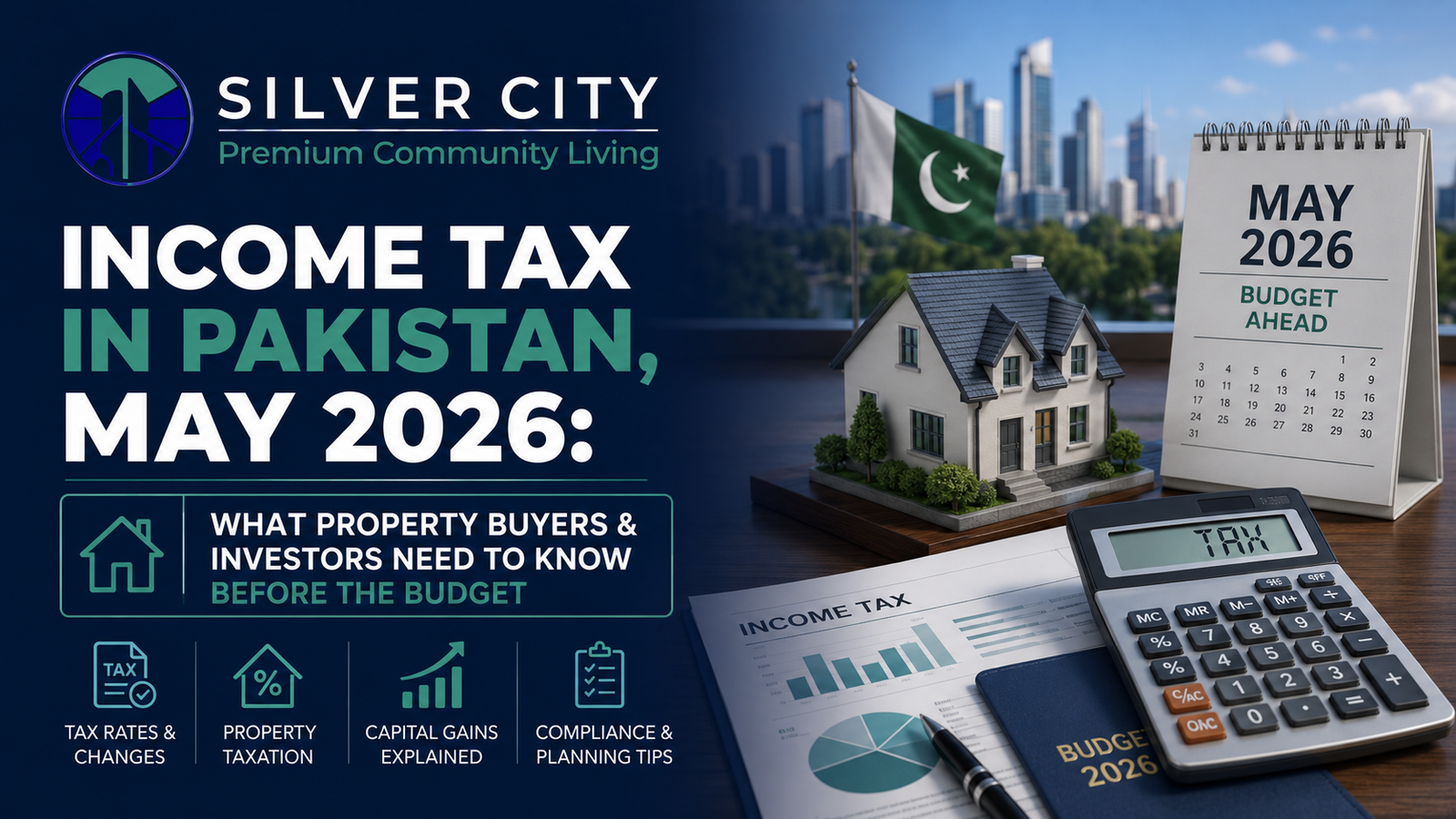
Pakistan’s income-tax landscape is in flux this May, and if you’re planning to buy, sell, or invest in property, the timing of these changes matters as much as the numbers themselves. With the federal budget for FY 2026–27 still under negotiation and the FBR signalling a friendlier stance toward businesses, real estate decisions taken in the next few weeks could land on very different ground depending on what gets announced.
Here’s a clear, plain-English breakdown of where things stand, and what it means for anyone considering a plot or home in projects like Silver City Islamabad.
The Big Picture: A Budget Tug-of-War
As of May 2026, the conversation around income tax is pulling in two opposite directions.
On one side, news reports suggest the government is weighing income-tax relief for salaried individuals, possibly by lowering rates or raising the taxable-income threshold. The idea being floated: hold salaries and pensions steady, and use that fiscal room to ease the burden on the salaried class instead.
On the other side, business groups are pushing back hard. The Businessmen Panel (BMP) of FPCCI has publicly opposed a reported plan to introduce around Rs230 billion in new taxes in the upcoming IMF-linked budget, arguing that businesses are already squeezed by high energy costs, expensive financing, and weak demand.
Meanwhile, FBR Chairman Rashid Mahmood Langrial has been telling chambers of commerce that the bureau intends to facilitate the business community rather than over-tax it.
Translation for property buyers: nothing is final, and the budget will likely set the tone for real-estate activity for the rest of the year.
Why This Matters for Real Estate
The salaried class reportedly paid over Rs425 billion in income tax during the first three quarters of the fiscal year — more than double what the real-estate sector contributed (around Rs200 billion).
That gap is exactly why salaried relief is on the table. But here’s the catch: if salaried Pakistanis get tax relief, they have more disposable income, which historically translates into stronger demand for housing and plots. Conversely, if new taxes land on businesses or property transactions, the cost of buying and selling can shift overnight.
If you’re eyeing a plot at Silver City, this is a moment to plan around scenarios rather than wait for headlines.
The Rules Still in Force Today
While the budget debate plays out, the current framework remains the law of the land. Here’s what governs income tax in Pakistan right now:
- Income Tax Ordinance, 2001 — the legal backbone, currently amended up to 20 February 2026.
- Withholding Tax Rate Card for Tax Year 2026 — the official slab and rate reference, based on the Finance Act 2025.
- IRIS 2.0 — FBR’s online portal for filing returns, wealth statements, and e-filings.
- Active Taxpayer List (ATL) — confirms your filer status, which directly affects the tax you pay on property transactions.
- Tax Asaan app — simplified return-filing for salaried filers.
- ePayment 2.0 — the digital route for generating PSID and paying tax online.
The five heads of income under FBR remain unchanged: salary, income from property, business income, capital gains, and income from other sources.
Why ATL Status Is a Property-Buyer’s Best Friend
If there’s one takeaway every real-estate buyer should hold onto, it’s this: being on the Active Taxpayer List saves you real money on property transactions.
FBR explicitly offers lower withholding rates on the purchase and sale of immovable property for filers. Non-filers pay significantly more — sometimes double — on the same transaction. For a plot at Silver City worth several million rupees, that difference can be the cost of a furnishing budget.
You can check your ATL status quickly:
- Online via the FBR ATL portal, or
- Via SMS using your CNIC or NTN.
If you’re planning a purchase in the next 3–6 months and you’re not yet a filer, this is the single highest-ROI compliance step you can take.
What to Watch For in the Budget
Three signals will tell you which way the wind is blowing:
- Salaried tax slabs — any reduction in rates or upward shift in the taxable-income threshold is a positive demand signal for housing.
- Property-related taxes — changes to advance tax on purchase/sale, capital gains tax timelines, or new levies on holding period and valuation.
- Filer vs non-filer differentials — the government has been steadily widening the gap; expect that trend to continue.
Practical Advice Before the Budget Drops
For salaried buyers: Don’t treat speculated relief as already granted. Plan your down payment and instalment schedule on the basis of current Tax Year 2026 rates, and treat any relief as a bonus.
For business owners and investors: Build flexibility into your timeline. If new taxes land, you may want to accelerate certain transactions; if relief comes through, holding may pay off.
For everyone: Get on the ATL before signing anything. The savings on a Silver City plot transfer alone usually outweigh any cost or effort of becoming a filer.
Why Silver City Still Makes Sense
Regardless of how the budget shakes out, the fundamentals of a well-located, well-approved housing society remain unchanged. Silver City Islamabad offers CDA-approved plots, a strategic location on the GT Road near the new Islamabad International Airport, and infrastructure that’s already in place — not promised.
Tax cycles come and go. What protects your investment is location, approval status, and developer credibility — and on all three counts, Silver City is positioned to ride out budget uncertainty.
Ready to Invest Before the Budget Changes Everything?
📞 Talk to a Silver City sales consultant today to lock in current pricing on residential and commercial plots.
🏡 Book a free site visit and see Silver City’s development progress firsthand.
💬 Have tax or transfer questions? Our team can walk you through the filer benefits and total cost of ownership.
[Contact Silver City] | [View Available Plots] | [Schedule a Site Visit]
Disclaimer: This article is for general awareness only. Budget measures under discussion are not final until officially announced. Tax outcomes vary by income head, filer status, and transaction type. Please consult a qualified tax professional before filing or finalising a property transaction.