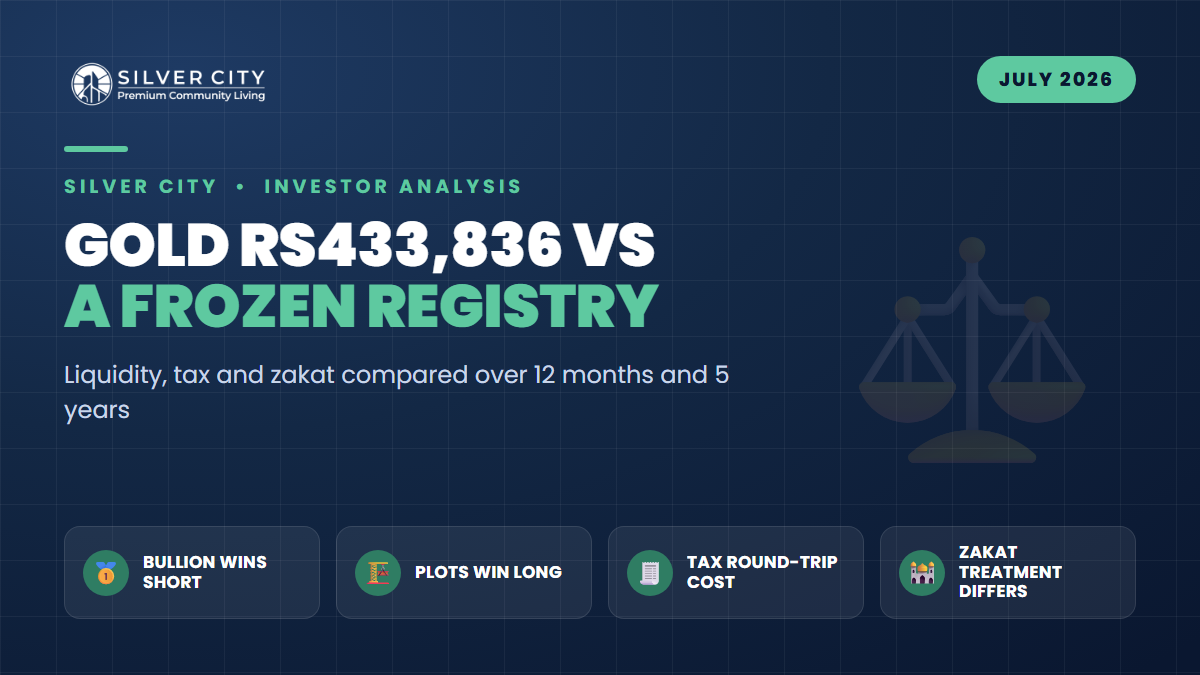
July 2026 handed Pakistani savers an unusually clean experiment. On 22 July, 24-karat gold in the local market jumped Rs4,600 in a single session to Rs433,836 per tola, opening the following business week at that level. Across the month bullion swung between roughly Rs424,200 and Rs442,900 — a Rs10,000-plus range — closing the month near Rs431,736. In the same weeks, the Rawalpindi property market could not complete a single transaction: the district administration had not notified revised valuation rates for FY2026-27, and no property was registered anywhere in Rawalpindi Division from 25 June until registrations resumed around 27 July. Officials put the revenue lost at roughly Rs1.5 billion.
So one asset repriced twice a day. The other could not legally change hands for a month. If you are sitting on Rs1 crore, that contrast deserves more than a WhatsApp forward.
What actually happened in Rawalpindi — and why it matters
The freeze was administrative, not a crash. When the new deputy commissioner finally issued the schedule, the previous financial year’s DC valuation rates were retained unchanged for 2026-27. Registrar-side representatives noted that while valuations held flat, higher fees and taxes would still push total registration expenses up by Rs30,000–Rs50,000 for residential and Rs50,000–Rs125,000 for commercial properties.
Two structural changes sit behind this. Punjab’s Stamp (Amendment) Ordinance 2026, promulgated on 10 April 2026, moved immovable property to a uniform 1% stamp duty across urban and rural areas (rural was previously 3%), and introduced an “assignable deed” giving private agreements legal cover — 1% duty for one year, 2% for two. CDA cut its Islamabad-side transfer fee from 3% to 1% the same day. Separately, Punjab is retiring the housing-society “file” system: from 1 July 2026 file trading is banned in Lahore, with sales moving to PLRA-issued property certificates through the Housing Schemes Management System. Rawalpindi sits in the next phase — a genuine positive for buyers, but one that will make undocumented, pre-development paper harder to flip.
The round-trip cost nobody quotes you
Federal taxes on property got materially cheaper this year. The Finance Act 2026-27 cut Section 236K (buyer) to a flat 1.25% of fair market value for ATL filers, down from 1.5–2.5%, and Section 236C (seller) to a flat 2.75%, down from 4.5–5.5%. Section 7E deemed-income tax was omitted outright following a constitutional challenge. Capital gains on property acquired on or after 1 July 2024 are taxed at a flat 15% under Section 37(1A) with no holding-period taper — and the Islamabad High Court has confirmed 37(1A) is the exclusive charging provision.
| Cost item | Rs1 crore plot | Rs1 crore bullion |
|---|---|---|
| Tax on purchase | 236K @ 1.25% = Rs125,000 | None |
| Stamp duty | 1% = Rs100,000 | None |
| Registration + district charges | Rs30,000–50,000 higher than last year | None |
| Dealer / agent | ~1% in + ~1% out = Rs200,000 | ~1% bar premium; buy-back below market rate |
| Tax on sale | 236C @ 2.75% = Rs275,000 (advance, adjustable) | None deducted at source |
| Capital gains | 15% flat on net gain | No property-style CGT schedule; taxable as income if you deal, plus Section 111 wealth-reconciliation risk on cash buying |
| Annual zakat | 2.5% only if bought with resale intent | 2.5% of market value every year above nisab |
| Effective friction | ~5–6% of value + 15% of gain | ~2–4% for bars/biscuits; 10–20% for jewellery |
On zakat, the distinction is real money. Nisab for Ramadan 2026 was fixed at Rs503,529 (the silver benchmark, 612.36g), up about 180% from Rs179,689 the year before. Gold above 7.5 tola is zakatable by its nature — Rs1 crore in bullion carries a Rs250,000 annual obligation. Land is different: mainstream Hanafi rulings treat a plot as trade goods only where it was bought with the intention of resale. A plot bought to build on, or bought with no formed intention, generally carries no annual zakat. Over five years that is a swing of roughly Rs12 lakh in favour of the plot — but only if your intention is genuinely to hold or build. Confirm your own case with a Darul Ifta; do not self-serve the ruling.
Twelve months: bullion wins, and it is not close
Gold was Rs361,200 per tola in late July 2025. At Rs431,736 today that is a ~19.5% rupee gain — call it 14–15% net of bar spreads and zakat. Now price the plot side honestly: DC rates flat, a 33-day window where registration was legally impossible, and roughly 4% of your capital consumed on entry before the market moves at all. Even an optimistic 8% nominal uplift leaves a cash buyer around break-even after entry costs, agent commissions, and 15% CGT on whatever gain survives. A 12-month plot trade in this market is a bet against your own transaction costs.
Five years: why the leveraged plot pulls ahead
The plot case is not about appreciation beating gold. It is about whose money is in the trade. Pakistani banks will not lend against raw land — SBP’s Mera Ghar Mera Ashiana scheme finances buying a completed home, constructing on a plot you already own, or renovation, not the purchase of an undeveloped plot. So the only leverage available is the developer’s instalment plan, and it is unusually cheap: 10% down with the balance over three to five years is standard in RDA-approved Rawalpindi schemes.
| Bullion (23.05 tolas) | Plot, cash | Plot, 10% down + 4-yr plan | |
|---|---|---|---|
| Cash out at day one | Rs1 crore | Rs1.04 crore incl. costs | ~Rs14 lakh (down + taxes) |
| Average capital deployed | Rs1 crore | Rs1 crore | ~Rs55 lakh |
| Zakat drag over 5 yrs | ~Rs12–14 lakh | Nil if held to build | Nil if held to build |
| Exit at Rs1.75 crore (≈11.8% CAGR) | — | Rs75 lakh gross gain | Rs75 lakh gross gain on half the average capital |
| Practical liquidity | Same day, any city | Weeks; zero during registry freezes | Transfer restricted until instalments clear |
Because the money enters in instalments funded from income, the money-weighted return on a plot can comfortably exceed its headline appreciation — that is the whole edge. Three caveats keep it honest. First, instalment pricing typically runs 10–20% above the cash price; that premium is your finance cost, roughly 2–4% a year. Second, the leverage comes from the developer, so execution risk replaces credit risk — approval status is your only real protection. Third, gold’s roughly four-fold rupee run since 2021 (about Rs109,000 a tola then) owed as much to currency depreciation as to bullion; nobody should underwrite a repeat.
Frequently Asked Questions
Is the 236C deducted on sale an extra cost on top of CGT?
No — 236C at 2.75% is advance tax and is adjustable against your final liability, so for a filer the real charge is the 15% CGT under Section 37(1A). It still hurts cash flow, because it is collected at registration whether or not you made a gain.
Do I pay zakat on a plot I am holding as an investment?
If you bought it with the intention of resale, most Hanafi rulings treat it as trade goods and zakat is due annually at 2.5% of market value. If it was bought to build on or for personal use, generally not. Gold above nisab is zakatable regardless of intention.
Will the Rawalpindi registration freeze happen again?
It can. The 2026 stoppage happened because DC valuation rates for the new financial year were not notified in time. Anyone planning a purchase or exit should avoid the last week of June and early July, and confirm the current schedule with the registrar before paying a token.
Can I borrow from a bank to buy a plot?
Practically, no. Housing finance in Pakistan covers a finished house, construction on land you already own, or renovation. For raw plots, the developer’s instalment plan is the leverage — which is why an approved society’s payment plan matters as much as its location.
The takeaway
If your horizon is under two years, or you might need the cash suddenly, bullion is the more honest instrument: it prices daily, sells in an afternoon, and does not depend on a deputy commissioner’s notification. If your horizon is five years and you are funding from monthly income rather than a lump sum, a staged-payment plot in a properly approved scheme still does something gold cannot — it converts future earnings into present asset exposure at a low effective cost, with no annual zakat drag when held to build. That “properly approved” qualifier is doing the heavy lifting, and it is where Silver City on Girja Road near Thalian Interchange is worth a look: an RDA-approved project offering 4 to 10 Marla and 1 Kanal plots on 10% down with instalments over three to five years. Verify the approval, the plot’s HSMS record, and the total instalment premium yourself before you commit — then decide which side of this trade fits your actual timeline.