For years, Pakistani property investors have learned to budget for surprises. A “mini-budget” in the middle of a fiscal year, a sudden withholding-tax hike, an FBR valuation revision — the transaction cost you calculated in July was rarely the one you paid in March. That uncertainty, more than any single rate, is what has kept serious buyers on the sidelines.
The 2026–27 fiscal year (FY27) is shaping up differently. With the IMF’s third review completed, construction officially credited as a growth engine, and property withholding taxes formally cut under the Finance Act 2026, Rawalpindi buyers are looking at something they rarely get: a locked-in cost structure for a full fiscal year. Here is why that window exists, and how to use it.
What Actually Changed on 1 July 2026
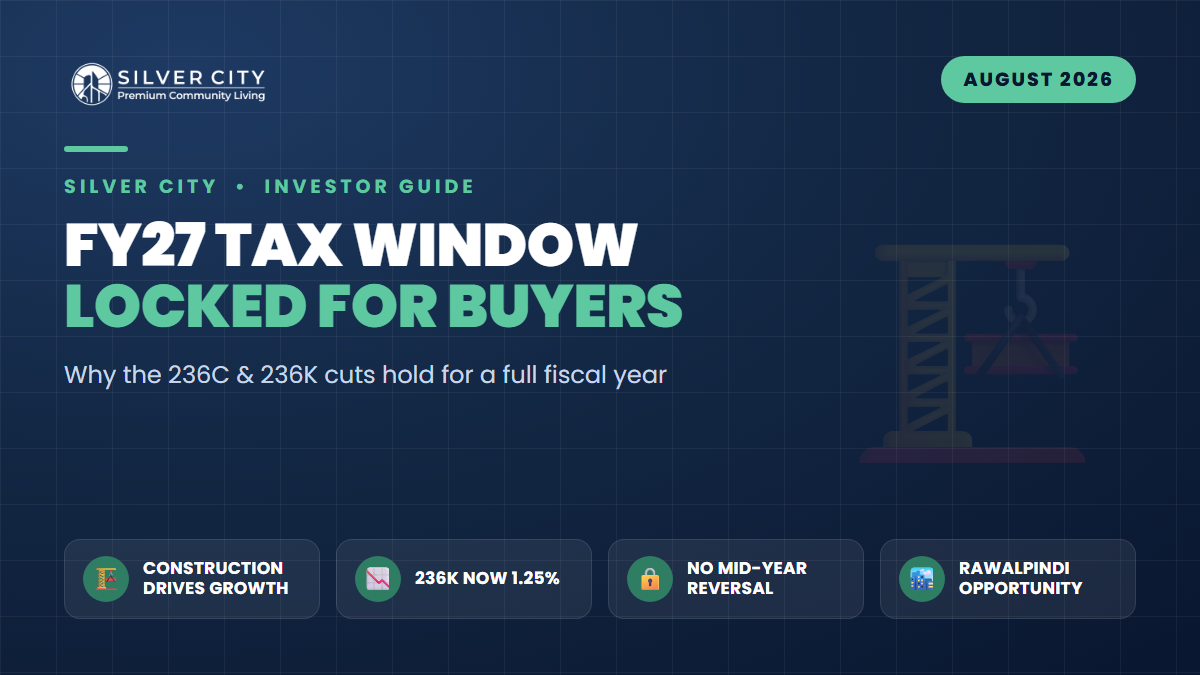
The Finance Act 2026 did two things that matter to anyone buying or selling property. First, it cut the headline advance-tax rates on transfers. Second — and arguably more important — it scrapped the value-banded slab system for filers and replaced it with a single flat rate that no longer climbs with the price of the property.
| Advance tax | Who pays | Old structure (to 30 Jun 2026), filer | New flat rate (from 1 Jul 2026), filer | New rate, non-filer |
|---|---|---|---|---|
| Section 236K | Buyer / purchaser | Value-banded, rising with price | 1.25% flat | 2.5% |
| Section 236C | Seller / transferor | Value-banded, up to 4.5% | 2.75% flat | 5.5% |
The practical effect is large. A filer buyer now pays 1.25% regardless of whether the plot is worth PKR 20 lakh or PKR 20 crore, and a filer seller pays 2.75% instead of a slab that used to push toward 4.5% on higher-value deals. For a PKR 2 crore transaction, the combined buyer-plus-seller advance tax drops meaningfully versus the previous year — and the gap between filer and non-filer rates makes tax registration close to mandatory for anyone transacting at scale.
Why FY26 Growth Made This Politically Durable
Tax cuts are easy to announce and easy to reverse — unless the government has a growth story riding on them. This year it does. According to the IMF’s own staff report, GDP growth picked up through the first half of FY26 to average around 3.8% year-on-year, “driven by the auto, construction, and garment industries.” Full-year FY26 growth came in near 3.7% — the fastest in four years, per local reporting.
Construction is not a footnote in that number; it is a headline driver. When a government has publicly tied its recovery to real-estate and construction activity, cutting the transaction taxes that throttle that activity becomes part of the growth plan, not a giveaway. Reversing those cuts mid-year would undercut the very sector being credited for the rebound.
The IMF Third Review: Discipline Cuts Both Ways
On 8 May 2026, the IMF Executive Board completed the third review of Pakistan’s 37-month Extended Fund Facility (EFF) and the second review of the Resilience and Sustainability Facility (RSF), releasing roughly SDR 760 million (about US$1.1 billion). The staff-level agreement had been reached on 27 March 2026. Fiscal performance was reported as strong, with a primary surplus around 1.6% of GDP and reserves near US$16 billion at end-December 2025.
Here is the part investors miss. IMF program discipline is usually framed as bad news for buyers — it means the government cannot hand out unfunded relief. But discipline runs in both directions. Under an active program, the FY27 revenue framework and the measures underpinning it are agreed with the Fund and built into the budget passed by Parliament. Changing a headline rate mid-year is not a quiet administrative tweak; it would mean reopening commitments with the IMF and Parliament.
That is precisely why the 236C and 236K cuts are, for practical purposes, locked for the fiscal year. The government has neither the fiscal room nor the program latitude to launch a mid-year mini-budget that hikes these specific transfer taxes back up — and it has every political incentive to leave a construction-friendly measure alone while construction is carrying growth. The realistic next decision point is the FY28 budget, not some February surprise.
A fair caveat: “locked” means very unlikely to be reversed, not legally guaranteed. Programs can be renegotiated and FBR valuation tables can still be revised. But the combination of program constraints and a growth narrative built on construction makes a mid-year rate reversal about as improbable as Pakistani tax policy allows.
How Rawalpindi Buyers Should Use the Window
Certainty is worth money because it lets you plan. A twelve-month runway of known transaction costs — roughly to 30 June 2027 — changes how you sequence a purchase.
- Get on the Active Taxpayer List first. The filer/non-filer gap is now the single biggest lever in your cost sheet. Filing before you transact turns a 2.5% buyer rate into 1.25%, and a 5.5% seller rate into 2.75%.
- Front-load higher-value purchases. Because the flat rate no longer rises with property value, the saving versus the old banded system is largest on premium and commercial plots — exactly the deals worth timing into this window.
- Budget on the real number. With rates fixed for the year, your total acquisition cost (advance tax, stamp duty, CVT and society transfer fees) is genuinely predictable. Model it once and hold to it.
- Prioritise approved, documented schemes. Lower taxes only help if the title and approvals are clean. In an RDA jurisdiction, buying inside a formally approved society protects you from the paperwork risk that no tax cut can offset.
A Simple FY27 Timeline
- Now – Q1 FY27: Confirm filer status; identify target plots in approved schemes.
- Q2–Q3 FY27: Execute purchases while flat rates are in force and demand builds.
- By Q4 FY27 (before 30 Jun 2027): Close before any FY28 budget could alter the framework.
Frequently Asked Questions
Are the 236C and 236K cuts permanent?
No rate is legally permanent — Pakistan sets tax rates annually through the Finance Act. What makes FY27 unusual is that a mid-year reversal is highly unlikely: the cuts are embedded in the IMF-aligned budget and support the construction-led growth the government is publicising. The next real review point is the FY28 budget in mid-2027.
What is the difference between 236C and 236K?
Section 236C is advance tax collected from the seller at the time of transfer, while Section 236K is advance tax collected from the buyer. Both are adjustable against your annual income tax liability, and both are now charged at a flat rate for filers rather than the old value-based slabs.
Do non-filers benefit from these cuts too?
Non-filers pay materially higher rates — 2.5% under 236K and 5.5% under 236C versus 1.25% and 2.75% for filers. The cheapest, cleanest path is to register and appear on the Active Taxpayer List before you transact.
Does this certainty apply to Rawalpindi specifically?
Yes — 236C and 236K are federal withholding taxes that apply nationwide, including RDA-regulated societies in Rawalpindi. Provincial charges such as stamp duty and CVT still apply separately, so confirm the full cost stack for your specific scheme.
The Takeaway
Rare in Pakistani real estate is the moment when the tax structure is both lower and stable. FY27 offers exactly that: cut rates on 236C and 236K, a flat structure that rewards higher-value and filer transactions, and program discipline that makes a mid-year reversal improbable. For buyers who move deliberately, that is a genuine planning advantage. If you are looking to act within this window, an RDA-approved development such as Silver City on Girja Road near the Thalian interchange is worth shortlisting — approved title and documented transfers let you capture the tax certainty without inheriting paperwork risk. Verify current rates and society-specific charges before you sign, and use the window while it is open.
@@END@@